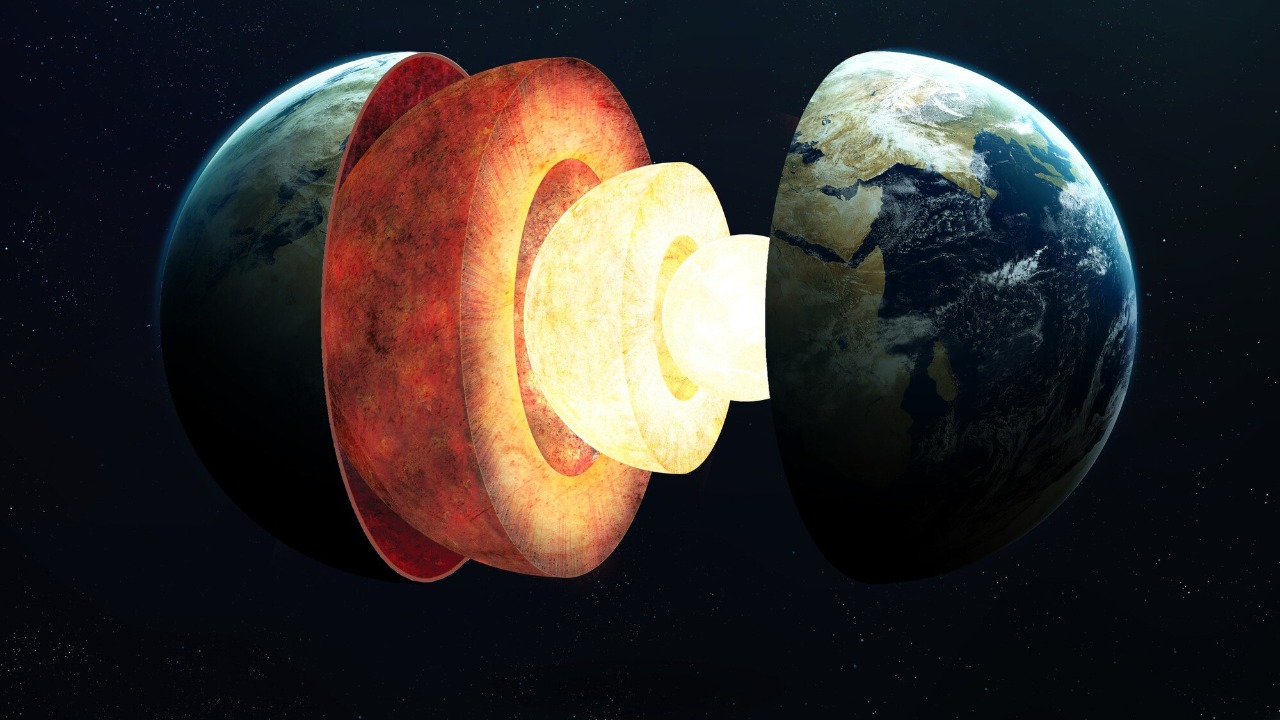

Stand on solid ground and it feels obvious that “down” points toward the center of the planet and “up” leads to the sky. Yet if space stretches in every direction, the idea of something being “beneath” Earth quickly becomes slippery. To understand what really lies under our feet, I have to follow two threads at once: the layered interior of the planet and the way gravity and motion erase any absolute notion of up or down in the wider cosmos.
Why “down” works on Earth but not in space
On the surface, “down” is simply the direction your body is pulled by gravity, toward the center of Earth. That shared pull makes it feel as if there is a universal up and down, even though people on opposite sides of the globe point in opposite directions when they agree which way is “up.” Once you move far from this gravitational well, however, those familiar cues vanish and, as one explanation of spaceflight puts it, once You leave Earth’s gravitational pull, those directions become relative and everything is relative. In orbit, astronauts strap their laptops to “walls” that would look like ceilings to a colleague floating a few meters away.
That relativity is why many astronomers bristle at questions about what is “below” the planets. In deep space there is no preferred direction, only positions and motions compared with something else. Discussions among space enthusiasts underline that “Down” is only down because it is where gravity is pulling you, and that once you are far from a massive body, the labels up and down lose any universal meaning, a point that is hammered home in Nov threads that try to reconcile everyday language with orbital mechanics. The paradox in the headline, then, comes from trying to export a local, gravity-based word into a universe that does not share our sense of direction.
Earth is not sitting still in a cosmic “down” direction
Even if I tried to define “beneath” Earth as some fixed direction in space, the planet refuses to cooperate. Earth spins on its axis while also tracing a path around the Sun, and that orbital motion defines a broad, flattened plane that astronomers use as a reference. Educational material on planetary motion notes that Orbit describes how Earth loops around the Sun once each year, with Earth’s orbital path forming an oval-like track around the Sun in space. There is no cosmic floor under that track, only more space.
When people ask what lies “under” the solar system, scientists often answer that the question is slightly mis-aimed. The planets cluster near the ecliptic plane, but above and below that sheet there is mostly vacuum, with the occasional dust grain, solar wind particle or stray asteroid, as astronomers explain when they describe that region as mostly empty, even though the volume of Not much is still significant. Informal explainers go further, sketching a mental zoom-out in which a few satellites and asteroids give way to the Milky Way and then to Millions of galaxies, a cascade that shows how any attempt to pick a privileged “below” direction quickly dissolves into the vastness of Aug scale.
What lies beneath our feet inside the planet
If the cosmos refuses to give us a universal down, the ground beneath us still hides a very real vertical story. A classic cutaway of The Earth shows that the planet is divided into four internal layers, and that They include a thin outer Crust, a thick mantle, and a core that is extremely hot and dense, details that are often summarized with the reminder that Did you know the surface is just the start. To really understand Earth, you would need to travel 6,400 kilometers, or 3,977 miles, beneath our feet, since Starting at the center, Earth is commonly described as a layered sphere of inner core, outer core, mantle and crust, a structure that is laid out in detail in educational Earth profiles.
Below the crust is the mantle, a mostly solid bulk that sits between Earth’s dense, super heated core and its thin rocky shell. Geoscience resources describe the Mantle as the mostly solid bulk of Earth’s interior and note that it accounts for about 84% of Earth’s total volume, with one overview putting its thickness at 2,900 km, a figure that appears in a description of how the mantle lies below the crust and makes up 84% of the Earth’s volume with a thickness of 2,900 km. Deeper still, Unlike the yolk of an egg, the Earth’s core is split into two parts, including a 2,200 km-thick liquid outer core wrapped around a solid inner core, an arrangement that geologists emphasize when they explain that below the crust is the mantle and that both pressure and temperature in the Jul interior increase with depth.
From tectonic plates to natural resonances
The layered structure is not just a diagram in a textbook, it drives the restless behavior of the surface. Under the Earth, the rigid crust is broken into tectonic plates that float on the hotter, more ductile mantle, and Let researchers trace how volcanoes and earthquakes happen where the pieces meet, a pattern that is laid out in resources that start at the very centre of the Earth and then work upward through the core, mantle and crust to explain why Under the Earth the ground is anything but static. The mantle itself is described as mostly solid but capable of very slow flow, and educational summaries of the Mantle stress that it lies between Earth’s core and crust and makes up a large fraction of Earth’s total volume, a reminder that the familiar continents are thin rafts on a deep convecting Apr layer.
Even the space just above the surface is structured in layers that interact with what lies below. Earth and its atmosphere can be viewed as a multi layered sphere, with Earth’s inner and outer core, mantle and crust forming the solid part while the atmosphere consists of several more layers that help trap and guide electromagnetic waves, a configuration that gives rise to Schumann resonances, the planet’s natural frequencies that ring between ground and sky, as described in overviews that talk about Earth and Our atmosphere as a coupled resonant cavity. In that sense, what lies beneath your feet is not just rock but part of a global system that vibrates, shifts and occasionally fractures, linking the deep interior to the storms and signals in the air above.
Language, perspective and the idea of “beneath”
Part of the confusion in the original question comes from language itself. In everyday English, Underneath implies directness whereas beneath does not necessarily, which is why someone might say the floor is underneath their feet but the center of the Earth is beneath their feet, a distinction that language learners discuss when they puzzle over how to describe the layers of the planet and the sky above, as in one exchange that notes that the center of the Earth is beneath my feet while the floor is Underneath them. When I ask what lies beneath Earth, I am really blending those two senses, sometimes meaning the physical layers under the crust and sometimes reaching for a cosmic below that physics does not recognize.
Scientists who tackle the question head on tend to split it in the same way. One recent explainer on what is below Earth, framed around the fact that space is present in every direction, argues that there is not really anything special about the direction we define as down relative to the Earth, and that once you move away from the planet, any line you draw continues through more space, stars and galaxies, a point that is made explicitly when the author asks So what is below the Earth and then notes that the answer depends on how far you go, before inviting readers to imagine that if they keep going, we will do our best to follow the chain of Jan reasoning. Astronomers use a similar trick when they talk about the south celestial pole, a point that must exist in the south below the horizon even though we cannot see it, and which is called the south celestial pole by astronomers, a reminder that “below” on the sky is just a projection of our local frame, not a sign that there is a physical pole sticking down into space, as explained in discussions of how that point is defined and located mathematically.
Online conversations about what is above or below us in space often circle back to the same conclusion. Commenters in one Sep Comments Section on whether there is anything in space below or above us point out that while the bulk of the planets fall within a plane, if You look out of that plane you still find stars, galaxies and structures like the Large and Small Magellanic Clouds, so any direction you pick eventually hits something, even if the local region is mostly empty, a perspective that helps dissolve the idea of a privileged cosmic down while still respecting our intuitive sense of Sep orientation. In that light, what lies beneath Earth is both very concrete, a stack of crust, mantle and core, and completely frame dependent, since once you step outside the planet’s gravity, beneath becomes just another word for somewhere else in the universe.
More from Morning Overview