
Interstellar comet 3I/ATLAS is giving astronomers a rare, close look at material that formed far beyond our planetary neighborhood, and the early verdict is that this visitor is stranger and more dynamic than expected. As it sweeps past our planet and around The Sun, observatories on and off Earth are racing to pin down its path, its chemistry, and even whether its behavior hints at anything more exotic than ice and rock.
Right now, researchers are tracking how 3I/ATLAS brightens, sheds gas, and twists its tails, while also checking for any hint of artificial signals and helping the public follow along from backyards and even from Mars orbit. I want to walk through what they are actually seeing, what those measurements imply about the comet’s origin, and why this fleeting encounter is already reshaping how we think about visitors from deep interstellar space.
Why 3I/ATLAS is such a rare catch
Interstellar objects are still a tiny club, and 3I/ATLAS is only the third confirmed member, after 1I/ʻOumuamua and 2I/Borisov. Astronomers classify it as an interstellar comet because its orbit is hyperbolic, meaning it is not bound to the Sun and will eventually head back into interstellar space after its swing through the inner system, a trajectory that sets it apart from the closed ellipses traced by ordinary comets. The object was first flagged as a candidate earlier in 2025, then its path and speed were refined until the case for an origin beyond our system became compelling enough that it received the 3I designation and the name ATLAS.
What makes this particular visitor so valuable is that it was spotted early enough for a coordinated global campaign. One detailed overview notes that Spotting even a single interstellar comet is likened to winning a cosmic lottery, and Seeing a third, with time to mobilize major observatories, is giving scientists a chance to compare how different planetary systems build and eject icy bodies. That context is crucial, because the more of these objects we can characterize, the better we can test models of how planets form and how often small bodies are flung into the void.
Where the comet is now and how bright it looks
As 3I/ATLAS recedes from its closest approach, astronomers are still tracking its position with high precision. Live orbital data place Comet 3I/ATLAS in the constellation of Leo, at a distance of exactly 269,408,175.3 kilometers from Earth, with its current Right Ascension and other coordinates updating as it moves. That geometry confirms that the comet is now climbing away from our planet on its outbound leg, even as its hyperbolic path keeps it on a one-time visit through the inner solar system.
In terms of brightness, 3I/ATLAS has never been a naked-eye spectacle, but it has been within reach of serious amateur setups. On 1 Jan 2026, projections put comet 3I/ATLAS at magnitude 15.6, a level best suited to imaging rigs rather than casual binocular viewing. Although that is faint by public-outreach standards, it is bright enough for astrophotographers and small observatories to keep monitoring subtle changes in its coma and tails as it moves through Leo and away from Earth.
What telescopes are seeing in the coma and tails
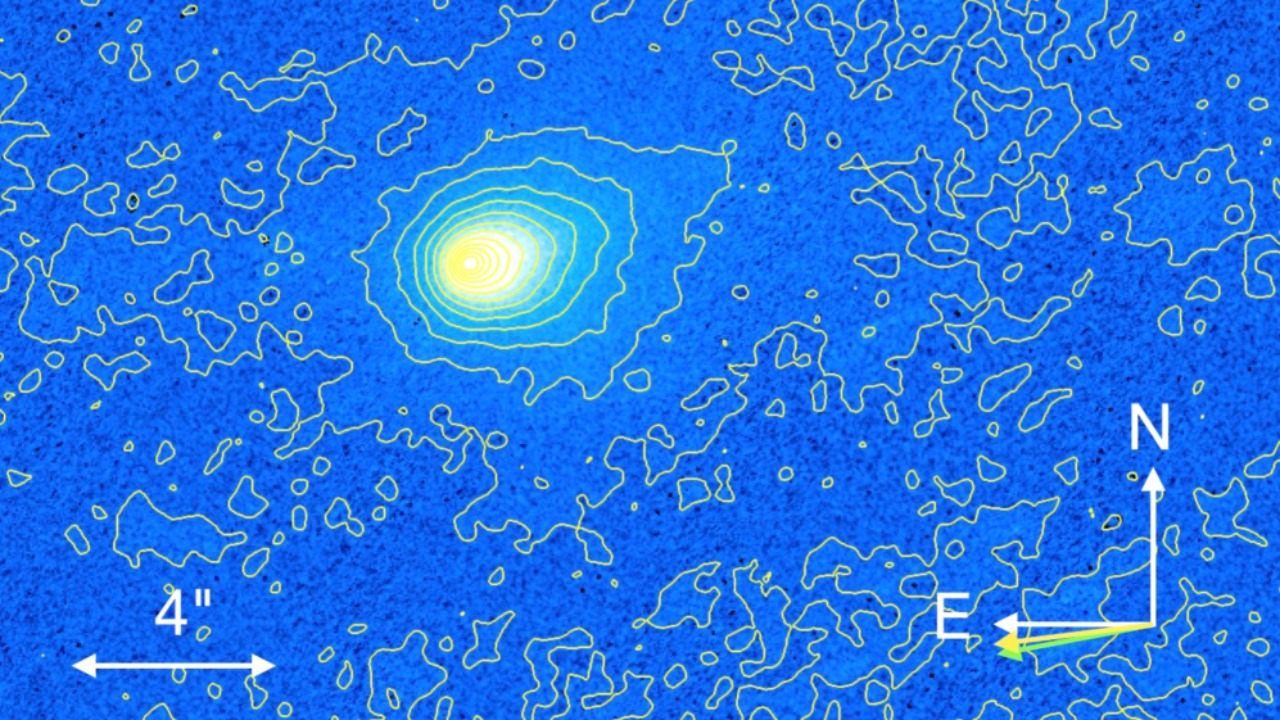
High resolution images show that 3I/ATLAS is not a simple, single-tailed streak. Early in its approach, astrophotographers including Michael Jäger, Gerald Rhemann and Enrico Prosperi captured views revealing that 3I/ATLAS is displaying multiple tails and a complex, extended coma as it makes its close passage near our Sun, a structure that has been highlighted in detailed observing reports from ATLAS. Those images suggest that jets of gas and dust are erupting from different regions of the nucleus, each responding differently as sunlight heats the surface and subsurface ices.
Spacecraft and large telescopes are resolving even finer detail in the inner coma, the hazy envelope of gas and dust that surrounds the nucleus. One technical description notes that the bright central dot in some frames is the nucleus and its immediate coma, while the surrounding glow and tails fan out behind it as The Sun heats the comet and drives sublimation, a process captured in images from missions such as ExoMars TGO and Mars Express that have been trained on TGO. Combined with ground based data, these views are letting researchers map how the coma evolves over hours and days, which in turn reveals how volatile the surface is and how quickly the comet is shedding mass.
Unusual wobble, flares and the “So Unusual” behavior
Beyond its basic structure, 3I/ATLAS is behaving in ways that have surprised even seasoned comet watchers. Observers report that the comet shows an unusual wobble and unexpected flaring activity, with its brightness and tail structure changing more dramatically than standard models would predict for a simple icy nucleus, a pattern that has been highlighted in coverage of how Astronomers are closely tracking this mysterious interstellar comet. Those flares could be driven by pockets of more volatile ices suddenly exposed as the surface fractures, or by rotational effects that bring active regions into and out of direct sunlight.
Earlier in its campaign, scientists emphasized What Makes 3I/ATLAS So Unusual, pointing out that shortly after its discovery the James Webb Space Telescope was turned toward ATLAS to capture its spectrum and thermal properties. Analyses of that early dataset, described in reports on What Makes the comet So Unusual, stress that because it is moving so fast, the ices on its surface have less time to warm near the Sun, which should in theory limit activity. The fact that astronomers are still seeing strong outbursts and a complex tail system despite that short heating window is one reason the object is being watched so intently.
How close it came to Earth and what that meant for observers
For all the drama in scientific circles, 3I/ATLAS never posed a danger to our planet. As it made its closest approach, public facing guides emphasized that the comet would pass safely by Earth at a comfortable distance, and that it did not pose a threat to Earth despite some of the more breathless headlines, a reassurance that was repeated in practical Stargazing advice. That safe flyby, however, did make it an attractive target for both professionals and amateurs, since a relatively close pass means brighter apparent magnitude and better resolution for instruments of all sizes.
Public outreach campaigns leaned into that opportunity. One widely shared explainer framed the event around the question Will you be able to see 3I/ATLAS from Earth, then walked through Where it would be in the sky and how, though 3I/ATLAS is not visible to the naked eye, those with modest telescopes or imaging gear could track it as it moves through our solar system, guidance that helped many first time observers point their rigs in the right direction toward Where ATLAS would appear. Local segments even highlighted that in some regions, such as the southeastern sky over Connecticut, the comet’s high amounts of carbon could create a greenish glow that skywatchers were told to look for, a detail that featured in coverage linked to Dec viewing tips.
What scientists are learning about its composition
Underneath the spectacle, the key scientific payoff from 3I/ATLAS lies in its chemistry. Spectroscopic observations from large telescopes and spacecraft are teasing out which ices and dust grains dominate its coma, and early reports point to high levels of carbon bearing compounds that can give the comet a greenish hue in some filters, consistent with the public advice to watch for that color in the sky. Detailed imaging of the nucleus and inner coma, such as the frames that isolate the bright central dot and its surrounding haze, show how The Sun is responsible for the comet’s activity because it heats up the comet’s nucleus to sublimate its ice into gas, which then drags dust into the coma and tails, a process described in technical summaries of 3I/ATLAS.
Those compositional clues matter because they let astronomers compare 3I/ATLAS to comets that formed in our own Oort Cloud and Kuiper Belt. If the mix of volatiles and dust grains looks similar, that suggests that the chemistry of planet forming disks around other stars is not wildly different from our own. If, on the other hand, the ratios of carbon, oxygen, and more complex molecules diverge, that could indicate that the comet was assembled in a very different environment, perhaps closer to or farther from its original star than typical solar system comets. The ongoing campaign, which includes spectra from instruments like The Gemini South telescope in Chile, is designed to pin down those ratios with enough precision to make that comparison meaningful, a goal highlighted in reports that describe how The Gemini South facility in Chile has been used to study the comet.
Alien probe speculation and what the data actually say
As with 1I/ʻOumuamua, the arrival of 3I/ATLAS has revived a familiar question: Could it be alien. Some commentators have noted that Our first assumption when we see something in space is that it is a lump of rock or ice, But the more unusual the orbit or light curve, the more tempting it is to ask whether an object might be an artificial probe, especially when it comes from interstellar space and passes near planets like Venus, Mars and Jupiter on its way through, a line of thought explored in analyses that look at why Could spotting such visitors be harder than it sounds. That speculation has only been amplified by the comet’s odd wobble and flaring, which some see as reminiscent of controlled maneuvers, even though standard physics offers more mundane explanations.
Scientists have not ignored the possibility outright, but they have approached it with data rather than wishful thinking. One high profile effort involved scanning 3I/ATLAS for artificial radio signals, using facilities like The Gemini South telescope in Chile to coordinate observations and then combing through the data for narrow band or repeating patterns that might indicate technology rather than geology, a search described in detail in coverage that notes how researchers Reading the data found no evidence of artificial transmissions despite targeting it for artificial radio signals, as summarized in the report By Ellyn Lapointe Published January on Reading. For now, the balance of evidence points firmly toward a natural origin, even if the comet’s behavior keeps theorists busy.
How Mars orbiters and live streams are following the flyby
One of the more novel aspects of the 3I/ATLAS campaign is that it is not just Earth based telescopes doing the watching. Instruments in Mars orbit, including the ExoMars Trace Gas Orbiter (TGO) and Mars Express, have been turned toward the comet to capture images and spectra from a vantage point far from our own planet, a strategy that lets scientists see the coma and tails from different angles and under different lighting conditions. Mission updates describe how ExoMars TGO images comet 3I/ATLA as a bright dot surrounded by a diffuse halo, with Mars Express providing complementary views, a dual perspective that has been highlighted in technical notes about how ATLA has been observed from Mars orbit.
Back on Earth, agencies and observatories have leaned heavily on live streams and public briefings to bring the encounter to a wider audience. One widely watched event billed as 3I/ATLAS LIVE featured NASA scientists unveiling new discoveries about the comet in real time, with the stream’s narration emphasizing that heat heat heat heat heat heat something ancient is racing through our skies and is older than the sun, stranger than any comet typically observed, a dramatic framing that nonetheless rested on real data about its age and origin, as captured in the broadcast archived at Dec. Another high profile appearance saw Avi Loeb explain what is unusual about 3I/ATLAS as it passed closest to Earth, stressing that ATLAS is following a path and showing activity unlike anything typically observed, a perspective that has been widely shared through a video where Avi Loeb walks through the implications.
What comes next as 3I/ATLAS heads back to interstellar space
With the comet now moving away from Earth and The Sun, the observing campaign is shifting from rapid response to long term monitoring. Astronomers are still collecting light curves to see how quickly its activity fades, and they are refining its orbit to understand exactly how it will exit the solar system and what that path implies about where it came from. Detailed explainers have already started to answer Why scientists say it is an interstellar comet, emphasizing that ATLAS will not loop back but will instead head out and back into interstellar space once its swing past the Sun is complete, a trajectory that has been laid out in analyses of Why ATLAS is classified as an interstellar object.
For the public, the window to see 3I/ATLAS is narrowing, but not yet closed. Guides continue to update charts and finder maps so that dedicated observers can keep tracking it as a faint smudge in Leo, even as its magnitude slips beyond the reach of smaller telescopes. Some of the most accessible coverage has packaged this as a way to start 2026 by spotting an interstellar comet in the sky, encouraging readers to use charts to help them find ATLAS and reminding them that Although faint, it is still a unique chance to image a visitor from another star system, a message that has resonated in practical observing notes about how to follow ATLAS into the new year.
More from MorningOverview