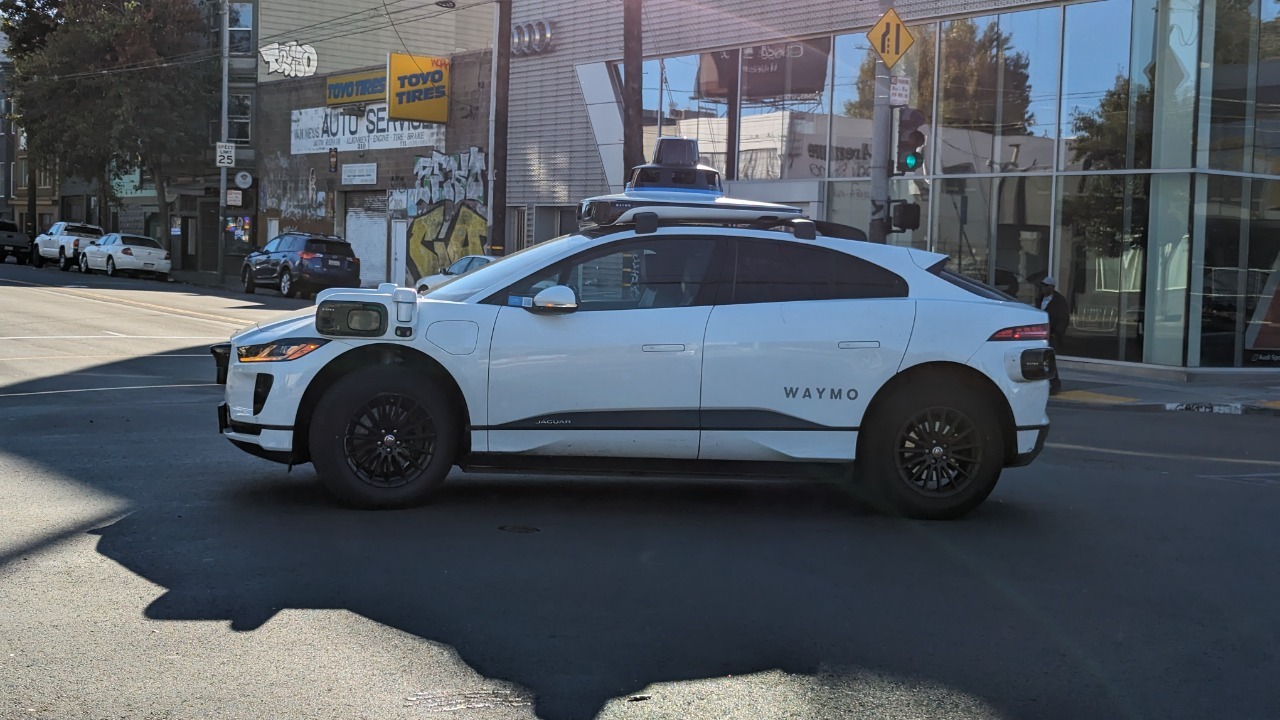

Waymo’s driverless taxis are supposed to showcase a future where software replaces human drivers, yet the company is literally paying people $22 a job to walk up and shut stuck doors on stranded vehicles. The image is jarring: a cutting edge robotaxi, frozen in the street, waiting for a gig worker to do what a basic minivan latch can handle on its own. I see that contrast as a useful lens on what “autonomous” really means in practice, and how much invisible human labor is still propping up the self-driving dream.
How a robotaxi ends up needing a $22 door closer
At the center of the story is a very simple failure mode. Waymo’s autonomous vehicles can navigate traffic, interpret lane markings, and negotiate with pedestrians, but when a passenger leaves a door ajar or a sensor thinks something is blocking the latch, the car can lock itself in place. Instead of rolling to the next pickup or heading to a depot, it sits in the street, hazard lights blinking, unable to continue until someone physically swings the door shut. That is where the $22 payment comes in, a flat fee Waymo offers for a human to show up and close the door on one of its stranded robotaxis.
Reporting on these incidents describes how Waymo Pays Workers to perform this tiny but essential rescue task when its fleet of autonomous robotaxis cannot resolve a door issue on their own. In one example, a tow truck operator who might normally charge his standard $250 flatbed fee instead accepted the $22 payout to simply close the door and send the vehicle back into service. The economics of that moment are almost absurd, but they underline a basic truth: the system is only as autonomous as its most fragile mechanical interaction with the real world.
The “secret army” behind Waymo’s driverless image
Those $22 door closers are part of a much larger, mostly invisible workforce that keeps Waymo’s driverless service running. The company’s public image leans heavily on the idea of cars that drive themselves, yet behind the scenes there is a network of remote technicians, on-call contractors, and local helpers who step in whenever the software hits a limit. I see the door problem as just the most vivid example of a broader pattern where human labor fills in the gaps that automation cannot yet bridge.
Accounts of this support system describe how Waymo pays workers $22 to respond when a robotaxi is stranded and a plea for help goes out through the company’s internal channels. These are not full-time drivers in the traditional sense, but they are still people whose job is to rescue a supposedly autonomous machine. The phrase “secret army” fits because riders rarely see this labor directly; they just experience a car that eventually shows up, or a stuck vehicle that mysteriously disappears after someone has been dispatched to fix a door, clear a sensor, or reset a system.
Why Waymo is paying strangers instead of relying on riders
On paper, the easiest fix for a half-closed door would be to ask the last passenger or a nearby pedestrian to give it a firm push. In practice, Waymo has learned that relying on riders and passersby is unreliable and risky. People may not respond to app prompts, may not be physically able to help, or may simply walk away from a stalled vehicle that is blocking traffic. From a liability perspective, asking unvetted strangers to manipulate a robotaxi’s hardware or sensors also raises questions that a company like Waymo would rather avoid.That is why the company has built a paid response layer in cities like Los Angeles, where Because riders and passersby can be unreliable, Waymo pays workers in Los Angeles $20 or more for rapid on-site help and is expected to expand that role as its service grows. The $22 door-closure fee fits into that pattern: a small but guaranteed payment to someone who has opted into this support network, rather than a hopeful nudge to whoever happens to be nearby. It is a controlled way to manage risk and response times, even if it undercuts the narrative of a fully self-sufficient robotaxi.
From job-killing hype to human-heavy reality
When companies like Waymo first pitched robotaxis, the story leaned heavily on efficiency and job displacement. The idea was that fleets of autonomous vehicles would reduce or eliminate the need for human drivers, cutting labor costs and reshaping urban transport. Nearly a decade into that vision, the reality looks more complicated. The cars are on the road, but they are surrounded by new categories of human work that did not exist when the early hype focused on eliminating drivers.
One account notes that Waymo Has to Pay People to close stuck robotaxi doors, even as it markets itself as a transportation company built on automation. Another passage in the same reporting points out that Nine years later, Waymo vehicles are on the roads and still require human intervention when they get stuck while looking for a charger or dealing with a minor glitch. Instead of a clean swap from human drivers to pure software, the industry has created a layered system where some tasks are automated and others are handed off to a dispersed, often precarious workforce.
The economics of a $22 rescue
Paying $22 to close a door sounds trivial, but it reveals how Waymo is balancing cost, uptime, and public perception. From the company’s perspective, a stranded robotaxi is a double problem: it is lost revenue while the car is offline and a potential public relations headache if it blocks traffic or confuses other drivers. Offering a flat $22 fee to anyone in its vetted pool who can quickly resolve the issue is a cheap insurance policy compared with towing, extended downtime, or a viral video of a helpless vehicle sitting in an intersection.
The details of one incident show how Waymo’s fleet of autonomous robotaxis can be rescued for a fraction of what traditional roadside assistance might cost, since a tow truck operator who might charge a standard $250 flatbed fee instead took the $22 payment to simply close a door. For the worker, that is a quick, low-effort job that fits into a broader patchwork of gigs. For Waymo, it is a way to keep vehicles circulating without building a large, salaried field team in every city. The tradeoff is that the company’s dependence on such micro-tasks becomes more visible each time one of these rescues is documented.
Remote technicians and the 1.5 workers per vehicle problem
The door-closure gig is only the most tangible part of a wider human safety net that surrounds each robotaxi. Behind every car on the road there are remote technicians monitoring performance, stepping in to guide vehicles through tricky situations, and coordinating on-the-ground responses when something goes wrong. That human layer is not a temporary training wheel; it is built into the operating model of current autonomous fleets.
One analysis of the sector notes that Even Waymo, described as the leading robotaxi company, relies on a rotation of remote technicians to bail out its driverless vehicles, with estimates of about 1.5 workers per vehicle. That ratio undercuts any notion that the cars are operating independently at scale. Instead, each vehicle is effectively tethered to a small team of humans who can intervene digitally or physically. The $22 door closer is just one node in that network, a reminder that autonomy today is as much about orchestrating human support as it is about writing better code.
What this says about “autonomy” as a marketing term
When I look at the gap between Waymo’s branding and the reality of $22 door rescues, I see a broader issue with how the tech industry uses the word “autonomous.” In public messaging, autonomy suggests a system that can handle the full range of real-world conditions without human help. In practice, companies are deploying vehicles that can manage a constrained set of scenarios, then quietly routing edge cases to human workers. The result is a hybrid system that is sold as self-driving but operates more like a call center with wheels.
The fact that Stranded Robotaxis can be brought back to life by a passerby with a smartphone and a $22 incentive is not just a quirky anecdote. It is evidence that the boundary between human and machine control is far blurrier than the marketing suggests. Autonomy, in this context, means the car can drive itself until it cannot, at which point a human, often poorly paid and largely invisible, steps in to restore the illusion of a seamless, driverless service.
The future of human work in a robotaxi world
For all the talk about robots taking jobs, the Waymo door saga points to a different future of work, one where humans are still essential but their roles are fragmented, lower profile, and often lower paid. Instead of a single driver responsible for a vehicle and its passengers, there are remote technicians, field responders, and ad hoc helpers who each handle a tiny slice of the overall operation. The labor is still there, but it is distributed across a network of people who may never meet the riders they indirectly serve.
As Waymo expands in cities like Los Angeles and continues to pay workers $20 or more for quick interventions, the company is effectively building a new kind of transportation workforce that sits somewhere between traditional driving jobs and app-based gig work. The $22 payment to close a stuck door is a small but telling part of that system, a reminder that even in a world of lidar sensors and machine learning, someone still has to walk up to the car and push the door until it clicks.
More from MorningOverview