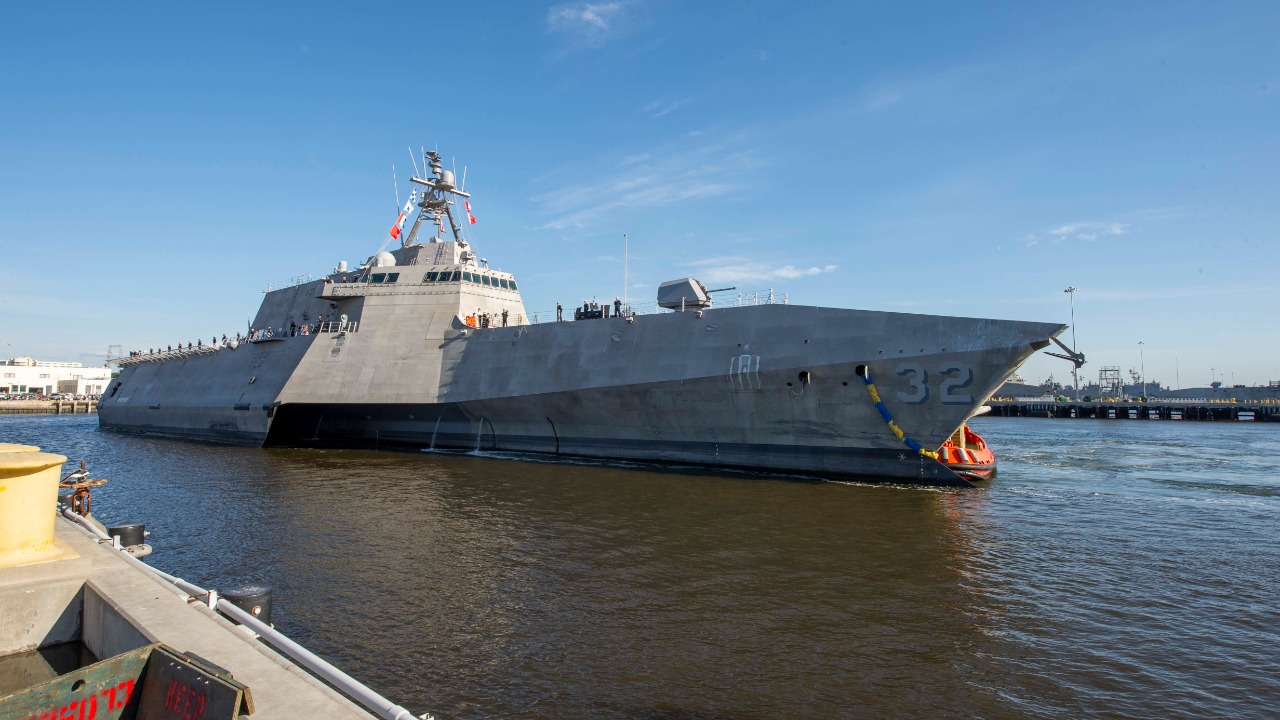

A US Navy warship has crossed a technological threshold by launching a one-way attack drone from its deck at sea, marking a new chapter in how the fleet can strike targets without risking pilots or expensive missiles. The test, carried out in the Middle East from a San Diego based littoral combat ship, signals that low cost “suicide drones” are moving from land battlefields into blue water operations. I see this as a pivotal moment in naval warfare, blending the improvisational drone tactics seen in Ukraine and the Red Sea with the industrial scale and discipline of the United States Navy.
The historic launch and why it matters
The core breakthrough is simple but consequential: a US warship has now fired a one way attack drone from its own deck while underway, proving that this class of weapon can be integrated into routine fleet operations. According to official accounts, Personnel assigned to U.S. Naval Forces Central Command and the U.S. Fifth Fleet conducted the launch in the Arabian Gulf, using a small, expendable aircraft designed to crash into its target rather than return. By validating that concept at sea, the Navy has effectively added a new rung to its escalation ladder, one that sits between warning shots and multi million dollar cruise missiles.
The service itself framed the event as the first time the U.S. Navy in the Middle East has employed an attack drone at sea, underscoring that this was not a lab demo but an operationally relevant test in a contested region. In its description of the event, the command highlighted that Personnel assigned to U.S. Naval Forces Central Command and the U.S. Fifth Fleet executed the launch, tying the milestone directly to the forces that police some of the world’s busiest shipping lanes.
USS Santa Barbara and the Arabian Gulf proving ground
The ship at the center of this story is the Independence class littoral combat ship USS Santa Barbara, a trimaran hull vessel homeported in San Diego that was deployed to the Middle East. Littoral combat ships were originally built for coastal missions, but in this case the San Diego based warship became a testbed for long range unmanned strike in the open waters of the Arabian Gulf. By using a relatively small surface combatant rather than a destroyer or cruiser, the Navy showed that even lighter ships can carry and employ these weapons without major redesign.
Local reporting emphasized that Santa Barbara’s namesake vessel “made history” when it launched the drone from its flight deck earlier in Dec, connecting a community on the California coast to a cutting edge experiment half a world away. The description of Santa Barbara’s role, credited to Credit Callie Fausey, stressed that the same class of one way drones has been used by Russia in attacks against Ukraine, a reminder that the technology is already reshaping land warfare and is now being adapted for sea.
Inside the LUCAS one-way attack drone
The aircraft itself, known as the Lethal Unmanned Combat Aerial System or LUCAS, is a compact, propeller driven drone purpose built to be expended on impact. The LUCAS drone was developed by US company SpektreWorks, which designed it as a low cost strike option that can be launched from simple rails or catapults rather than complex catapults or runways. In practice, that means a ship like USS Santa Barbara can carry a magazine of these drones in containers, assemble and arm them on deck, and then fire them in quick succession if needed.
What makes LUCAS particularly notable is its lineage. Reporting on the program states that The LUCAS drone was developed as a reverse engineered version of Iran’s Shahed series, the same family of loitering munitions that has been used to threaten energy supplies and international trade. By copying and improving on a design that adversaries already field at scale, the Navy is signaling that it intends to fight fire with fire, turning a once asymmetric threat into a tool it can wield from its own decks.
From land battlefields to the open sea
One way attack drones have become grimly familiar over Ukraine, where Russia has used Iranian style Shahed systems to strike cities and infrastructure, and over the Red Sea, where similar weapons have targeted commercial shipping. Until now, however, the US response at sea has relied on defensive intercepts using missiles and guns, a costly and reactive posture. By arming its own ships with LUCAS, the Navy is moving toward a more symmetrical approach in which it can answer drone attacks with its own swarms of expendable aircraft.
Analysts have noted that the same attributes that make these drones attractive to Russia and Iran, relatively cheap airframes, simple engines, and GPS guided warheads, also make them ideal for navies that need volume more than exquisite performance. The U.S. Navy has acknowledged that its first ship launched LUCAS “suicide drone” marks a new phase in low cost maritime strike, describing how First Ship Launched LUCAS Suicide Drone Marks New Phase in how the fleet can deliver precision effects without tying up its most advanced aircraft.
Task Force Scorpion Strike and the CENTCOM experiment
The launch did not happen in isolation. Earlier this month, U.S. Central Command announced the establishment of a new unit known as Task Force Scorpion Strike, a formation explicitly designed to experiment with and field unmanned systems across the region. By placing the LUCAS test under this umbrella, Central Command signaled that it views one way attack drones as part of a broader family of autonomous tools that can help counter threats from Iran aligned groups and protect shipping in chokepoints like the Strait of Hormuz.
In describing the milestone, one account noted that Earlier this month, U.S. Central Command stood up Task Force Scorpion Strike to accelerate exactly this kind of innovation. The task force’s mandate is to blend new sensors, unmanned surface vessels, and aerial drones into a coherent network, and the Santa Barbara launch is one of its first visible outputs, showing how quickly the concept is moving from planning slides to the flight deck.
How the Navy describes the mission and its operators
Officially, the Navy has been careful to present the event as both a technical and a human achievement, highlighting the sailors and officers who made it possible. From Commander U.S. Naval Forces Central Command Public Affairs, the service emphasized that Personnel assigned to U.S. Naval Forces Central Command and the U.S. Fifth Fleet carried out the launch as part of routine operations in the Middle East. That framing matters, because it suggests the Navy wants this capability to be seen as a normal tool in the kit, not a boutique experiment reserved for specialized units.
The same public affairs account stressed that the From Commander Naval Forces Central Command Public Affairs statement was meant to underline the role of Personnel and the broader Naval Forces Central Comma team in integrating unmanned systems into daily patrols. By naming the commands and the people, the Navy is also quietly pushing back against the idea that drones will sideline sailors, instead presenting them as tools that expand what crews can do in dangerous waters.
Strategic stakes in the Arabian Gulf and beyond
The Arabian Gulf is not just a convenient test range. It is a corridor where Iranian forces and their partners have repeatedly used drones and missiles to harass tankers, threaten energy infrastructure, and challenge US and allied navies. By proving that a US warship can launch its own one way attack drone in this environment, the Navy is sending a signal to Tehran and other actors that it can respond in kind, using similar tools to hold hostile platforms at risk without escalating to larger strikes. That deterrent effect depends on credibility, which is why a real launch at sea matters more than any number of exercises ashore.
One detailed account of the event noted that Personnel assigned to US Naval Forces Central Command, NAVCENT, and the US Fifth Fleet successfully launched a one way attack drone from a ship in the Arabian Gulf, describing how the test fits into a wider push to integrate unmanned systems across the theater. The report explained that Personnel Naval Forces Central Command NAVCENT Fifth Fleet see this as part of a continuum that stretches from the Middle East to North America, where similar technologies are being evaluated for coastal defense and homeland security.
Cost, risk, and the appeal of expendable airpower
At the heart of the Navy’s interest in LUCAS is a simple calculus of cost and risk. Traditional naval strike options, such as Tomahawk cruise missiles or carrier based jets like the F/A 18E/F Super Hornet, are extremely capable but also expensive and limited in number. A one way attack drone, by contrast, can be built for a fraction of the price, stored in larger quantities, and sent against targets that might not justify a multi million dollar weapon. For commanders, that opens up new options for suppressing enemy radars, striking small boats, or hitting makeshift launch sites without burning through high end munitions.
One analysis framed the Santa Barbara launch as a moment when a US warship launched a one way attack drone at sea, opening a new chapter of aerial warfare in which expendable systems complement, rather than replace, traditional aircraft. The description of how A US warship launched a drone that is not expected to return captures the essence of this shift, where the value lies not in recovering the platform but in delivering precise effects at acceptable cost.
How this fits into the Navy’s broader drone push
The LUCAS launch is one piece of a much larger puzzle as the Navy races to integrate unmanned systems across air, surface, and undersea domains. The service has already fielded MQ 8 Fire Scout helicopters on some littoral combat ships and is experimenting with large unmanned surface vessels in the Pacific, but those platforms are primarily focused on sensing and scouting. By contrast, a one way attack drone is unapologetically offensive, designed to deliver a warhead rather than a data feed, and its arrival on a San Diego based ship in the Middle East shows that the Navy is no longer content to keep unmanned systems in the supporting cast.
Coverage of the Santa Barbara deployment highlighted that a LUCAS drone launched from the ship’s flight deck earlier this month, underscoring how quickly the Navy is moving from concept to practice. The account of the San Diego based littoral combat ship described sailors working with the new system as part of their normal deployment rhythm, a sign that unmanned strike is being woven into the fabric of fleet life rather than treated as a one off stunt.
Global implications and what comes next
Although the test took place in the Arabian Gulf, its implications are global. The US Navy has already signaled that it sees one way attack drones as a tool it can adapt for other theaters, from the Western Pacific to the North Atlantic, where adversaries field dense anti ship missile networks and swarms of small boats. The fact that The US Navy has launched a one way attack drone from a ship amid growing threats shows that leaders are responding to a world in which cheap, long range drones are no longer the preserve of rogue actors but a staple of state arsenals.
In its broader framing, the Navy has described how The US Navy is integrating attack drones into naval operations as part of a layered defense and offense that stretches from the seabed to space. As more ships receive the hardware and training to fire LUCAS or similar systems, I expect commanders to experiment with salvo tactics, pairing drones with electronic warfare and cyber tools to overwhelm defenses. For now, the image of a single drone arcing off the deck of USS Santa Barbara in Dec is a symbol of that future, a first step toward a fleet where expendable robots share the sky with crewed jets and missiles.
More from MorningOverview