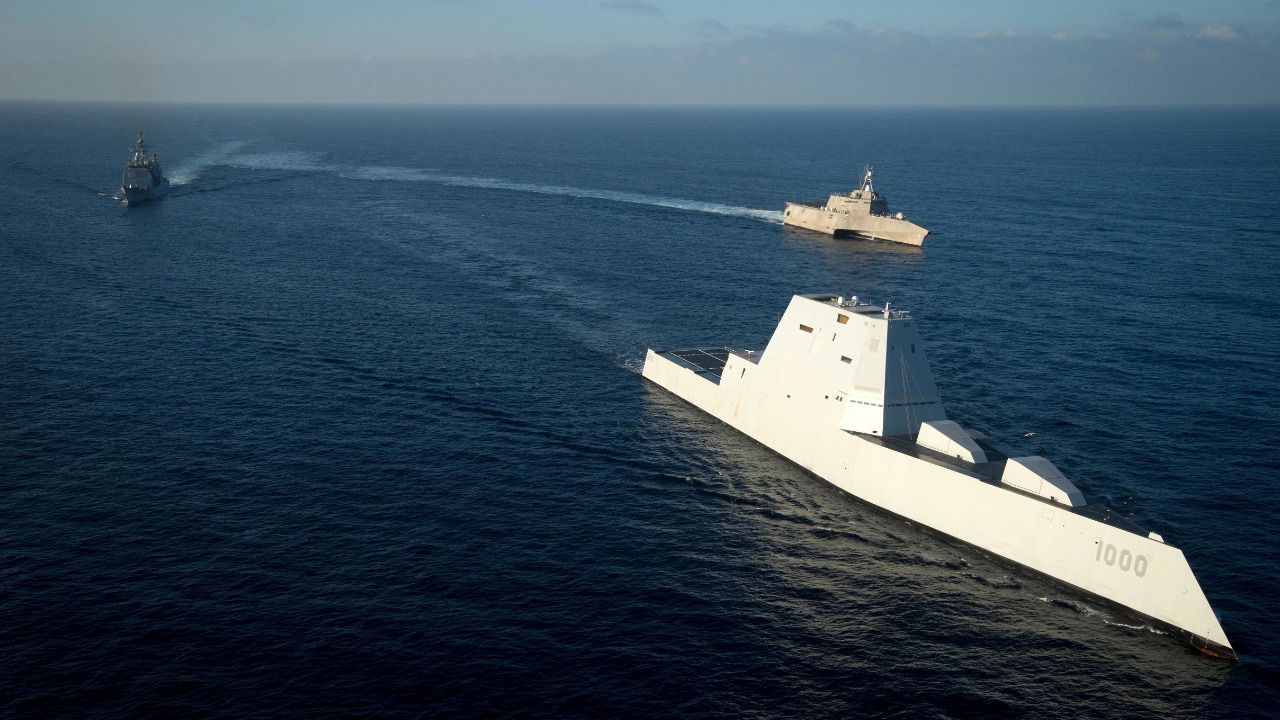

The US Navy’s most unconventional warship is finally edging toward the role it was built to play. After years of experimentation, redesigns, and political scrutiny, the futuristic destroyer USS Zumwalt is moving from symbol of ambition to operational asset, taking its $8 billion blend of stealth and firepower back out to sea with a new mission profile.
Instead of the coastal bombardment role that once defined it, the ship is being reshaped as a long‑range strike platform built around hypersonic weapons. That pivot is turning the sleek, angular hull into a test case for how the Navy adapts expensive, experimental programs into usable combat power in the Pacific.
The $8 billion gamble that reshaped a destroyer
The Zumwalt-class destroyer was conceived as a radical break from traditional surface combatants, with a wave‑piercing hull, integrated power system, and a superstructure designed to all but erase its radar signature. Those innovations came at a steep price. An April GAO report put the total cost of the three Zumwalt destroyers, including research and development, at $24.5 billion, which works out to about $8 billion per ship. That figure, far above a conventional destroyer, turned the class into a political lightning rod and forced the Navy to justify how such a small fleet could deliver meaningful combat capability.
The original concept leaned heavily on advanced guns and precision shells for shore bombardment, but the ammunition proved so expensive that the Navy abandoned the idea, leaving the ships without their intended primary weapon. As the program struggled, critics questioned whether The Zumwalt would ever be more than a technology demonstrator. Yet the same stealthy hull and oversized power margins that drove up costs also created room for reinvention, a point underscored in detailed assessments of Price of Stealth that emphasize how each ship is estimated to cost several billion dollars more than initially planned.
From experimental cruises to Pacific Fleet workhorse
For the Navy, proving that the Zumwalt-class could function as more than a costly prototype meant getting the lead ship into blue water and under operational command. The destroyer’s early Pacific deployments were deliberately limited, focused on shaking out basic systems and crew proficiency rather than front‑line missions. During one such underway in the Pacific, the ship sailed without an aviation detachment, a sign that the priority was testing its combat systems and sensors rather than full-spectrum operations, according to PACFLEET commanders who framed that cruise as a first step for the class.
Those incremental trials paved the way for the ship’s formal integration into the Pacific Fleet battle force. While the Zumwalt will now officially join the U.S. Pacific Fleet battle force and will count towards the Navy’s total count of battle force ships, officials have been clear that it is still on the path toward reaching initial operational capability sometime next year, as reflected in Navy planning for the Pacific Fleet. In practical terms, that means the destroyer is now part of the day‑to‑day force structure on paper, even as its most advanced weapons and tactics are still being refined at sea.
Hypersonic firepower and a new mission set
The most dramatic change to the Zumwalt’s future is the decision to turn it into a hypersonic strike platform. Instead of relying on the abandoned gun system, the Navy is cutting into the hull to install large vertical launch tubes sized for the Conventional Prompt Strike missile, a weapon built around an Advanced Hypersonic Glide Body. Program officials have laid out a schedule in which Zumwalt To Finish Hypersonic Weapon Tube Install By End Of 2025, with the third ship in the class, DDG‑1002, slated to Start Mod in 2026, a timeline that underscores how The Navy is trying to move quickly from concept to operational capability across the DDG fleet.
That shift dovetails with a broader reorientation of US undersea and surface strike power in the Pacific. As hypersonic‑armed destroyers and submarines are slated to relocate to Hawaii, the Navy’s sea systems command has already outlined Construction requirements in a sources sought notice for contractors that could support maintenance and pier work, a sign that NAVSEA is planning for a sustained presence of these platforms in the central Pacific. In that context, a stealthy destroyer able to launch hypersonic weapons from within the region becomes a key part of the United States’ effort to complicate any adversary’s targeting calculus.
Modernisation, testing setbacks, and the path to reliability
Transforming the Zumwalt into a hypersonic ship has required extensive modernization work that goes far beyond simply bolting new launchers to the deck. The guided‑missile destroyer USS Zumwalt (DDG‑1000) arrived in Mississippi to begin a two‑year process of structural modifications, combat system upgrades, and integration of the new missile tubes, a complex overhaul that has kept the ship in the yard even as it is counted in the fleet, according to detailed updates on the Mississippi work. That modernization is as much about software and power management as it is about steel, since the ship’s integrated power system must support both propulsion and high‑demand weapons.
The weapons themselves have not had a smooth path. The initial test flight of the AUR in June 2022 did not succeed, and Planned evaluations set for March and September 2023 were designed to gather more data on the glide body and booster performance, part of a broader evaluation campaign for CPS by the Navy that has been closely watched by Pentagon planners and foreign militaries alike. Those details, laid out in technical reporting on the AUR, highlight how even as the ship’s hull and combat systems near completion, the missile it is meant to carry is still working through the inevitable setbacks of cutting‑edge flight testing.
What the Zumwalt experiment means for the future fleet
As the Navy pushes the Zumwalt back to sea with a new mission, I see it as a live‑fire experiment in how to salvage value from an over‑budget, under‑delivering program. The class’s tiny size, just three ships, limits its impact on raw fleet numbers, but it gives the service a controlled environment to test new concepts in power generation, automation, and long‑range strike. If the hypersonic integration succeeds and the ship proves reliable in the Pacific, the lessons learned could shape how future destroyers and cruisers are designed, even if they never replicate the exact lines of The Zumwalt or its distinctive composite deckhouse.
There is also a strategic signaling effect that goes beyond the ship’s immediate combat power. Sailing a stealthy, $8 billion destroyer equipped with hypersonic weapons into contested waters sends a message about US technological ambition and willingness to invest in high‑end capabilities, even when the path is messy. An April GAO report that once read like an indictment of cost overruns now doubles as a reminder of how much sunk investment is riding on making this class work. As the ship leaves the yard and returns to the Pacific, the real test will be whether that investment translates into a platform that commanders trust enough to send into the most demanding missions the Navy can imagine.
More from Morning Overview