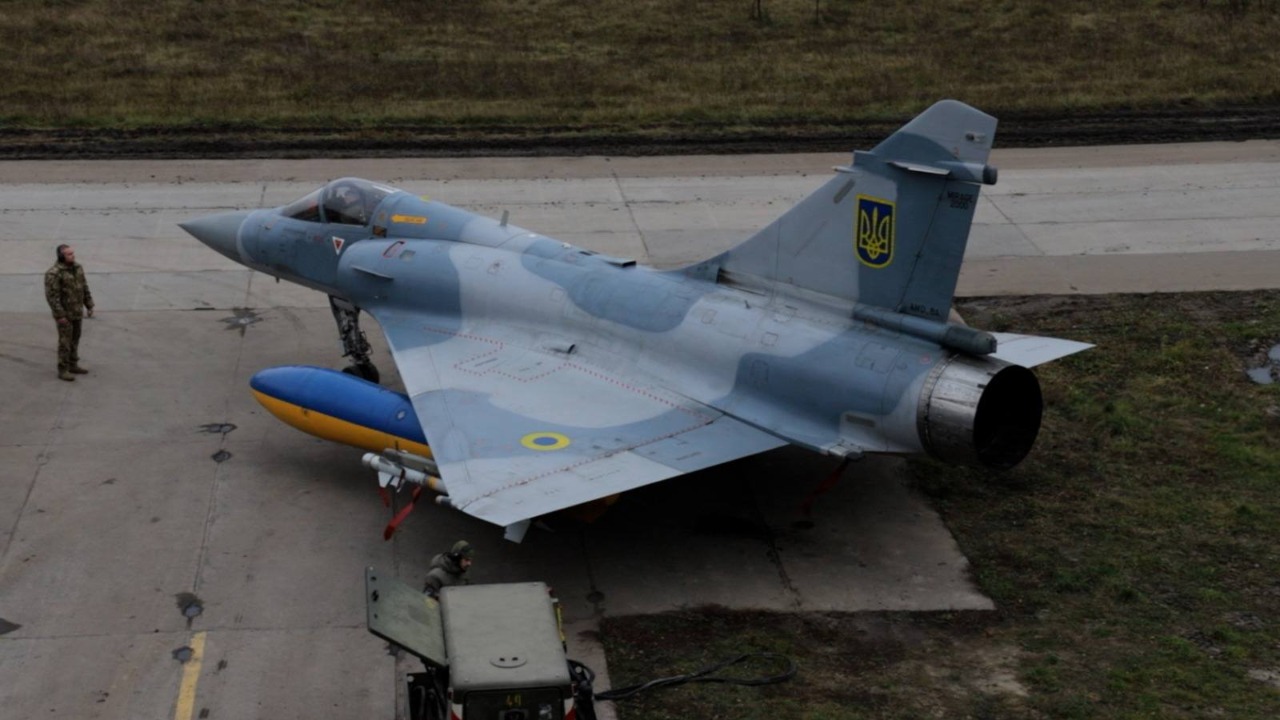

Ukraine’s French supplied Mirage 2000-5F fighters have quietly crossed an important threshold: they are now flying with modern MICA air to air missiles instead of relying on aging short range weapons. That shift turns the Mirage from a niche interceptor into a genuine medium range hunter, able to contest Russian aircraft and drones well beyond visual range. It is a rare case in this war where a single weapons pairing meaningfully changes what Ukrainian pilots can attempt in the sky.
By arming these jets with both radar guided and infrared guided MICA variants, Kyiv is closing a capability gap that had limited how aggressively its pilots could use the Mirage. The upgrade does not guarantee air superiority, but it does give Ukraine a sharper, more survivable spear at a time when Russian aviation and cruise missile attacks remain central to the campaign.
From symbolic gift to frontline workhorse
When the first Mirage 2000-5F aircraft arrived, they were initially seen as a political signal of French support rather than a decisive battlefield tool. According to reporting on Ukrainian air superiority, Ukraine has been operating at least six Mirage 2000-5F jets since early 2025, with pilots and ground crews completing an accelerated transition from Soviet era platforms. That small fleet was enough to plug gaps in air defense and to deepen cooperation between Ukraine and NATO air forces, but it did not yet transform the air war.
The Mirage 2000-5F is a capable multirole fighter with a modern radar, advanced computing systems, and a laser based inertial navigation system, and it can operate effectively in poor weather and at night. French sources highlighted that the aircraft can carry a mix of air to air missiles and precision guided munitions, and Ukrainian officials quickly pushed it into air defense duty. One report on additional deliveries notes that the jet’s avionics allowed a Ukrainian Mirage 2000 to down a Russian cruise missile during a large scale air attack, underscoring that even a small number of these fighters can have outsized impact when properly armed.
Why the MICA pairing matters
The real transformation began once the Mirage fleet received French MICA missiles as part of a broader package. Earlier this month, Ukrainian officials confirmed that Ukrainian Mirage 2000 fighter jets have been equipped with French MICA medium range air to air missiles, a step explicitly framed as a response to sustained high intensity Russian air operations. A detailed breakdown from a Ukrainian defense outlet notes that Ukrainian Mirage 2000 aircraft are now carrying both radar guided and infrared guided MICA variants, giving pilots flexibility in how they engage targets.
The MICA family, formally designated MICA, Missile, Interception, Combat, Auto défense, was designed as a dual role weapon that can be fired beyond visual range or used in close combat. Technical data describe it as a highly maneuverable missile capable of withstanding up to 30g as energy is lost, with both active radar and imaging infrared seekers available. That combination allows the same basic weapon to cover multiple engagement envelopes, simplifying logistics for a small air force that cannot afford to field a wide array of specialized missiles.
MICA IR and the reach of Ukraine’s new intercepts
For Ukraine, the infrared guided version is particularly important. Local reporting specifies that The MICA IR variant with an infrared GSN has certain advantages over its counterparts, namely a range of 60 km. At the same time, the missile’s seeker can be cued by the aircraft’s radar or by an off board sensor, allowing Ukrainian pilots to launch without necessarily emitting a strong radar signal of their own. In a sky saturated with Russian electronic warfare and surface to air missiles, that matters.
The radar guided MICA EM complements this by giving the Mirage a true beyond visual range punch. Analysis of the Mirage 2000-5 notes that the aircraft can carry six MICA EM or IR missiles, each having fire and forget mode and a range of 40 to 50 miles, which corresponds to roughly 60 to 80 k in metric terms. That envelope allows Ukrainian fighters to threaten Russian aircraft before they reach launch points for glide bombs or stand off missiles, especially when cued by ground based radar or NATO surveillance assets.
From Magic 2 to MICA, closing a dangerous gap
Until recently, Ukrainian pilots flying the Mirage were largely limited to older short range missiles. Combat accounts describe Mirage 2000s taking part in air defence missions armed with the R. 550 M agic 2 short range air to air missile, which Ukrainian pilots used effectively against designated drones and missiles. According to that reporting, the R. 550 M agic 2 was a stopgap that allowed quick integration of the French jets into Ukraine’s layered air defence, but it left the aircraft at a disadvantage in any confrontation with Russian fighters.
A later comparison of Magic 2 vs MICA, framed as a Capability table contrasting the 1986 missile with the Modern design, underscores how limiting that arrangement was. The analysis notes that the MICA is faster, more maneuverable, and has a much longer reach, and that continuing to rely on Magic 2s effectively handicaps the fighter. By shifting to MICA, Ukraine is not just adding range, it is aligning the missile’s performance with the Mirage’s radar and avionics so the jet can finally operate as designed.
How many missiles can a Mirage really carry?
There has been some confusion, including in gaming communities, about the Mirage 2000-5F’s exact missile loadout. One technical discussion points out that Currently the Mirage 2000-5F is capable of using 8 air to air missiles in some simulations, equipping 6 MICA EM and 2 Magic 2s on underwing pylons. The same source notes that official documentation states the Mirage 2000-5F should only have a maximum of 6 missiles total, which aligns with operational analyses that describe a typical load of six MICA EM or IR weapons.
For Ukraine, the practical question is not whether the jet can carry six or eight missiles, but how many modern rounds it can afford to keep on the rails. French commentary on the transfer emphasizes that the small size of the missile made it hard to detect in flight, and that a delayed switching on of its own seekers was central to the concept of operations for the Jun package. In practice, that means a fully loaded Mirage can approach, launch several MICAs with minimal warning to the target, then turn away while the missiles complete the engagement autonomously.
French politics and the prospect of more Mirages
The missile upgrade is intertwined with French decisions about how many aircraft to send. Public comments by Former Ukrainian Foreign Minister Dmytro Kuleba indicate that France may double Mirage 2000-5 transfers to Ukraine, with additional fighters sourced from French stocks. That would expand the number of airframes able to carry MICA and would ease the strain on a small fleet that has been flying intensive sorties since its introduction.
French leaders have framed the Mirage and MICA package as a way to help Ukraine defend its cities and infrastructure without directly involving NATO pilots. The same logic is visible in other Western programs, such as the U.S. Army’s decision to fund a Precision Grenadier System that, in the words of one manufacturer, will improve soldier capabilities on the battlefield and help engage threats such as unmanned aerial systems. In both cases, Western governments are betting that better precision weapons in Ukrainian hands can blunt Russian advantages without crossing political red lines.
What the Mirage brings to Ukraine’s wider air picture
Even before the MICA integration, analysts highlighted that the Mirage 2000-5’s radar and sensor suite would mesh well with Ukraine’s evolving air defense network. One technical assessment notes that Mirage 2000-5s have the ability to classify and prioritize multiple aerial targets, and that their weapons can be employed automatically when needed. In practice, that means a Ukrainian pilot can rely on the jet’s systems to help manage complex engagements involving cruise missiles, drones, and manned aircraft, rather than juggling everything manually in a crowded battlespace.
The same analysis stresses that the Mirage 2000-5s can carry six MICA EM or IR missiles with fire and forget capability and a range of 40 to 50 miles, or 60 to 80 k, while also retaining the option to carry bombs and standoff range missiles. That flexibility allows Ukraine to use the Mirage both as a high end interceptor and, when the air threat permits, as a precision strike platform. In a war where Russian forces routinely launch mixed salvos of ballistic missiles, cruise missiles, and Shahed type drones, having a fighter that can switch between roles without major reconfiguration is a significant advantage.
Combat lessons and pilot tactics
Ukrainian pilots have already begun to adapt their tactics around the Mirage’s strengths. A widely viewed analysis video titled The Mirage 2000 is CRUSHING Russia’s Air Force argues that the combination of French radar, Western situational awareness, and modern missiles has allowed Ukraine to ambush Russian aircraft that previously operated with relative impunity. While some of the rhetoric is clearly aimed at a popular audience, the underlying point matches battlefield reports that Russian pilots have become more cautious in sectors where Mirages are known to operate.
Another account, framed around a dramatic intercept and shared under the title Ukrainian MIRAGE Pilot Just Did Something UNBELIEVABLE, describes how Ukraine’s air force disrupted a Russian missile and drone attack by using the Mirage’s sensors to detect threats early and then vectoring other assets into position. The narrative emphasizes that for years Russia has launched relentless missile and drone strikes, and that the arrival of Western fighters has given Ukrainian commanders more options to break up those salvos before they reach major cities. With MICA now on the rails, those options expand further, since a single Mirage patrol can engage multiple targets at medium range instead of waiting until they are almost overhead.
What comes next for Ukraine’s air war
The integration of MICA onto Ukraine’s Mirage fleet does not end Russian air dominance, but it does complicate Moscow’s planning. Russian crews now have to assume that any incursion near Ukrainian controlled airspace could be met by a fighter carrying six modern missiles with ranges measured in tens of miles rather than a handful of short range Magic 2s. That uncertainty alone can force higher altitude flight profiles, more circuitous routes, or heavier reliance on stand off weapons, all of which reduce the efficiency of Russian operations.
For Kyiv, the challenge will be sustaining this capability over time. MICA missiles are expensive, and the Mirage 2000-5F airframes will require careful maintenance after years of intensive use. Yet the trajectory is clear. From the first small batch of jets to the prospect that France may double Mirage transfers, and from R. 550 Magic 2 stopgaps to fully integrated MICA IR and EM, Ukraine is steadily building an air force that looks and fights more like its Western partners. The Mirage and its new missiles are not a silver bullet, but they are a serious boost at a moment when every additional kilometer of defended airspace counts.
More from Morning Overview