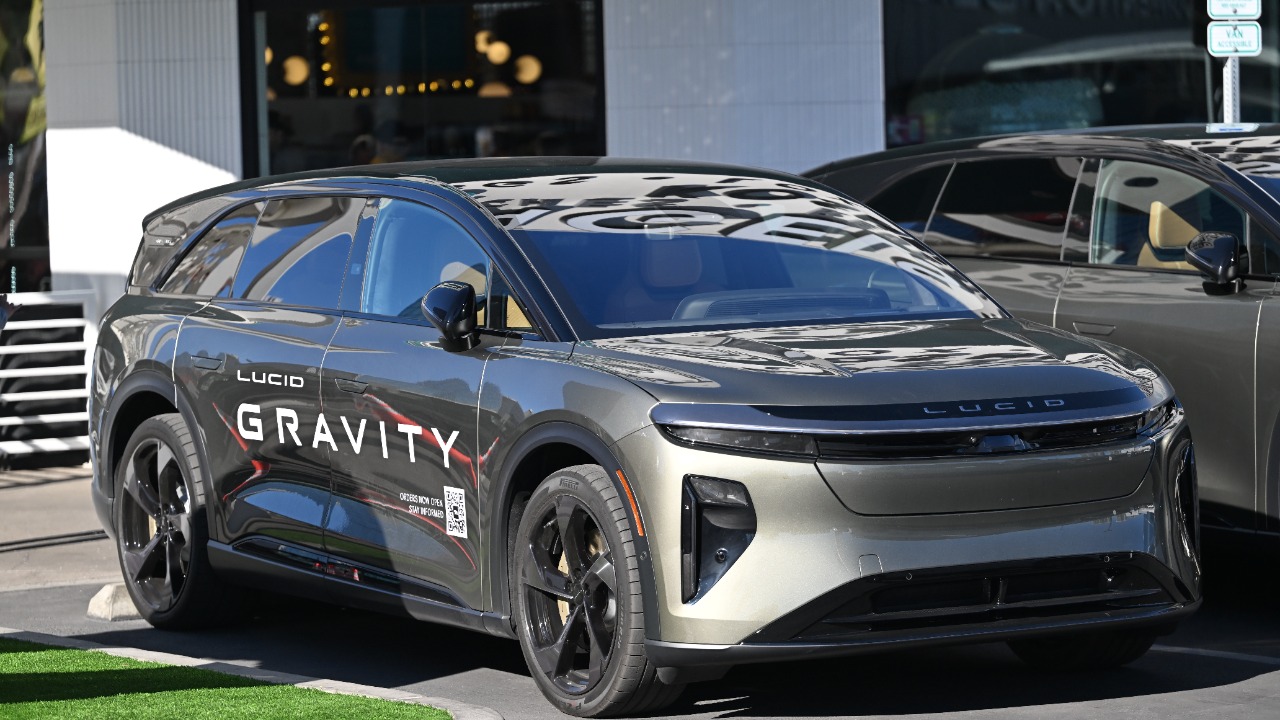

Self-driving Lucid Gravity SUVs wearing Uber logos are no longer a concept sketch or a stage prop. They are already circulating on San Francisco streets as part of a tightly controlled pilot, turning a luxury electric family hauler into a rolling test bed for the next phase of ride hailing. The move signals that robotaxis are shifting from isolated experiments to integrated services inside mainstream apps, with Lucid Motors, Uber, and Nuro betting that their combined strengths can make autonomy feel less like a science project and more like a normal way to get across town.
From CES reveal to real San Francisco streets
The Gravity robotaxi project arrived in public view as a polished showcase, but its most important milestone is happening far from the Las Vegas show floor. Earlier this year, Lucid Motors confirmed that its Gravity based robotaxis were already running structured routes in San Francisco, not just looping around a private track. That means the vehicles are interacting with real traffic, pedestrians, and city infrastructure, even if the program is still framed as testing rather than a full commercial launch.
According to Lucid Motors, the company moved its autonomous program from lab work and closed facilities into a city scale pilot after extensive virtual and closed course validation. The company has described how Lucid Starts Gravity Robotaxi Testing in San Francisco only after running large scale simulation to accelerate development, a sequence that mirrors how other autonomous players have tried to de risk their first steps into dense urban environments.
Why Lucid picked the Gravity as its robotaxi workhorse
Lucid Motors did not choose an anonymous pod or a stripped down shuttle for its first robotaxi. Instead, it leaned on the Gravity, a premium electric SUV that the company already positions as a flagship family vehicle. Turning an existing high end model into a driverless fleet car is a strategic choice, because it lets Lucid reuse its battery, chassis, and interior platform while layering on sensors and software rather than starting from scratch.
The Gravity is not a budget car, and that matters for how the economics of the service will eventually work. One report notes that prices for the Gravity electric car start at $79,900 and run well into six figures, which underscores how unusual it is to see such an expensive platform repurposed as a high mileage urban workhorse. Whatever the eventual pricing for rides, the decision to base the service on a luxury EV signals that Lucid wants the robotaxi experience to feel like an upgrade over a typical compact sedan, not a downgrade.
Inside the Lucid, Uber, and Nuro alliance
Lucid Motors is not trying to build a robotaxi ecosystem on its own. Instead, it has formed a three way alliance with Uber and Nuro that splits responsibilities along each company’s strengths. Lucid brings the Gravity hardware and its electric drivetrain expertise, Uber contributes the ride hailing platform and customer base, and Nuro supplies core autonomous driving technology that has already been tested in other contexts.
The partnership was framed as a strategic triad when Lucid, Uber, and Nuro Unite to Unveil Revolutionary Gravity Robotaxi Fleet at CES, with each company emphasizing that the collaboration is meant to deliver both scale and consistency in the autonomous sector. By tying the Gravity robotaxis directly into Uber’s existing app and leveraging Nuro’s self driving stack, the group is trying to compress the timeline from prototype to everyday service.
How the Uber experience changes when the driver is a Gravity
For riders, the most visible change is that a trip request in the Uber app can now be matched with a Lucid Gravity instead of a human driven sedan, at least in the limited San Francisco test area. The vehicle still appears as an Uber ride, but the cabin is configured around screens, sensors, and controls that assume no one is sitting behind the wheel. That shifts the experience from a conversation with a driver to an interaction with software, from the moment the doors unlock to the point the car pulls away from the curb.
Uber has framed the service as a way for people to ride in a self driving Lucid Gravity robotaxi later this year, describing how Lucid Is Turning the Gravity into a Robotaxi with Uber in a collaboration that aims to make autonomous rides feel like a natural extension of the existing app. The company has already integrated other autonomous fleets in select cities, but the Gravity adds a premium electric option that could appeal to riders who care as much about cabin quality and quiet as they do about the novelty of not having a driver.
What “already on the streets” really means
When people hear that robotaxis are already operating in San Francisco, it is easy to imagine a city suddenly flooded with driverless SUVs. The reality is more measured. The Lucid Gravity vehicles are running defined routes and time windows, with safety protocols that reflect the early stage of the program. They are visible enough that residents can spot them in traffic, but the fleet is still small compared with the thousands of conventional Uber cars that crisscross the city every day.
Reporting on the pilot notes that Uber, Lucid Gravity Robotaxis Are Already On The Streets Of San Francisco after Uber, Lucid, and Nuro began their work with closed course validation and simulation before moving into public roads. That progression matters, because it shows that the companies are trying to balance the pressure to demonstrate progress with the need to avoid the kind of high profile incidents that have dogged other autonomous programs in the city.
From simulation labs to city blocks
Behind every Gravity robotaxi that merges into San Francisco traffic sits a long chain of virtual tests and controlled experiments. Lucid Motors has emphasized that it leaned heavily on large scale simulation to train and validate its autonomous systems before exposing them to the chaos of real streets. Simulation lets engineers replay rare edge cases, adjust software quickly, and stress test the system against scenarios that would be too dangerous to stage in the real world.
Only after that virtual gauntlet did Lucid Motors move the Gravity into structured city testing, a step it described when it confirmed that Gravity robotaxis were operating in San Francisco following extensive simulation and closed course work. That path mirrors the broader industry’s shift away from learning primarily on public roads and toward a hybrid model where most of the early learning happens in software, with the city used to validate and refine rather than to discover basic behaviors.
The business logic behind a premium robotaxi
On paper, using a vehicle that starts at $79,900 as a robotaxi looks counterintuitive. Fleet operators typically chase low acquisition costs and easy maintenance, not high end interiors and cutting edge battery packs. Lucid Motors is betting that the Gravity’s range, charging performance, and cabin comfort will offset its upfront price by enabling more trips per day and higher rider satisfaction, especially if Uber can position the service as a premium autonomous option.
One analysis framed the decision by noting that, whatever the pricing, turning an already expensive Gravity into a robotaxi is a bold way to enter the market, since the Gravity electric car sits at the upper end of the EV spectrum. If the alliance can keep the vehicles on the road for long duty cycles and command a modest premium over standard rides, the economics may still work, especially when spread across a fleet that shares charging, maintenance, and software infrastructure.
How this triad fits into the wider autonomous race
The Lucid, Uber, and Nuro project lands in a city that has already become a proving ground for autonomous services. San Francisco residents have seen multiple self driving brands test and operate in their neighborhoods, and regulators have had to weigh safety concerns against the promise of cleaner, more efficient transportation. Against that backdrop, the Gravity robotaxis are not arriving in a vacuum, but they do bring a different mix of partners and a more overt link to a mainstream ride hailing app.
At CES, the companies framed their collaboration as a landmark development, with Unveil Revolutionary Gravity Robotaxi Fleet used to describe how the triad wants to set new expectations for consistency in the autonomous sector. By combining a high end EV, a dominant ride hailing platform, and a specialist in self driving systems, the group is positioning itself as a serious contender in a field that has already seen both high profile launches and painful retrenchments.
What comes next for riders and the city
For now, the Gravity robotaxis in San Francisco are a glimpse of a possible future rather than a replacement for human drivers. Riders who happen to be in the right neighborhoods at the right times may get the chance to experience a self driving Lucid Gravity through the Uber app, while most trips will still be handled by people behind the wheel. The key question is how quickly the alliance can expand coverage without running into the safety, regulatory, or public perception setbacks that have slowed other autonomous rollouts.
Uber has already signaled that people will be able to ride in this self driving Lucid Gravity robotaxi later this year as the collaboration with Nuro and Lucid Motors matures, describing the Robotaxi plan as a way to bring autonomy into everyday ride hailing. If the San Francisco pilot holds up under real world pressure, the Gravity could move from a limited test fleet to a more common sight in the app, turning what is now a novelty into another option on the list when people tap to request a ride.
More from Morning Overview