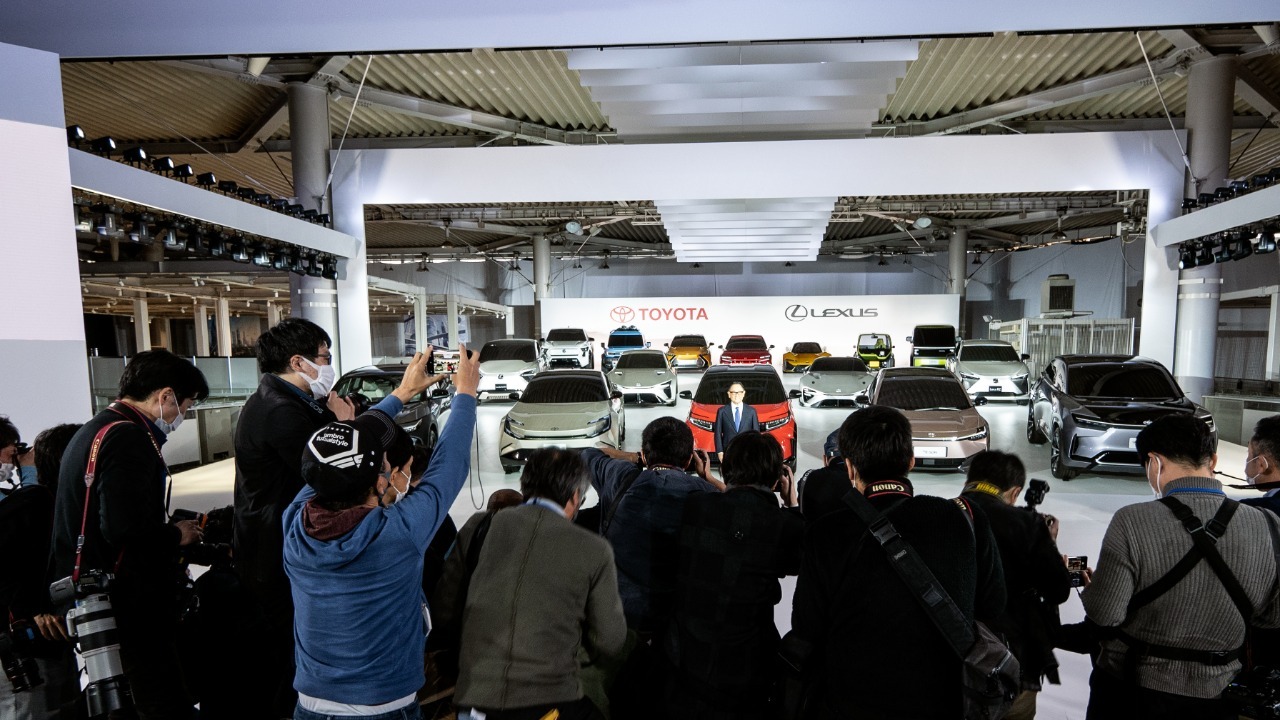

Toyota built its reputation on reliability and scale, but the center of gravity in the car business is shifting toward electric vehicles where Chinese manufacturers are setting the pace. As Chinese EV makers surge at home and abroad, the Japanese giant now faces a genuine shock risk to its dominance, forcing it to rethink everything from product strategy to factory design. I see a company still leading global sales, yet suddenly on the defensive in the very technology that will define the next era of mobility.
The global champion with a growing vulnerability
Toyota remains the benchmark for volume and brand strength, a position that masks how exposed it is to the electric transition. In the first half of 2025, Key Takeaways data show Toyota as the world’s best selling car brand, reaching 4.7 m units, a reminder that its hybrid heavy lineup still resonates with buyers. Yet that success is rooted in combustion and hybrid technology, while the fastest growth and fiercest competition are now concentrated in battery electric vehicles where Chinese players are rapidly scaling.
The tension for Toyota is that its traditional strengths, such as incremental engineering and long product cycles, are less suited to a market where software, batteries and price wars move at digital speed. Internally, the company has framed its manufacturing philosophy around continuous improvement, with corporate materials stressing that Through combined projects Toyota ( TOYOTA MOTOR CORPORATION ) aims to shift to plants that are always competitive rather than plants that depend on volume. That mindset is now being tested by rivals that are not only competitive on cost, but also on software defined features and rapid model refreshes.
Chinese EV makers seize the initiative
While Toyota leans on its global scale, Chinese manufacturers are turning their domestic dogfight into a springboard for global expansion. In China, the EV market has become intensely contested, with reports noting that China’s EV market is fiercely competitive as car manufacturers slash prices to take market share. That same reporting highlights how BYD posts its slowest annual sales growth in 5 years yet still positions itself to be the best selling car brand of 2025, underscoring how high the base has become for Chinese EV volume.
The pressure at home is now pushing Chinese brands to look outward. Analysts describe how Domestic competition is pushing China’s car companies to look overseas for new markets, turning Europe, Southeast Asia and Latin America into the next battlegrounds. For Toyota, which has long relied on these regions as profit centers, the arrival of low cost, feature rich Chinese EVs threatens to erode pricing power and brand loyalty just as regulators tighten emissions rules.
BYD’s rise crystallizes the threat
No company embodies Toyota’s new reality more clearly than BYD. According to recent sales data, BYD Sells 2.26 M electric cars in 2025, with the figure explicitly cited as 2.26 M, confirming its status as the new global BEV sales leader. That volume is not just a headline number, it reflects a vertically integrated model that spans batteries, chips and complete vehicles, allowing BYD to compete aggressively on price while still investing in new technology.
The scale of the shift is also captured in reporting that Fred Lambert notes as BYD officially overtakes Tesla in all electric sales for 2025, with 166 Comments attached to that milestone and a cited growth rate of 50.4% (2,288,709 units). For Toyota, which still leans heavily on hybrids and plug in hybrids, the message is blunt: the center of innovation and volume in pure EVs is now anchored in China, and the competition is no longer just about matching Tesla but about catching up to BYD’s integrated ecosystem.
China’s home market turns into a survival test
The irony for Toyota is that the same forces that make Chinese EV makers formidable abroad are also destabilizing at home in China, creating both risk and opportunity. Analysts describe how China EVs in 2026 look less like a boom and more like a survival test as global expansion ramps up, with a brutal price war compressing margins. That environment is forcing weaker brands to consolidate or exit, while the strongest players double down on exports, potentially flooding overseas markets with discounted models.
Within China, BYD has already cemented its leadership in new energy vehicles, with official figures showing Updated deliveries reaching 4.67 million units of NEV models, a scale that gives it enormous leverage over suppliers and distribution. That same report notes how a photo taken on Nov 3, 2025 shows a NEV assembly line, underlining how deeply embedded NEV production has become in China’s industrial base. For Toyota, competing in this market means not only matching product specs but also navigating a policy environment that strongly favors domestic champions.
Toyota’s late pivot and scaled back ambitions
Toyota has not been blind to the shifting landscape, but its response has been cautious and, at times, conflicted. The company has publicly warned that Toyota issues urgent warning: Falling behind China goes far beyond just EVs, highlighting concerns about China’s lead in the EV battery market in 2024 and the broader ecosystem around software and supply chains. That admission from a company long seen as a technology leader signals how seriously it views the structural advantage Chinese manufacturers have built.
At the same time, Toyota has had to temper its own electric ambitions. In a move that underscores both market uncertainty and internal hesitation, Toyota Scales Back 2026 EV Production Target By 30% Amid Market Slowdown, with Toyota Motor Corporation explicitly cited as announcing the cut after already selling about 80,000 units. Scaling back in the face of Chinese acceleration risks leaving Toyota further behind in the learning curve that comes from high volume EV production.
Teaming up with China instead of trying to beat it
Confronted with the scale and speed of Chinese EV makers, Toyota is increasingly choosing partnership over head on confrontation. Its new EV strategy in China has been framed around the idea that if it cannot beat local players, it will work with them, with reports describing how If it can’t beat China it is teaming up instead in China. That approach includes joint ventures on EV platforms and batteries, as well as deeper collaboration with Chinese suppliers that have moved ahead on cost and chemistry.
The logic is straightforward: by aligning with the most advanced parts of the Chinese ecosystem, Toyota can accelerate its own learning curve and secure access to competitive components. Yet there is a strategic trade off in becoming more dependent on a rival nation’s industrial base at the very moment when EVs and batteries are turning into geopolitical assets. For a company that once defined independence through its own in house engines and transmissions, relying on Chinese partners for core EV technology marks a profound shift in identity as well as strategy.
China as Toyota’s toughest battleground
Nowhere is Toyota’s vulnerability more exposed than in China itself, where it has lost ground to domestic EV specialists. Commentators have pointed out that Toyota and its Japanese peers have been slow to put high tech EVs similar to those provided by BYD on the market, creating an opening that Chinese brands have exploited. That lag has chipped away at what was once seen as a jewel in Japan’s industrial crown, as consumers gravitate toward connected, software rich models that feel more like smartphones on wheels.Toyota is trying to claw back share with products tailored to local tastes and price points. Its push into made for China EVs includes a new model priced around $15,000, with reports noting that Toyota’s foray into made for China EVs has some teething problems, including dozens of trivial issues reported by early owners. That mix of aggressive pricing and early quality glitches shows how far Toyota still has to go to match the refinement and localization that Chinese brands have achieved over several EV product cycles.
A volatile 2026 will punish slow movers
The timing of Toyota’s adjustment could hardly be more challenging. Industry outlooks for 2026 emphasize that Key Takeaways include Unpredictability as the defining feature of the year, with automakers prioritizing agility over traditional planning and scale. That shift favors companies that can rapidly reconfigure supply chains, update software and pivot product mixes, attributes more commonly associated with Chinese EV startups and tech infused manufacturers than with legacy giants.
Further analysis stresses that What will make this year different is not just the continuation of 2025’s issues, but that the pace of the challenges will persist, according to the study cited. For Toyota, which has historically excelled at long term, methodical planning, this environment demands a cultural shift toward faster decision making and greater risk tolerance, especially in EV investments where waiting for perfect information can mean ceding entire market segments to more aggressive rivals.
Japan’s crown at risk as Chinese EVs go global
The stakes for Toyota extend beyond its own balance sheet to Japan’s broader industrial standing. Analysts warn that Toyota risks electric shock from Chinese carmakers, with commentary noting that many of the Japanese carmakers have been slow to embrace fully electric models even as Chinese brands race ahead. The phrase Almost exactly 30 years after Japanese automakers disrupted Western incumbents now hangs over the industry as a reminder that the disruptor can quickly become the disrupted.
Within Japan, there is growing recognition that the country’s automotive crown is loosening as Chinese EVs gain ground in export markets and in technology leadership. The earlier observation that Japanese peers to Toyota have also lagged in high tech EVs underscores that this is not just a Toyota problem but a systemic challenge. If Chinese brands succeed in defining global EV standards, from charging protocols to in car software ecosystems, Japanese automakers could find themselves locked into follower status in a market they once dominated.
Can Toyota turn its manufacturing edge into an EV advantage?
Despite the mounting pressure, Toyota still holds assets that could be decisive if it moves quickly enough. Its production system, often studied and emulated worldwide, is already being retooled for the EV era, with corporate materials emphasizing that Toyota MOTOR CORPORATION aims to shift to plants that are always competitive rather than plants that depend on volume. If Toyota can apply that philosophy to battery pack assembly, software integration and modular EV platforms, it could compress development cycles and lower costs in ways that narrow the gap with Chinese rivals.
The question is whether that transformation can happen at the speed the market now demands. The company’s willingness to partner in China, as seen in its strategy that Aug outlines, suggests a pragmatic recognition that it cannot build every capability alone. Yet the same partnerships risk deepening its exposure to the very ecosystem that is challenging its dominance. Whether Toyota can convert its manufacturing discipline and global brand into a true EV advantage, rather than a legacy strength, will determine if the current electric shock is a passing jolt or the start of a long term power shift toward China.
More from MorningOverview