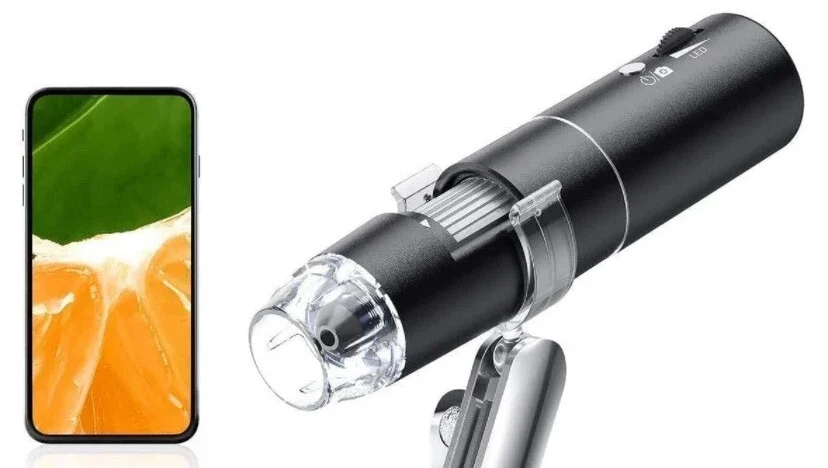

Clip-on lenses and wireless scopes now let a smartphone camera resolve textures and structures that used to require a lab bench. Instead of peering into a bulky eyepiece, I can hold a leaf, a circuit board, or a fabric swatch under my phone and watch a hidden world snap into focus on the screen.
What started as a novelty accessory has matured into a small ecosystem of serious tools, from fingertip lenses that cost less than a night out to WiFi rigs that rival entry-level optical microscopes. The core idea is simple, but the execution varies wildly, and the latest wireless gadget that turns a phone into a microscope sits at the center of a much broader shift in how we explore the microscopic world.
From lab bench to pocket: how phone microscopes got here
The leap from traditional optics to phone-based microscopy began with simple macro clips, but the hardware has quickly grown more ambitious. I now see compact rigs that combine high magnification, integrated lighting, and dedicated apps so a phone becomes both the eyepiece and the image recorder, a role that used to be filled by expensive cameras bolted onto lab scopes.
Some of the most polished examples are sold as complete product kits that bundle stands, clips, and calibration targets so users can go from unboxing to imaging in minutes. Others arrive as bare lenses that rely on the phone’s own camera app, but even those now tend to ship with molded housings and alignment guides that make them feel more like scientific instruments than toys.
The wireless gadget at the center of the trend
The device that has captured the most attention lately is a wireless scope pitched as “The Wireless Gadget That Turns Your Phone Into” a full-fledged “Microscope,” and it leans heavily on convenience. Instead of clamping directly over the camera, it creates its own WiFi hotspot so a phone or tablet can stream the live view, capture stills, and record video without any physical tether.
In practice, that means I can rest the scope on a desk, position a coin or insect under its lens, and then step back with my phone to adjust focus, tweak exposure, and save images. Coverage of this wireless gadget highlights how it uses a companion app to provide full photo access on mobile, turning the phone into both a remote control and a gallery for microscopic shots.
What “wireless” really buys you
Going wireless is not just a party trick, it changes how and where I can use a microscope. With a self-powered scope broadcasting over WiFi, I can place it in tight or awkward spaces, such as inside a 3D printer enclosure or under a car dashboard, and still see a sharp feed on my phone without wrestling with cables.
That flexibility shows up in other designs too, from compact wireless kits that slip into a pocket to more elaborate rigs with articulated stands. The common thread is that the phone becomes a roaming display and control surface, which is especially useful in classrooms where several students can crowd around a single live feed.
Clip-on lenses that turn any phone into a lab tool
Not every user needs a standalone WiFi scope, and clip-on lenses remain the most accessible way to get microscopic detail. A simple plastic frame that slides over the phone’s camera can add serious magnification, and because it uses the phone’s own sensor and processing, the image quality can be surprisingly good.
One of the more refined examples is the The Tipscope Ultra Magnifier, marketed as a Phone Microscope under the BRAND name Tipscope with a TYPE listed simply as Tips. It is a reminder that a clever piece of glass and plastic, properly aligned, can turn a standard camera module into a surprisingly capable inspection tool without adding batteries, screens, or radios.
How much magnification is enough?
Magnification numbers are the headline spec on almost every listing, but the right figure depends heavily on what I want to see. For basic texture work, such as checking a fabric weave or reading tiny print on a label, 50 to 100 times is usually plenty, while more demanding tasks like examining plant cells or solder joints benefit from 200 times or more.
Some phone microscopes push that envelope aggressively. The APEXEL 300X Phone Microscope Lens is sold as a Phone Camera Micro Lens with a Universal Clip, LED Light, and CPL filter, while Nano Zoom accessories like the Phone Microscope with CPL Lens, LED Light, and Nano Zoom 200X Pocket Microscope Camera Attachment promise up to 200X on most phones through a universal clip. At the higher end, fingertip-style optics have been described as “comparable to a desktop microscope” while still costing only $35, which is a striking price-to-performance ratio.
Lighting, filters, and why LEDs matter
Magnification alone is useless without good lighting, and the best phone microscopes treat illumination as a first-class feature. Built-in LEDs help freeze motion, reduce blur, and reveal surface detail that would be lost under ambient room light, especially at higher zoom levels where the lens sits very close to the subject.
Many of the more advanced clips now integrate rings of LEDs and polarizing filters. The APEXEL 300X kit, for instance, pairs its Phone Microscope Lens with LED Light and a CPL filter to tame reflections, while Nano Zoom accessories marketed as Nanozoom Magnification lenses lean on 200X Magnification claims to “unveil” hidden detail. A separate listing for EZGHAR’s Nanozoom 200x Magnification Zoom describes a Product under the Brand name EZGHAR with a focal length description of 40.6 m, a figure that is technically implausible for a clip-on microscope and should be treated as unverified based on available sources.
WiFi scopes that behave like portable labs
Wireless rigs go beyond simple optics by adding their own sensors and processing. A typical unit combines a small camera module, adjustable focus, and a ring of LEDs inside a handheld body, then streams the feed over WiFi to a phone, tablet, or laptop, effectively turning any of them into a live-view monitor.
One example is the Cainda WiFi Digital Microscope for iPhone, Android Phone Mac Windows, which advertises HD 1080P and 720P Video Record modes and 50 to 1000X Magnification Wireless Portable operation. Another is the Bysameyee 4K HD Wi-Fi Digital Microscope with a Metal Stand, described as The Bysameyee Newest Microscope with 3840x2160P resolution, which underscores how quickly phone-linked optics are closing the gap with dedicated imaging gear.
USB and hybrid options for laptops and desktops
Not every workflow revolves around a phone, and some of the most flexible gadgets straddle mobile and desktop worlds. Hybrid scopes that support both WiFi and USB let me plug directly into a laptop for latency-free viewing or switch to wireless mode when I want to roam with a tablet or phone.
The Skybasic Wireless Digital Microscope is a good example of that approach. Marketed as a Wireless Digital Microscope, Skybasic 50X-1000X Magnification unit, it is described as a WiFi and USB Microscope designed to work with a mobile Android device as well as a PC. That dual personality makes it as comfortable in a classroom hooked up to a projector as it is in a field kit powered by a phone.
Polarizing microscopes and the rise of creative imaging
As the hardware matures, phone microscopes are moving beyond simple bright-field views into more specialized territory. Polarizing optics, which use filters to control the orientation of light waves, can reveal stress patterns in plastics, crystalline structures in minerals, and other features that are invisible under ordinary illumination.
A recent example is a phone-attached polarizing microscope that fits in a pocket and is explicitly pitched as budget friendly. Reporting on this phone-attached polarizing microscope notes that it can turn a phone into a microscope “in a jiffy” while still fitting both in a pocket and in a tight budget, which is exactly the kind of creative imaging tool that appeals to photographers and science educators alike.
Education, hobbies, and the “Welcome to Micro World” pitch
For all the technical nuance, the emotional hook of these gadgets is simple: they promise a doorway into a hidden universe. Listings aimed at students and hobbyists lean into that language, inviting buyers to “Welcome to Micro World” and framing the lens as a Practical tool for collectors, engineers, testers, and anyone curious about the invisible structures around them.
The 200X Phone Mini Pocket Microscope with LED Light and universal attachments is a good illustration of that positioning. Marketed as a useful and Practical lens for students and enthusiasts, it is sold as a way to explore the invisible micro world around you with no app required, a claim that anchors the Welcome Micro World pitch. An upgraded 2024 version of the 200X Phone Mini Pocket Microscope with 12 LED lights extends that idea with video demonstrations that walk through setup and compare multiple products, as shown in the 2024 Upgraded listing.
Premium builds and meticulously engineered adapters
At the higher end of the market, build quality and ergonomics become key differentiators. Metal stands, precision focus knobs, and carefully machined adapters make it easier to get repeatable results, which matters for anyone using a phone microscope for work rather than occasional curiosity.
Some adapters are described as Meticulously engineered over several years, promising 75x optical Magnification and Digi-ready compatibility with iOS and Android devices. Others, like the Supereyes Smartphone Microscope Camera Universal Adapter, emphasize how they can turn an existing optical microscope into a phone-friendly imaging system, effectively upgrading lab hardware for the mobile era.
Where the wireless phone microscope goes next
Looking across this landscape, the wireless gadget that turns a phone into a microscope is less an outlier than a signpost. It sits alongside fingertip lenses that cost $35, Nano Zoom clips that promise 200X views, and WiFi rigs that stream 4K video, all of them converging on the same idea: the best microscope is the one you actually have with you.
As more of these devices arrive, from the Skybasic WiFi and USB Microscope to the Cainda HD units and the Bysameyee 4K models, I expect the line between casual curiosity and serious imaging to blur even further. The next wave will likely focus less on raw Magnification numbers and more on software, stitching, and sharing, but the core appeal will remain the same as the first time someone clipped a lens over a phone camera and whispered, “Welcome to Micro World.”
More from MorningOverview