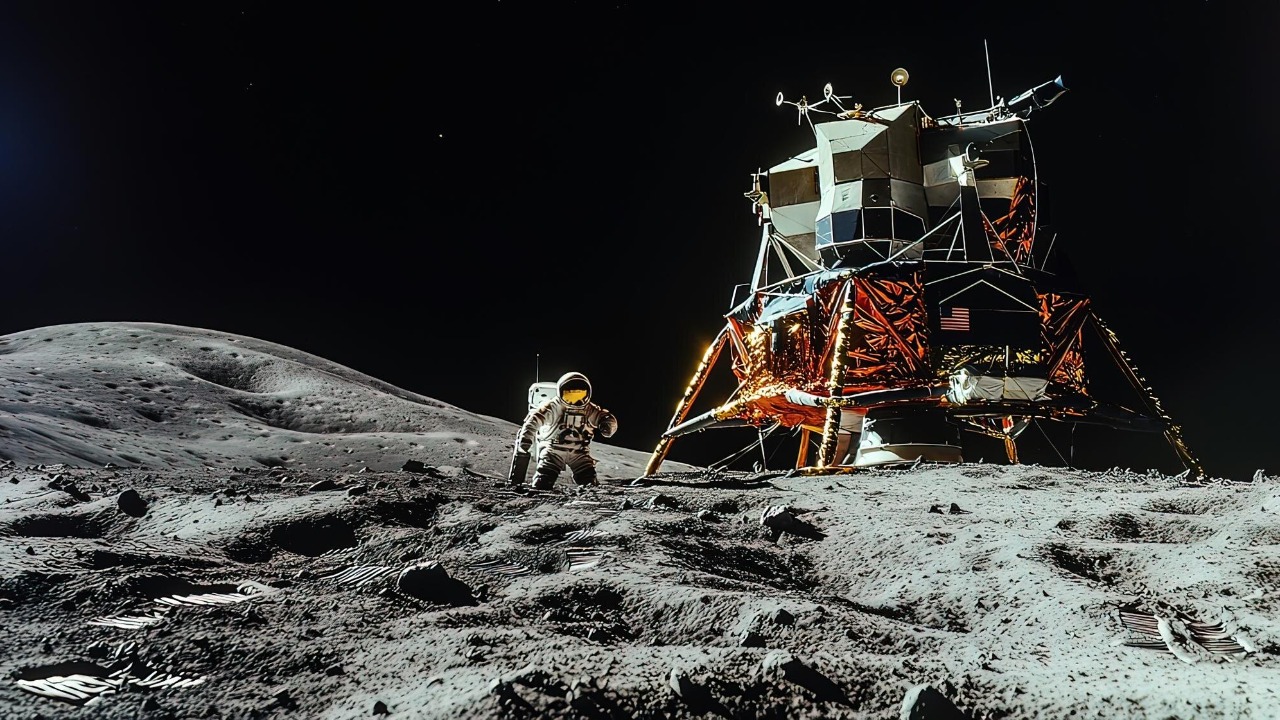

The idea that a private company could be strip‑mining the lunar surface before the end of the decade has shifted from science fiction to a concrete business plan. One startup now talks openly about running industrial hardware on the Moon by 2029, betting that the first mover in off‑world resources will shape a market measured in billions of dollars. I see that ambition colliding with a fast‑forming field of rivals, a still‑uncertain legal regime, and a simple question that no one can dodge much longer: who really owns the Moon’s riches.
The 2029 moon‑mining bet takes shape
The most aggressive timeline in this emerging sector comes from Interlune, a startup that wants to turn the Moon’s soil into a commercial supply of helium‑3 within the next few years. Interlune’s leadership has described a stepwise plan that starts with robotic prospecting, then scales to industrial extraction and processing, with the explicit goal of operating a lunar resource chain by the late 2020s and early 2030s. In public materials, the company frames that schedule as a way to be the first to put lunar helium‑3 into customers’ hands, positioning itself as the flagship player in a market that barely exists today.
Interlune’s technical roadmap centers on a proprietary system it calls Excavate, Sort, Extract, and Separate, described as the Interlune Core Intellectual Property that will dig into regolith, concentrate useful material, and isolate helium‑3 for shipment back to Earth. The company has said that by the early 2030s it aims to have this system running at scale, which implies that pilot‑level mining and processing would need to be underway on the Moon well before that, effectively aligning with a 2029 operational target. That kind of schedule would make Interlune one of the first private firms to move from talk to actual lunar resource production.
Helium‑3: a $20 million‑per‑kilogram prize
The reason Interlune is willing to race toward such an aggressive date is the perceived value of helium‑3, a rare isotope that is abundant in lunar soil but scarce on Earth. Company executives have pointed to estimates that helium‑3 could be worth about $20 million per kilogram, a figure tied to its potential role in next‑generation nuclear fusion and advanced quantum technologies. In one account, Interlune’s leaders describe helium‑3 as a “unique isotope” that is abundant only on the Moon, arguing that whoever controls its supply will sit at the center of a future energy and computing ecosystem.
Interlune has already signaled that it wants to move beyond speculation by lining up real buyers for this material. Reporting on the company’s plans notes that Interlune hopes to put a helium‑3 sample into customers’ hands as soon as it can safely return material from the lunar surface, treating that first delivery as proof that a commercial supply chain is possible. The company’s focus on helium‑3’s roughly $20 million per kg valuation, and on the fact that it is abundant only on the Moon, underpins its argument that lunar mining is not just a scientific exercise but a potentially transformative business.
From prospecting to processing: Interlune’s hardware play
Turning that vision into reality requires more than a catchy valuation, and Interlune has begun to spell out the machinery it thinks can do the job. The company has showcased an electric lunar harvester concept, a robotic system designed to scrape, heat, and process regolith in situ, then separate out helium‑3 and other volatiles. The idea is to minimize human presence on the surface by relying on autonomous or semi‑autonomous machines that can operate for long stretches in harsh conditions, then feed processed material into storage and transport systems for eventual return to Earth.
Interlune’s own description of its future operations talks about establishing a robotic collection and automated processing line on the Moon, then scaling that into a full industrial chain. In a detailed blog post, co‑founder Lai explains how the company plans to collect regolith, run it through its Excavate, Sort, Extract, and Separate system, and then ship helium‑3 back to terrestrial customers. Lai describes the potential output of this process as “pretty phenomenal,” arguing that once the first system is in place, additional units can be replicated and expanded. That vision of robotic collection and automated processing is laid out in Interlune’s plan to bring home lunar resources, which frames the Moon not as a one‑off destination but as a long‑term industrial site.
Rivals are already circling the Moon and nearby asteroids
Interlune is not alone in trying to turn off‑world rocks into revenue, and that competitive pressure is one reason I see the 2029 target as more than marketing. AstroForge, for example, has built its brand around asteroid mining, pitching itself as a company that will extract platinum‑group metals from near‑Earth objects. The company has already flown a demonstration mission and is preparing additional scouting flights, positioning itself as a pioneer in deep‑space resource extraction even as it eyes lunar opportunities that could complement its asteroid work.
AstroForge’s public materials describe a strategy that starts with small, relatively low‑cost missions to identify promising targets, then scales up to more capable spacecraft that can extract and refine metals in space. The company’s website lays out how it wants to use compact spacecraft, rideshare launches, and partnerships with lander providers to keep costs down while it learns how to operate in harsh environments. That approach is detailed on AstroForge’s own site, which frames asteroid and lunar mining as a way to supply gold, platinum, and nickel without the environmental damage associated with terrestrial mines.
AstroForge, Odin and the new prospecting model
The most concrete example of this new prospecting model is AstroForge’s Odin mission, a small spacecraft designed to hitch a ride to the Moon and then head out toward an asteroid. Odin is set to launch as a secondary payload, riding on a lunar lander developed by Intuitive Machines, which itself will be delivered to space by a commercial rocket. By stacking its mission on top of existing lunar infrastructure, AstroForge is trying to prove that early‑stage space mining can piggyback on other companies’ hardware rather than shouldering the full cost of a dedicated launch.
AstroForge’s leadership has been explicit that the goal of Odin is to gather data on asteroid composition and refine the company’s ability to operate in deep space, not to return large quantities of metal on the first try. The mission is framed as a scouting run that will inform later, more ambitious attempts to extract and process material in situ. In coverage of the launch, AstroForge’s team describes how Odin will fly with the lunar lander from Intuitive Machines, using the shared ride to keep costs manageable. That strategy is captured in reports that describe how, With the February launch, Odin will ride as a secondary payload on the Intuitive Machines lander, illustrating how lunar and asteroid mining startups are learning to share infrastructure.
NASA’s cautious path and the role of Starship
While startups race ahead with aggressive timelines, NASA has been more measured, but it still sees lunar resources as central to the future of spaceflight. Agency officials have said they expect some form of lunar mining trial within the next decade, focused initially on extracting oxygen and other basic resources from regolith. The logic is straightforward: if missions can “live off the land” by turning lunar soil into air, water, and fuel, the cost of deep‑space exploration drops dramatically, and a circular economy in space becomes possible.
One NASA official, Sanders, has emphasized that developing access to resources on the Moon will be key to cutting costs and enabling that circular economy. Sanders has talked about how technologies that can extract oxygen from lunar regolith would allow future missions to refuel and resupply without hauling everything from Earth. That perspective is laid out in comments that describe how Developing access to resources on the Moon, and learning to extract that oxygen, will be essential to long‑term exploration.
On the transportation side, heavy‑lift vehicles are poised to reshape what is possible on the lunar surface, and Starship looms especially large in that picture. Analysts have argued that, assuming it overcomes its teething problems, Starship could be the game changer that makes large‑scale lunar infrastructure economically viable. The vehicle’s promised capacity to deliver tens of tons of cargo to the Moon in a single flight would radically lower the cost per kilogram of mining hardware, from excavators to processing plants. That potential is highlighted in assessments that note how, Assuming Starship can get past its early issues, it could enable the kind of heavy, power‑hungry equipment that lunar mining will require.
Interlune’s 2027 scouting mission and the road to 2029
Interlune’s path to a 2029 mining operation runs through a smaller, but crucial, step: a prospecting mission planned for 2027. Company co‑founder Meyerson has described how this first flight will carry a payload of less than 100 kilograms, focused on scouting for helium‑3 resources rather than extracting them at scale. The mission is designed to test key technologies, gather data on regolith composition, and validate the company’s assumptions about where helium‑3 is most concentrated on the lunar surface.
Meyerson has framed the 2027 mission as the bridge between concept and commercial operation, arguing that the data it returns will shape where and how Interlune deploys its larger mining hardware. The company’s plan is to use that scouting run to refine its models, then follow up with more capable landers and processing units that can begin actual extraction. That sequence is laid out in reporting that describes how, according to Jun coverage of Meyerson’s comments, the road ahead starts with a 2027 prospecting mission carrying less than 100 kilograms of payload to explore for helium‑3 resources.
Asteroid miners, Japanese robotics and a broader space‑resources rush
The lunar race is unfolding alongside a broader scramble for space metals, and the two trends are feeding each other. Several companies focused on asteroid mining have already begun to build the tools and partnerships that could later be adapted for lunar work. One such firm has partnered with the Tohoku University Space Robotics Laboratory, based in Japan, to develop advanced space robotics capable of operating on small bodies with weak gravity. Those same robotic systems could one day crawl across the Moon, digging into regolith and feeding material into processing plants.
Despite the flurry of activity, no company has yet mined an asteroid or returned commercial quantities of metal from space, which underscores how early this industry still is. Investors and engineers are betting that the combination of better robotics, cheaper launches, and more capable spacecraft will finally make off‑world mining viable. The partnership with the Tohoku University Space Robotics Laboratory in Japan is one example of how asteroid miners are trying to solve the technical challenges in advance, even as they acknowledge that no one has yet mined an asteroid.
Helium‑3 contracts and the first real money on the table
For all the talk of trillion‑dollar markets, the most telling sign that lunar mining is edging toward reality is the appearance of actual contracts. Interlune has reportedly signed a $300 million deal for lunar helium‑3, described as essential for quantum technologies and next‑generation computing. That agreement suggests that at least some customers are willing to commit serious money to a resource that has not yet been delivered, betting that Interlune can solve the technical and logistical challenges in time.
The same reporting notes that, currently, private firms like Interlune and Bluefors are leading the global push to secure helium‑3 supplies, deploying robotic harvesters and planning logistics chains that stretch from the lunar surface to Earth‑based labs. The $300 million figure is modest compared with the long‑term projections for space resources, but it marks a shift from speculative talk to binding commitments. In that sense, the contract described in Currently available information is an early down payment on the idea that lunar helium‑3 will become a critical industrial input.
Global competition and the “next gold rush” narrative
As more startups announce plans to mine the Moon and nearby asteroids, the language around space resources has started to sound like a 21st‑century gold rush. Analysts have highlighted at least three top startups leading an asteroid mining push, each with its own demonstration missions and target materials. One company’s plan, for instance, is to fly a demonstration mission that analyzes soil on the Moon as early as 2026, using that data to guide future efforts to extract gold, platinum, and nickel. That kind of dual focus on lunar and asteroid targets reflects a belief that the first companies to master off‑world mining will enjoy a durable advantage.
Investors have embraced this framing, treating space resources as a high‑risk, high‑reward frontier similar to early oil exploration. The “next gold rush” narrative is not just metaphorical; it is grounded in specific plans to pull precious metals and industrial inputs from beyond Earth. One analysis of the sector describes how The company plan is for a demonstration mission analyzing soil on the Moon as early as 2026, with a strategy built around future extraction of gold, platinum, and nickel. That kind of concrete timeline reinforces the sense that the race is already underway, even if large‑scale mining remains years away.
Legal gray zones and the scramble for rules
All of this activity is unfolding in a legal environment that has not kept pace, and that is one of the biggest wild cards for any startup promising to mine the Moon by 2029. Existing space treaties prohibit national appropriation of celestial bodies, but they are less clear about private companies extracting and selling resources. As more firms announce plans to drill, scrape, and process lunar regolith, pressure is building for clearer international rules that spell out who can do what, where, and under which conditions. Without that clarity, early movers risk investing billions in hardware that could be tripped up by diplomatic disputes.
Experts have warned that the absence of detailed rules could lead to conflicts over prime mining sites, especially in resource‑rich regions near the lunar poles. They argue that a framework is needed to manage everything from environmental impacts to safety zones around active operations. One analysis notes that Interlune itself is part of a broader race that urgently needs clear international rules, highlighting how even the most ambitious startups are operating in a gray zone. Until those rules are written, every new mission will be a test case as much as a technical experiment.
Billions at stake and the need for a “clear timeline”
Despite the uncertainties, the financial stakes are already enormous. Analysts estimate that there are billions of dollars in potential revenue for companies able to kickstart mining operations on the Moon, even if the earliest returns are modest compared with the long‑term vision. The first firms to drill into the lunar surface and return usable resources will not just earn money; they will also shape the standards, supply chains, and expectations that follow. That prospect is driving a wave of investment into everything from prospecting missions to processing technologies.
One assessment of the sector puts it bluntly, noting that There are billions of dollars in it for companies able to drill on the lunar surface. At the same time, experience from large infrastructure projects on Earth suggests that success will depend on setting and meeting realistic milestones. A separate example, far from the Moon, illustrates this point: a Colombian solar program has been praised for its Clear Timeline, with installations scheduled to roll out between 2026 and 2030, providing a clear roadmap for a large‑scale deployment. That praise for a Clear Timeline underscores why lunar miners, too, are under pressure to move beyond vague aspirations and commit to specific dates like 2027 and 2029.
A crowded decade ahead on the lunar frontier
Looking across these plans, I see the late 2020s shaping up as a crowded and contentious decade on the lunar frontier. Interlune wants to be the first company to turn helium‑3 into a commercial product, backed by proprietary hardware and a 2027 scouting mission that sets up a 2029 mining push. AstroForge is using missions like Odin, riding on Intuitive Machines landers, to refine techniques that could apply to both asteroids and the Moon. NASA, for its part, is laying the groundwork for resource extraction focused on oxygen and basic consumables, while heavy‑lift vehicles like Starship promise to make all of this hardware cheaper to deliver.
At the same time, international competition is intensifying, with reports describing how Space Startups Race to Mine Moon and Asteroids for Billion Dollar Resources, often illustrated with Virtual images of Interlune’s lunar harvester and references to helium‑3 as a next‑generation nuclear fusion material. That mix of real contracts, detailed mission plans, and still‑unsettled rules suggests that the first company to mine the Moon by 2029 will not just win a commercial prize. It will also help decide how humanity treats the Moon: as a shared scientific preserve, an industrial quarry, or something in between.
More from MorningOverview