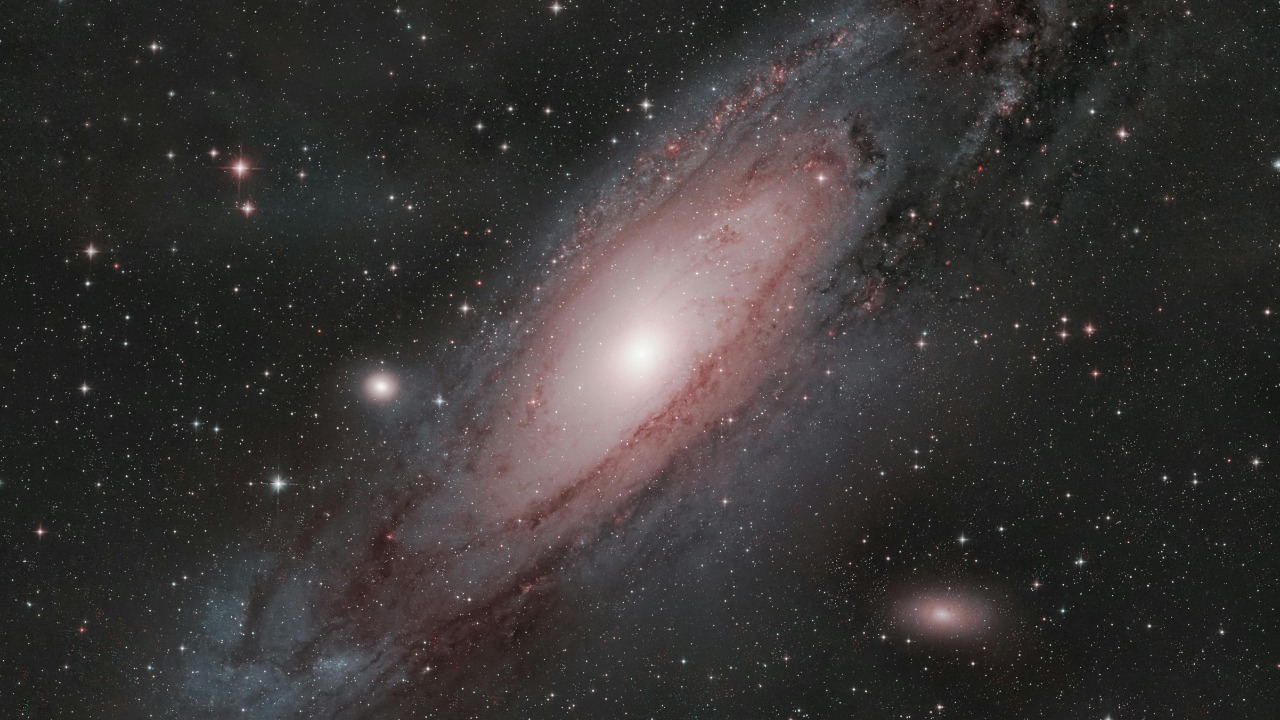

A strange, starless cloud on the edge of a nearby galaxy is forcing astronomers to confront one of the biggest unknowns in physics. The object, nicknamed Cloud‑9, looks like a wisp of hydrogen gas, yet it behaves as if it is anchored by a massive, invisible skeleton. That hidden structure may be packed with dark matter, turning this faint smudge into a rare laboratory for the universe’s missing mass.
Cloud‑9 is not alone. Across the cosmos, astronomers are now picking out similarly elusive structures by the way they bend light or tug on surrounding gas, from warped “Einstein rings” to isolated dark clumps. Put together, these discoveries hint that we are finally starting to see the outlines of dark matter itself, not just its indirect fingerprints in galaxy rotation curves and cosmic maps.
Cloud‑9: a starless cloud that should not exist
Cloud‑9 first stood out because it breaks the usual rules of galaxy building. It is a compact pocket of cold hydrogen gas with no stars at all, yet it appears to be gravitationally bound and long‑lived. A team using the Hubble Space Telescope examined this object and found that its gas is stable enough that something heavy must be holding it together, even though that “something” does not shine in visible or infrared light. In other words, Cloud‑9 looks like a galaxy that never quite managed to ignite.
In technical terms, Cloud‑9 has been classified as a “RELHIC,” a starless, gas‑rich, dark‑matter dominated halo that sits in the outskirts of a larger system. NASA describes it as a new type of astronomical object that could help test how dark matter clumps on small scales and how gas behaves inside those clumps. Because the team using NASA’s Hubble Space Telescope can map the gas distribution in detail, they can infer how much unseen mass is required to keep Cloud‑9 intact, turning this faint cloud into a weighing scale for dark matter itself.
A failed galaxy with dark matter “bones”
When I look at Cloud‑9, I see something like a fossil of galaxy formation. It appears to be a halo of dark matter that gathered gas but never formed stars, leaving behind only the “bones” of a galaxy that failed to light up. Reporting on this object describes it as a starless, gas‑rich system whose gravity is dominated by invisible matter, a configuration that fits naturally with the idea of a dark halo that never crossed the threshold for star birth. In that sense, Cloud‑9 may show astronomers what a small galaxy looks like before the first stars ever switch on.
That is why some researchers have framed Cloud‑9 as the dark‑matter skeleton of a failed galaxy, a phrase that captures both its fragility and its importance. Analyses of the object emphasize that it is invisible in most wavelengths except for the faint radio and ultraviolet signatures of hydrogen, yet its gas is confined in a way that demands a massive, unseen component. One report describes this as Mysterious Cloud May Be The Dark Matter Bones of Failed Galaxy, underscoring how closely the observations match theoretical predictions for dark halos that never quite make the leap into full‑fledged galaxies.
Why RELHICs matter for dark matter theory
Cloud‑9 is not just a curiosity, it is a test case for how dark matter behaves on the smallest galactic scales. Cosmological simulations predict that the universe should be filled with low‑mass dark halos, many of which never form stars. These “reionization‑limited H I clouds,” or RELHICs, are expected to be rare but extremely informative, because their gas traces the underlying dark matter potential without the complicating effects of stellar feedback. By measuring Cloud‑9’s gas mass, size and internal motions, astronomers can check whether its dark halo matches the predictions of standard cold dark matter models.
That is why the Hubble team has stressed that Cloud‑9 could help probe the nature of dark matter itself. If its inferred halo mass, density profile or concentration differ from what simulations expect, it might point to new physics, such as warm or self‑interacting dark matter that smooths out small structures. Early analyses suggest that Cloud‑9’s properties are broadly consistent with a compact dark halo, but the details matter, and future observations will refine those constraints. The fact that RELHICs aren’t to be confused with hydrogen clouds around the Milky Way is crucial here, because it means Cloud‑9 is not just a local gas blob but a distinct class of object tied to dark matter structure.
Gravitational lenses reveal other dark objects
Cloud‑9 is nearby enough to be studied through its gas, but in the distant universe astronomers have to rely on a different trick to find dark structures. Gravity itself can act as a telescope, bending and magnifying light from background galaxies when it passes near a massive object. These “gravitational lenses” often produce arcs and rings of distorted light, and subtle irregularities in those patterns can betray the presence of otherwise invisible clumps. A team using telescopes worldwide has exploited this effect to identify a low‑mass dark object that does not emit light but still warps the image of a more distant galaxy.
In one case, researchers analyzed a black ring and central dot that show an infrared image of a distant galaxy distorted by a gravitational lens, then used the distortions to infer the mass and location of a hidden structure along the line of sight. They argue that, given the sensitivity of their data, the lensing signal is best explained by a compact dark object that could be a small dark‑matter halo or a similar mass concentration. The discovery, described as astronomers find mystery dark object in distant universe, shows that even far from any visible galaxy, dark matter can reveal itself through the way it bends spacetime.
A record‑breaking dark object inside an Einstein ring
Another lensing discovery pushes this technique to an extreme. Astronomers have reported a record‑breaking dark object hiding within a warped Einstein ring roughly 10 billion light‑years away, identified by the way it distorts the otherwise smooth ring of light from a background galaxy. By modeling the ring’s shape, they concluded that a compact mass, far smaller than a typical galaxy but far heavier than a star, must be embedded in the lens. This object does not appear in any direct imaging, which strongly suggests that it is dominated by dark matter.
The team behind this work describes the find as a suspected dark‑matter clump that could shed light on the universe’s missing matter budget. Because the Einstein ring is so distant, the dark object must have formed when the universe was relatively young, offering a glimpse of how early dark halos assembled. The discovery has been framed as a Record breaking dark object found hiding within warped Einstein ring, and it complements Cloud‑9 by probing a similar kind of structure at a much earlier cosmic time.
Imaging a mysterious dark object in the distant Universe
While lensing usually reveals dark matter indirectly, some teams have gone further and effectively “imaged” a dark object by reconstructing its mass distribution from multiple distorted views. An international collaboration has used radio and optical data to map a low‑mass dark object in the distant cosmos, again without seeing any light from the object itself. They relied on the fact that gravitational lenses produce multiple images of the same background source, each slightly altered by the mass along its path, and then inverted those distortions to recover the hidden structure. In their summary, the researchers emphasize that distortions caused by gravitational lenses can be used to study the properties of dark matter clumps that would otherwise be completely invisible. The work is described as astronomers image a mysterious dark object, highlighting how far the technique has come from simply spotting arcs to reconstructing detailed mass maps. A related report notes that an international team of astronomers has found a low mass dark object in the distant Universe, not by directly observing it but by its gravitational imprint, and that such objects can inform models of how galaxies like our own Milky Way formed. That second account, which describes how an international team of astronomers has found a low mass dark object in the distant Universe, underlines the broader stakes: these dark clumps are not isolated oddities, they are the building blocks of familiar galaxies.
A faraway object that might be pure dark matter
Not every mysterious object fits neatly into the category of a dark halo with gas. Some may be almost entirely dark matter, with little or no ordinary material attached. A recent study describes a faraway cosmic object that could be either a dark‑matter dominated structure or a very faint dwarf galaxy, identified through its subtle influence on radio signals. Researchers turned to high‑resolution arrays to pick out a compact mass that does not match any known luminous source, then modeled its properties to see whether it could be explained by a small galaxy or by a more exotic dark configuration.
The team behind this work has suggested that the object’s existence could force astronomers to rethink what they know about dark matter, particularly how it clusters on small scales and how it interacts with baryonic gas. They argue that, depending on its true nature, it might represent a new class of dark structure or an extreme example of a dwarf galaxy stripped of most of its stars. The discovery has been described as a mysterious faraway cosmic object that could be dark matter or dwarf galaxy, and it adds another piece to the puzzle that Cloud‑9 has sharpened: dark matter may assemble into a spectrum of structures, from starless clouds to barely visible dwarfs.
Hubble’s dark matter “phantom” and the invisible web
Closer to home, the Hubble Space Telescope has also uncovered what some astronomers call a dark matter “phantom,” a clump of mass that appears only through its gravitational effects. A team working with Hubble has reported a unique discovery in which they inferred a dark matter clump by the way it distorted the light of background galaxies, even though no corresponding luminous structure could be seen. This result strengthens the case that dark matter forms a complex web of filaments and knots, some of which never host enough gas or stars to be visible in traditional surveys.
The report describes how a team of astronomers working with the Hubble Space Telescope has made a unique discovery, using gravitational lensing to effectively see the invisible. By comparing the observed shapes of background galaxies with theoretical expectations, they reconstructed the mass distribution along the line of sight and found a clump that could not be accounted for by any known galaxy or cluster. This phantom resembles the dark objects seen in more distant Einstein rings, but because it is closer, it offers a sharper test of dark matter models and a bridge between local structures like Cloud‑9 and the deep‑field lenses.
How Cloud‑9 compares with other cosmic oddities
Cloud‑9 sits in a growing menagerie of strange, dark‑leaning objects that challenge simple categories. On one side are the lensing‑based discoveries, where dark matter is inferred from warped light rather than from gas or stars. On the other are extreme events powered by black holes that, while not dark matter themselves, illuminate how gravity behaves in the most intense environments. For example, astronomers have recently reported a colossal black hole about 10 billion light‑years away that has been caught devouring one of the universe’s biggest stars, producing a flare roughly 30 times brighter than any seen before. That event, described in a Space & Time News summary, shows how much energy can be released when gravity acts on ordinary matter, a useful contrast to the quiet pull of dark halos like Cloud‑9.
These comparisons matter because they help separate what is truly exotic about Cloud‑9 from what is simply extreme. A tidal disruption flare around a black hole is violent but well described by general relativity and known physics of gas and radiation. A starless, gas‑rich halo that appears to be held together almost entirely by dark matter, by contrast, probes the regime where our ignorance is greatest. As one overview of invisible structures notes, if astronomers count up all the visible matter in a galaxy, the stars, gas and dust, there is not enough gravitational pull to keep the system from flying apart as it rapidly rotates, so there must be some other component providing the missing mass. That logic, summarized in a discussion of a strange dark invisible object in space, is exactly what makes Cloud‑9 so compelling: it is a clean, almost laboratory‑grade example of gravity without light.
What comes next for Cloud‑9 and dark matter
For Cloud‑9, the next steps are clear. Astronomers will want deeper radio observations to map its hydrogen in three dimensions, more precise measurements of its internal motions to pin down its total mass, and searches for any ultra‑faint stars that might lurk within it. If it remains truly starless, that will strengthen the case that it is a pristine dark halo, perhaps one of many RELHICs waiting to be found in the outskirts of galaxies. If a sprinkling of stars appears, it might instead represent the dimmest end of the dwarf galaxy population, still valuable but slightly less exotic.More broadly, I expect Cloud‑9 to become a benchmark for simulations of galaxy formation and dark matter clustering. Theoretical models will be tuned to reproduce its size, gas content and inferred halo mass, while lensing studies of distant Einstein rings and dark objects in the distant Universe continue to map the dark web on larger scales. Popular accounts have already framed the discovery in vivid terms, with headlines inviting readers to Meet Cloud New Type of Object That Shows What Failed Galaxy Looks Like Astronomers, and that attention is likely to draw more observing time and theoretical effort. If Cloud‑9 really is loaded with dark matter, then every new measurement of this ghostly cloud will double as a measurement of one of nature’s deepest mysteries.
More from Morning Overview