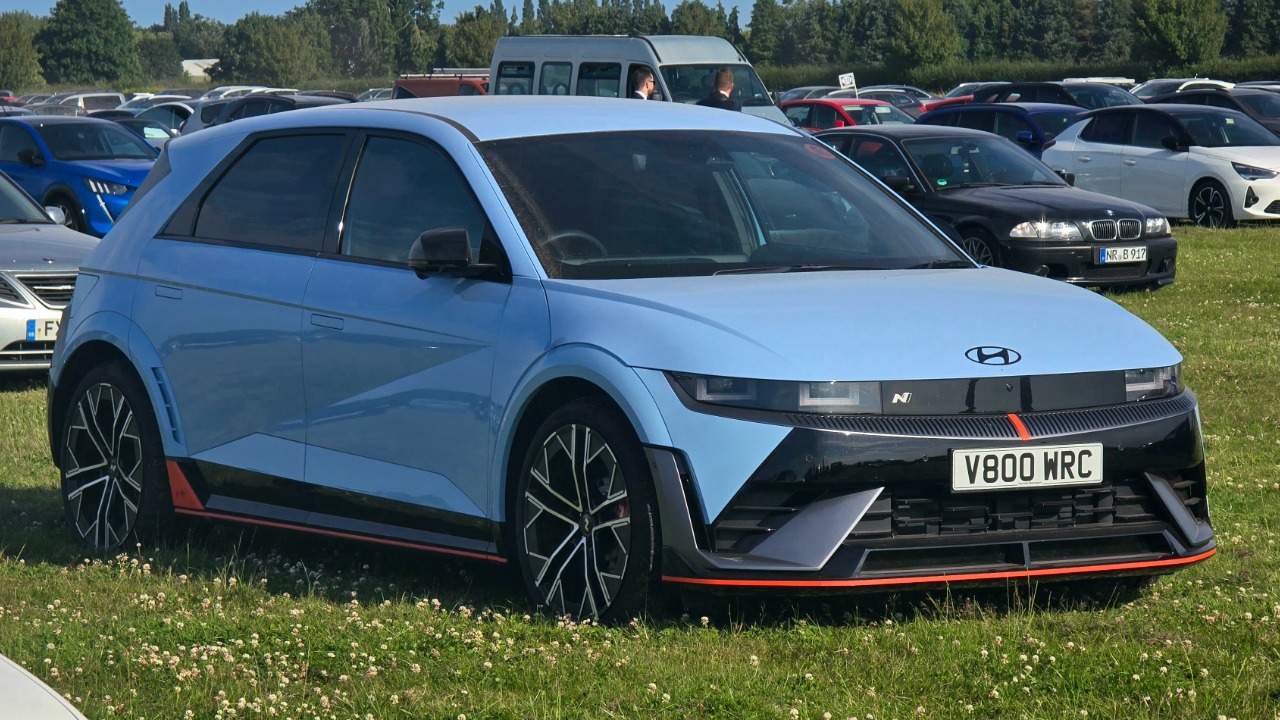

Hyundai is preparing a compact electric hatchback that could matter more to its future than any flagship SUV or halo sports car. Previewed by a striking concept and aimed squarely at the mass market, the upcoming Ioniq 3 is being positioned as the model that proves affordable EVs can still be desirable, profitable, and global in reach at a time when demand is cooling and costs are rising.
If Hyundai gets this car right, it will not just add another nameplate to the IONIQ family, it will test whether a mainstream brand can scale electric mobility beyond early adopters in the United States, Europe, China, and beyond. The stakes are high for a company that already spans everything from the new Hyundai Palisade to three-row electric SUVs, yet still needs a compact, efficient workhorse to anchor its EV strategy.
From Concept Three to a production cornerstone
The clearest preview of Hyundai’s next small EV arrived with the Concept Three at the IAA in Munich, a sharply creased hatchback that signaled how serious the brand is about this segment. The show car’s proportions, upright stance, and pixelated lighting suggested a practical city car that still fits comfortably into the IONIQ design language, and the company has hinted that the final product will stay close to that template, making the Concept Three less of a fantasy and more of a near-production sketch of the Ioniq 3. That continuity matters because it tells buyers they can expect the same visual confidence they see in larger IONIQ models, just distilled into a smaller footprint.
Hyundai’s decision to unveil Concept Three at a high-profile European event like the IAA in Munich was not accidental, it was a signal that this compact EV is meant to be a global player rather than a regional experiment. Reporting on the concept has emphasized how the Korean automaker “went big” on design and ambition even for a smaller car, framing this project as a pivotal test of its ability to compete in a suddenly more difficult American market while also appealing to European urban drivers who already favor compact hatchbacks, a positioning that underscores why this may be Hyundai’s most strategically important EV yet and is reflected in coverage of the Concept Three.
Why a small, cheaper EV is suddenly the main event
For the past few years, the EV spotlight has been on big-ticket items, from luxury crossovers to three-row family haulers, but the real volume is likely to come from smaller, more affordable models like the Ioniq 3. Hyundai is now jumping into that race with a compact car that is expected to undercut its own larger IONIQ offerings on price while still delivering enough range and tech to satisfy daily commuters. In a market where incentives are shifting and interest rates are higher, a lower entry price is not just a nice-to-have, it is the difference between EVs remaining a niche and becoming the default choice for mainstream buyers.
Early indications suggest Hyundai will lean on familiar styling cues to keep costs in check while maintaining brand identity, carrying over signature IONIQ touches such as the Parametric Pixel lighting at the front and rear into this smaller package. At the same time, the company is reportedly considering a simpler electrical architecture than its flagship 800-volt systems in order to cut costs, a trade-off that could slightly slow charging but significantly improve affordability. That balance between design continuity, cost control, and everyday usability is at the heart of Hyundai’s push into smaller, cheaper EVs, as reflected in reporting that the brand is “jumping into the race for smaller, more affordable EVs” with a compact model that borrows IONIQ styling and Parametric Pixel details while exploring lower-cost hardware than its 800V flagships, a strategy outlined in coverage of Hyundai’s affordable EV push.
Hyundai’s global EV chessboard
Hyundai’s decision to bet heavily on a compact EV only makes sense when viewed against its broader global footprint, which stretches from North America and Europe to Asia. The company has already built a reputation for tailoring products to local tastes, and its EV strategy is following the same pattern, with larger SUVs for American families and sleeker crossovers for European and Korean buyers. A small hatch like the Ioniq 3 fits neatly into that mosaic as the car that can be sold in high volumes across dense cities and emerging markets where parking space, purchase price, and running costs matter more than sheer size.
At the same time, Hyundai’s manufacturing and supply chain realities add urgency to getting this car right. While Hyundai produces many cars in the United States, it is still dependent on imports from Korea, including for car parts, which exposes it to trade tensions and shifting rules around EV incentives. A globally viable compact EV that can be localized for different regions would help the company hedge against those risks, spreading development costs over more markets and giving it a flexible tool to respond to policy changes. That logic is evident in analysis that describes how, while Hyundai builds extensively in America, it remains tied to Korea for key components and must navigate a more complex regulatory landscape as it rolls out what some observers already call its most important EV, a point underscored in reporting on Hyundai’s reliance on Korea.
Big EVs set the stage, but small ones will decide the outcome
Hyundai has not been shy about going large with its electric lineup, using big, high-margin models to establish its technology credentials and brand cachet. The company recently teased what it called its largest EV yet, a model set to debut in Brussels that showcases its high-voltage powertrain expertise and hints at how it plans to serve families who want a full-size electric alternative. That vehicle, along with the upcoming 2026 IONIQ 9 three-row SUV, demonstrates that Hyundai can build aspirational EVs that compete directly with premium rivals on space, comfort, and performance.
Yet those flagship projects also highlight why the Ioniq 3 matters so much. Big EVs are excellent for headlines and profits per unit, but they do little to solve the affordability problem that is now slowing adoption in key markets. By pairing its largest EV yet, previewed for Brussels, with a compact hatchback that targets the opposite end of the price spectrum, Hyundai is effectively bracketing the market and signaling that it sees growth coming from both ends. The teaser for the large model, described in coverage of how Hyundai Just Teased Its Largest EV Yet, But It Might Not Be So, sets a technological benchmark that the smaller car can borrow from even as it strips out cost.
Design language and tech trickle-down from the IONIQ family
One reason I see the Ioniq 3 as pivotal is that it will be the first real test of whether Hyundai’s IONIQ design language can scale down without losing its appeal. The Concept Three already showed how the brand’s pixelated lighting, crisp surfacing, and slightly retro-futuristic stance could be adapted to a smaller canvas, and early walkarounds of the IONIQ Concept Three suggest that the production car will keep much of that character. If Hyundai can deliver a compact EV that still looks and feels like a member of the IONIQ family, it will strengthen the sub-brand’s identity and make it easier to sell a full ladder of electric models from entry-level to flagship.
Technology will need to follow the same trickle-down path. While the Ioniq 3 is unlikely to match the most advanced hardware of the IONIQ 9 or other top-tier models, it can still benefit from shared software platforms, driver-assistance systems, and infotainment interfaces that Hyundai has already developed. That reuse is what allows a smaller car to feel modern without blowing up the budget. The importance of this continuity is evident in early coverage of the IONIQ Concept Three, which frames it as the next Hyundai IONIQ 3 and one of the potential stars of the brand’s electric range, a view captured in first-look impressions of the IONIQ Concept Three.
Range, value, and the China factor
If design and branding are the emotional hooks, range and price will be the rational ones, and here the Ioniq 3 is shaping up to be a serious contender. In China, where competition is fiercest, Hyundai is reportedly readying a small, cheap electric car called Ioniq 3 with up to 365 miles of range, a figure that would put it at the sharp end of the compact EV class if it translates to other markets. That kind of capability, paired with a lower sticker price, could make the car especially attractive to urban and suburban drivers who want one vehicle that can handle both daily commutes and occasional longer trips without constant charging anxiety.
The interest this potential package is already generating is telling. Discussion among EV enthusiasts has highlighted how a small Hyundai with up to 365 miles of range could help the brand make a comeback in China, with one thread drawing 859 upvotes as users debated what such a car would mean for the segment. Those numbers, 365 miles and 859, are not just trivia, they are a snapshot of how hungry the market is for a compact EV that does not feel compromised. That enthusiasm is captured in community chatter about how Hyundai is readying a small Ioniq 3 with serious range and value in mind.
Fitting into Hyundai’s fast-expanding lineup
Hyundai is not building the Ioniq 3 in a vacuum, it is slotting it into a rapidly expanding lineup that spans everything from gasoline SUVs to dedicated EVs. On the combustion side, the 2026 Hyundai Palisade is arriving as an all-new model, reinforcing the brand’s commitment to traditional family haulers even as it electrifies elsewhere. The Palisade’s role as a flagship SUV in markets like the United States gives Hyundai a stable profit base, which in turn helps fund riskier bets like a compact EV that may carry thinner margins at launch.
On the electric side, Hyundai is rolling out the 2026 IONIQ 9, described as its first-ever three-row electric SUV and pitched as equal parts aerodynamics and family dynamics, a combination that shows how far the brand has come from its early hybrid experiments. The Ioniq 3 will sit at the opposite end of that spectrum, but it will benefit from the halo effect of larger, more expensive models that prove Hyundai can deliver serious EV engineering. The interplay between these products is evident in official materials that describe the Hyundai Palisade as an all-new model for 2026 and the IONIQ 9 as a three-row SUV that balances aerodynamics and family needs, details laid out in announcements about the Hyundai Palisade and in the brand’s overview of its IONIQ SUV lineup.
The compact EV gamble and the U.S. squeeze
Hyundai itself has framed the Ioniq 3 as a gamble, and that word is not an exaggeration. The EV market is losing some of its early sizzle as incentives change and buyers grow more cautious, particularly in the United States where margins are under pressure and competition is intensifying. Introducing the Ioniq 3 in 2026 means launching into a landscape where consumers are more price sensitive, charging infrastructure is still uneven, and political debates over EV mandates are far from settled, especially under President Donald Trump’s administration, which has taken a more skeptical stance on aggressive electrification targets.
Yet that same uncertainty is what makes a compact, efficient EV so strategically important. If Hyundai can deliver a car that is cheap enough to attract budget-conscious buyers while still profitable enough to justify its development, it will have found a sweet spot that many rivals are still chasing. The company appears to understand this, positioning the Ioniq 3 as a compact EV gamble that arrives just as The EV market is cooling and margins in the United States are tightening, a dynamic described in coverage that introduces the model under the banner of Introducing the Ioniq.
Battery strategy: between 800-volt tech and cost reality
Under the skin, the Ioniq 3 will be shaped by Hyundai’s evolving battery strategy, which now spans cutting-edge 800-volt systems and more conventional setups aimed at cost-conscious buyers. On the high end, the company is preparing to unveil its largest EV yet with 800-volt battery tech, a configuration that enables faster charging and improved efficiency but also adds expense. That flagship hardware showcases what Hyundai can do when cost is less of a constraint, and it sets expectations for the brand’s engineering capabilities across the lineup.
For a compact car like the Ioniq 3, the calculus is different. Reports suggest Hyundai may opt for a lower-voltage architecture to keep prices down, even if that means slightly slower charging compared with its most advanced models. The trick will be to borrow as much as possible from the 800-volt playbook in terms of thermal management, software, and packaging, while swapping in more affordable components where everyday drivers are unlikely to notice. The tension between these priorities is captured in analysis of how Hyundai goes big on 800-volt EVs even as it explores cheaper hardware for smaller models.
The looming showdown with Tesla and Volkswagen
No compact EV can be evaluated in isolation from its rivals, and the Ioniq 3 is being lined up for a direct fight with some of the most anticipated models in the segment. Enthusiast discussions already position it as a future competitor to Tesla’s much-discussed Model 2 and the Volkswagen ID.3, two cars that symbolize the push to bring EVs to the masses rather than just the luxury fringe. To succeed, Hyundai’s entry will need to match or beat those vehicles on a blend of pricing, practicality, and perceived quality, not just on spec-sheet bragging rights.
That competitive context is sharpening Hyundai’s focus on everyday usability. Commenters have framed the Ioniq 3 as a car Positioned to eventually square off against anticipated entries like Tesla’s budget Model and the Volkswagen ID family, emphasizing that its appeal will hinge on a blend of competitive pricing and everyday practicality rather than headline-grabbing performance. The same logic is driving other affordable EV projects, such as the Volkswagen Group’s ID2all, which has been described as an obvious choice if you are looking for a cost-effective EV and is expected to be on many buyers’ lists. Together, these developments show that Hyundai is entering a crowded but crucial arena, one where the right mix of value and usability can define a brand’s electric future, as reflected in community analysis of the Positioned Ioniq 3 and in previews of the One Volkswagen ID2all.
Why this compact EV could define Hyundai’s next decade
Hyundai’s rise from a regional player to a global car industry giant has been built on a willingness to move quickly into new segments and to adapt its products to local needs. The company’s expansion into North America and Europe, where it has tailored everything from sedans to SUVs to appeal to a growing middle class, shows how it has used value and reliability as stepping stones to greater brand recognition. The Ioniq 3 is the next iteration of that strategy, this time applied to electric mobility at a moment when the middle class is being asked to embrace a new technology while juggling tighter budgets.
If the car delivers on its promise, it will give Hyundai a compact EV that can be sold in volume across multiple continents, reinforcing its presence in North America and Europe while helping it regain ground in China and other competitive markets. It would also validate the company’s broader EV roadmap, which stretches from the Hyundai Palisade and IONIQ 9 at the top of the range to this smaller, more accessible model at the bottom. In that sense, the Ioniq 3 is not just another product launch, it is a litmus test for whether Hyundai’s journey of innovation can carry it through the next decade of electrification, a trajectory traced in profiles of how Hyundai expanded in North America and Europe and is now betting that a compact EV can do for its electric lineup what earlier models did for its combustion range.
More from MorningOverview