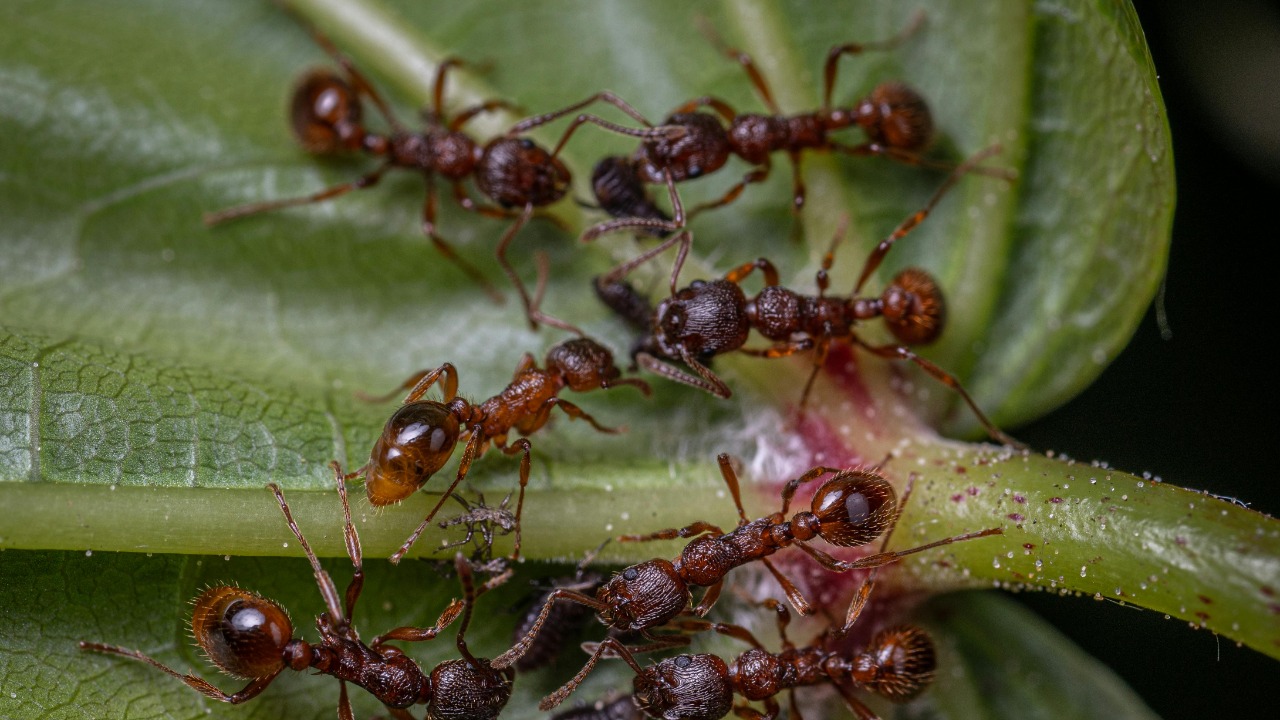

Deep inside an ant nest, some of the youngest members are primed to die for the group. When infection strikes, these baby ants do not just fall sick and fade away. They actively trigger their own destruction, turning their bodies into a biological firewall that keeps disease from racing through the colony.
The behavior looks brutal at the level of an individual larva, but at the scale that matters to ants, it is a lifesaving strategy. By sacrificing themselves, these vulnerable youngsters help preserve the genetic future of the nest, revealing how far evolution can push self-destruction in the name of collective survival.
How sick baby ants “ask” to be killed
The most striking new evidence for self-sacrifice comes from baby ants of the species Lasius neglectus, a common garden ant whose larvae can become fatally infected by pathogens. When these larvae fall ill, they do not hide their condition. Instead, they change their chemistry in a way that flags them as doomed, effectively advertising that they are no longer worth saving for the colony’s future.
Researchers have found that these sick baby Lasius neglectus ants emit distinctive chemical signals on their cuticle that mark them as terminally ill, prompting adult workers to remove or destroy them before the infection can spread. In one study, the team described how these larvae carry out a final altruistic act, with the altered scent functioning as a self-authored death warrant that protects the rest of the nest, a pattern detailed in reporting on sick baby Lasius behavior.
Altruism, from philosophy to the ant nest
Biologists use the word “altruism” for any behavior that harms an individual’s own chances of survival or reproduction while helping others, and these baby ants fit that definition with unsettling precision. By chemically announcing that they are infected, they all but guarantee their own death, yet they increase the odds that their nestmates, and the queen’s genetic line, will survive. The cost is paid by the larva, the benefit accrues to the colony.
Writers exploring how altruism shows up in the natural world have seized on this example as a particularly stark case of self-sacrifice, describing how terminally ill baby ants essentially tell other ants to kill them when they carry a disease that could wipe out the group. One analysis notes that this kind of behavior makes sense once you see the colony, not the individual, as the unit that evolution is shaping, a point made vivid in a discussion of how altruism shows up in nature.
Why evolution rewards self-destruction
From a human perspective, a baby animal that “chooses” death sounds like a contradiction, but in evolutionary terms it can be a winning strategy. Ant colonies are tight-knit families, with workers, soldiers, and larvae all descended from the same queen. When a larva sacrifices itself to prevent an outbreak, it preserves the survival of many close relatives, which means the genes that shaped that behavior still have a good chance of being passed on.
Commentators who have unpacked the baby ant findings point out that this is a textbook case of what evolutionary theorists call inclusive fitness, where genes that promote helping relatives can spread even if they reduce the survival of the individual that carries them. In that framing, terminally ill baby ants that signal for their own execution are not acting irrationally, they are following a genetic script that favors the long-term success of the colony’s lineage, a logic highlighted in a second discussion of terminally ill baby ants and other altruists.
Exploding ants and the extreme edge of defense
Self-destruction in ants is not limited to sick larvae. In Southeast Asian forests, tiny workers of certain species have evolved a far more dramatic tactic: they literally burst apart in combat. When a predator or rival ant threatens the nest, these workers clamp down on the attacker and rupture their own bodies, releasing sticky, toxic fluids that glue and poison the enemy at the cost of their own lives.
One widely discussed example involves small ants that confront much larger weaver ants. Then, if the would-be attacker does not retreat, one or more tiny defenders bite down and detonate, smearing the aggressor with a lethal secretion that can immobilize or kill it. This behavior has sparked debate among evolutionary enthusiasts about how such “exploding ants” manage to pass on their genes, with online discussions dissecting how these suicidal workers still fit within kin selection theory, as seen in a thread on how the exploding ant passes down its genes.
The Malaysian exploding ant and its specialized body
Among the best documented of these blast-ready insects is Colobopsis saundersi, also known as the Malaysian exploding ant. This species, listed with the synonym Camponotus saundersi, has workers whose bodies are packed with enlarged glands that store a viscous defensive fluid. When they engage an enemy, they can contract their muscles so forcefully that their own exoskeleton ruptures, spraying the substance over the opponent.
Descriptions of Colobopsis saundersi emphasize that this is not a freak accident but a built-in strategy, part of a suite of defenses belonging to the genus Colobopsis. The Malaysian exploding ant has become a textbook example of suicidal defense in social insects, with its very anatomy shaped around the possibility of self-destruction in battle, a profile captured in entries on Colobopsis saundersi and its unusual glands.
Other insects that die for the group
Ants are not alone in turning their bodies into weapons or shields. In the rainforests of Borneo, some insects have evolved similar explosive tactics, while in more familiar settings, bees and certain aphids also pay the ultimate price to defend their kin. These behaviors sit at the far end of a spectrum of self-sacrifice that runs through many social insects, from stinging to plugging nest entrances with their own bodies.
Analyses of insect self-sacrifice note that this is not typical animal behavior, since most creatures behave in ways that give themselves the best shot at surviving and reproducing. Yet in dense colonies of ants, termites, bees, and aphids, the calculus shifts, and individuals can become disposable parts of a larger machine. Reports on four intense ways insects sacrifice themselves describe exploding defenders in Borneo, suicidal stings in bees, and aphids that rupture to form protective barriers, illustrating how insects sacrifice themselves for the good of the colony.
Programmed death far beyond insects
The logic behind these sacrifices is not confined to animals with complex societies. At the microscopic scale, single-celled organisms also carry genetic instructions that can trigger their own demise. In bacteria, researchers have identified systems of programmed cell death, often abbreviated as PCD, that cause some cells to self-destruct under stress, which can help the rest of the population survive by limiting damage or freeing up resources.
Studies of PCD in unicellular eukaryotes and bacteria suggest that even organisms without nervous systems can follow molecular scripts that lead to their elimination when they are defective or when their death benefits the group. These pathways resemble, in concept if not in detail, the sacrificial roles seen in ant colonies, with death serving both in development and in the elimination of damaged cells, as outlined in work on PCD in unicellular eukaryotes and bacteria.
When cells sacrifice themselves inside our bodies
Self-destruction also plays out inside our own tissues. Human cells routinely undergo controlled death to sculpt organs, remove damaged cells, and maintain healthy function. In the brain, for example, certain structures form inside cells under stress or disease, and scientists have long debated whether these bodies are harmful debris or part of a protective response that helps the larger organism cope.
Early live studies of key cell structures involved in neurodegenerative conditions such as Alzheimer’s disease have underscored how little is known about whether these formations are doing good or bad things for cells. Some researchers had speculated that these bodies might represent a kind of internal triage, sacrificing parts of the cell, or even the entire cell, for the good of the entire organism, a question raised in work on Alzheimer’s and other diseases that may benefit from live imaging of these structures.
From baby ants to tardigrades: survival strategies compared
Set against these sacrificial strategies are organisms that seem built to endure at all costs. Tardigrades, the microscopic animals often called water bears, are famous for surviving extremes of temperature, radiation, and even the vacuum of space. Rather than self-destructing, they shut down into a near-dead state that lets them ride out conditions that would kill almost any other creature.
Coverage of what makes tardigrades so tough has highlighted how their proteins and DNA repair systems allow them to withstand desiccation and cosmic radiation, turning them into icons of individual resilience. In that sense, tardigrades sit at the opposite pole from baby ants that self-eliminate for the colony, yet both strategies are products of evolution’s trial and error, with one path favoring near-indestructible individuals and the other favoring fragile workers that can be sacrificed for the group, as seen in reporting on what makes tardigrades so tough and how they survive space travel.
More from Morning Overview