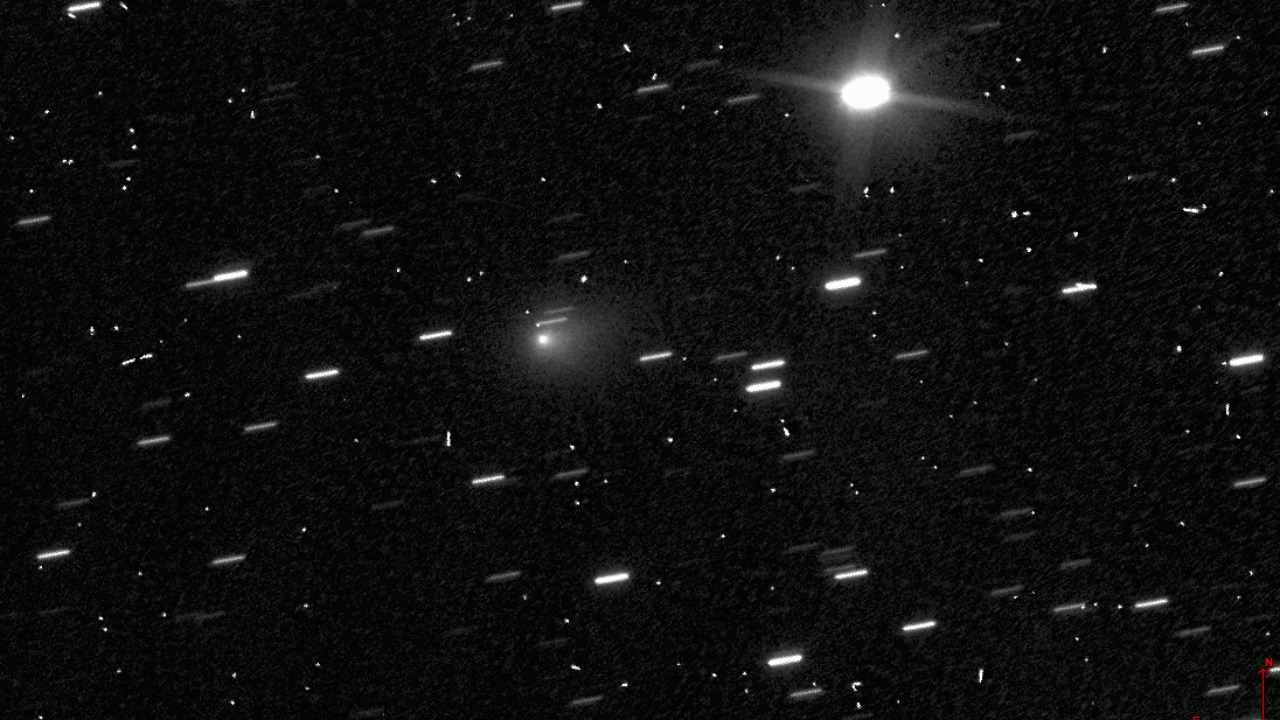

The small, icy visitor now racing away from the inner solar system is not just another comet. It is an interstellar object, cataloged as 3I/ATLAS, and its evolving behavior is giving planetary scientists a rare, live look at material forged around another star. As it recedes from the Sun, this comet is still changing in ways that are forcing researchers to rewrite early assumptions about how such wanderers form, age, and survive their long journeys through the galaxy.
For only the third time in recorded history, astronomers are watching a confirmed interstellar body pass through our neighborhood, and this one is unusually cooperative. It is bright, active, and distant enough to be safe, yet close enough for telescopes to dissect its chemistry, structure, and outbursts in real time. The result is a cascade of new measurements that are, quite literally, spilling its secrets into view.
How 3I/ATLAS crashed the solar system party
When astronomers first picked up the faint trace of 3I/ATLAS, they quickly realized its orbit did not belong to anything born alongside the planets. Its path is hyperbolic, meaning it is not bound to the Sun and will never return, a hallmark of an object that formed around another star before being flung into interstellar space. Tracking data showed it would sweep through the inner solar system only once, making this a one-shot opportunity to study a pristine fragment of another planetary system as it moves toward its closest approach to the Sun in October, then back out into the dark.
Specialists in planetary defense and small bodies flagged the object as soon as NASA Discovers Interstellar Comet Moving Through Solar System became more than a label and turned into a coordinated observing campaign. The designation 3I/ATLAS reflects both its status as the third recognized interstellar object and the survey system that first spotted it, with the ATLAS network feeding continuous positional updates into public trackers. Amateur and professional observers alike now follow its changing brightness and motion through tools such as the live charts hosted at atlas.fallingstar.com, which plot its trajectory as it threads between the orbits of the planets.
A safe but tantalizingly close flyby
For all the drama of an interstellar visitor, 3I/ATLAS is not a threat to Earth. Its orbit keeps it far from our planet, even at its nearest point. Imaging campaigns have emphasized that the closest it will ever come is about 170 million miles away, a comfortable buffer that lets scientists focus on the science rather than on impact scenarios. That distance is roughly comparable to the gap between Earth and the Sun, so the comet is a spectacle for telescopes, not a hazard for cities.
Even from that remove, the object is bright enough to be tracked by large observatories and space telescopes, which is part of what makes it such a compelling target. As it reached its closest point to the Sun, detailed coverage stressed that Scientists see it as a “tantalizing target” precisely because it is both harmless and unusually revealing. The combination of safety and scientific payoff has turned this flyby into a kind of natural experiment in how interstellar debris behaves when it brushes past a new star.
An ancient traveler from a much older star system
What sets 3I/ATLAS apart is not only where it is going, but where it likely came from. Orbital modeling and compositional clues suggest it may have been born in a planetary system that predates our own, making it a time capsule from an era before the Sun ignited. Reporting on its perihelion passage has underscored that Comet 3I/ATLAS could be older than our own solar system, which would make it a relic of a long-vanished disk of gas and dust around another star. If that is correct, every molecule now boiling off its surface carries information about conditions that prevailed billions of years before Earth formed.
Size estimates add another layer of context. Observers note that the nucleus is not bigger than 3.5 miles across, a modest scale compared with some long-period comets, yet large enough to preserve complex layers of ice and dust. That compact, ancient core has survived ejection from its home system, a long drift through interstellar space, and now a close pass by the Sun. When coverage explains that the interstellar comet is special both because it is interstellar and because of its unusual activity, the implied message is that this small, old object has endured an extraordinary journey and still has enough volatile material left to put on a show.
Wrapped in carbon dioxide fog and unexpected chemistry
One of the most striking revelations about 3I/ATLAS is its shroud of gas. Infrared observations have shown that the comet is enveloped in a thick layer of carbon dioxide, forming a kind of fog around the nucleus. Reporting on space telescope data notes that the interstellar comet 3I/ATLAS is wrapped in carbon dioxide fog, a composition that hints at how cold and distant its birthplace must have been. Carbon dioxide ice is stable only in very frigid environments, so its abundance suggests the comet formed far from its original star, in a region comparable to or beyond our own Kuiper Belt.
That chemistry is not just a curiosity, it is a clue to planetary formation in other systems. When astronomers compare the gas cloud, or coma, of 3I/ATLAS with those of comets native to the solar system, they see different ratios of key molecules. Coverage of Observations from the James Webb Space Telescope emphasizes that the James Webb Space Telescope, or JWST, has detected far more carbon dioxide than expected, along with other volatiles that point to a distant star system with a different mix of ices. Those differences are the “secrets” the comet is now revealing, because they let researchers test whether the recipe for building planets is universal or varies significantly from star to star.
Jets, pulses, and a comet that refuses to behave
As 3I/ATLAS approached the Sun, its activity did not follow the smooth, predictable curve astronomers often see in long-period comets. Instead, it brightened in sudden bursts, then dimmed, then flared again, as if something on or beneath its surface were switching on and off. Detailed coverage has described how the interstellar invader experienced an unexpected brightening that left researchers baffled, suggesting that patches of fresh ice were suddenly exposed or that buried pockets of gas were venting in fits and starts. This erratic behavior is part of what makes the comet feel so alive, because it hints at a complex internal structure rather than a uniform ball of ice.
High resolution images have added another twist: a set of three remarkably even jets streaming away from the nucleus. One report describes how Victor Tangermann highlighted a “symmetric jet structure” with three distinct plumes, noting that Three symmetrical jets jutting out of interstellar object 3I/ATLAS appear almost engineered in their regularity. The coverage even calls out that the pattern involves Three jets and references the number 57 in the context of image metrics, underscoring how carefully the geometry has been measured. For a natural object, such symmetry is unusual, and it raises questions about whether the jets trace fractures in the crust, localized patches of volatile-rich material, or some deeper layering that dates back to the comet’s formation.
Measuring a comet that is already on its way out
Because 3I/ATLAS is moving fast and will not return, astronomers have rushed to extract as much information as possible before it fades. Spectroscopy, imaging, and thermal modeling all feed into a growing picture of how the comet is evolving as it recedes from the Sun. Detailed analysis has focused on how the measurements revealed something remarkable when the comet had traveled out to 1.4 astronomical units, with the figure 1.4 cited explicitly as a key distance. At that point, the activity level did not drop as quickly as standard models predicted, implying that fresh volatiles were still being uncovered or that the thermal wave from perihelion was still propagating inward.
Those same measurements are helping to constrain the size and density of the nucleus, as well as the thickness of the insulating dust mantle that blankets it. By tracking how the brightness and gas production change with distance, researchers can infer how quickly the surface is losing material and how much mass remains locked inside. Discussions in community forums, including a widely shared breakdown of 4 key things NASA just revealed about the comet, note that some early papers are already outdated because they were written before the object reached the Sun, or Sun, in late Octo. That rapid obsolescence is a sign of how quickly new data are reshaping the story as the comet continues to evolve.
Why this interstellar visitor has scientists so excited
Interstellar objects are rare, and active comets from other systems are rarer still. That scarcity is why planetary scientists have thrown so many instruments at 3I/ATLAS. Coverage has stressed that the comet is special both because it is interstellar, meaning it came from outside our solar system, and because its activity pattern is unlike anything seen in previous visitors. As one widely cited segment put it, the comet is special both because it is interstellar and because it is only the third such object identified in recorded history. That combination of rarity and accessibility makes it a benchmark for future discoveries.
There is also a broader motivation at work. By comparing 3I/ATLAS with comets that formed around the Sun, researchers can test whether the building blocks of planets are similar across the galaxy. If the ratios of water, carbon dioxide, carbon monoxide, and more complex organics match what we see in our own Oort Cloud, that would support the idea that planet formation follows a common script. If they differ, it would suggest that each star writes its own chemical story. Reports that Scientists believe the latest interloping comet may have originated in a star system much older than ours underline how high the stakes are: this is not just a curiosity, it is a probe of planetary chemistry in a different era of the galaxy.
Watching the show in real time
For the public, 3I/ATLAS has become a kind of serialized spectacle, unfolding in images and animations as new data arrive. NASA has released close-up visualizations and flythroughs that stitch together telescope observations into a coherent view of the comet’s path and changing coma. One widely shared animation, highlighted under the banner Discovers Interstellar Comet Moving Through Solar System, shows how the object threads through the solar system on a steeply inclined trajectory, emphasizing just how foreign its orbit is compared with the planets. These visual tools help translate abstract orbital elements into something intuitive, a moving target that anyone can follow.
Live streams and explainer videos have amplified that sense of immediacy. A popular broadcast titled 3I/ATLAS LIVE framed the comet as a “stellar visitor” and referred to it as Threeey Atlas, noting how it appeared to glow brighter and pulse with strange variations in brightness as it neared the Sun in Nov. Those pulses correspond to the same outbursts that professional astronomers are logging in their data, but presented in a way that lets non-specialists see the drama unfold. In that sense, the comet is not just a scientific object, it is a shared event, a moment when the usually abstract idea of interstellar space becomes visible on screens and in backyard telescopes.
What 3I/ATLAS means for the next interstellar visitor
As 3I/ATLAS recedes, the question is what comes next. The techniques refined on this comet, from rapid spectroscopic follow-up to coordinated space telescope campaigns, will shape how astronomers respond to the next interstellar object that wanders through. Surveys like ATLAS, which gave this comet its name, are already being tuned to spot such visitors earlier and at greater distances, so that there is more time to plan observations or even, one day, a spacecraft flyby. The infrastructure that turned this discovery into a global observing effort, including real-time tracking at atlas.fallingstar.com, is now in place for whatever arrives next.
There is also a growing recognition that interstellar comets are not just curiosities but essential data points for understanding how common planetary systems like ours really are. When reports describe how Named 3I/ATLAS, the comet’s carbon dioxide fog hints at a distant, cold birthplace, they are pointing toward a future in which dozens of such objects might be cataloged and compared. Each one would carry its own mix of ices and dust, its own pattern of jets and outbursts, and together they would map the diversity of planetary nurseries across the galaxy. For now, 3I/ATLAS is the best, and only, such laboratory in reach, and it is still, for a little while longer, spilling its secrets into the telescopes trained on its fading tail.
More from MorningOverview