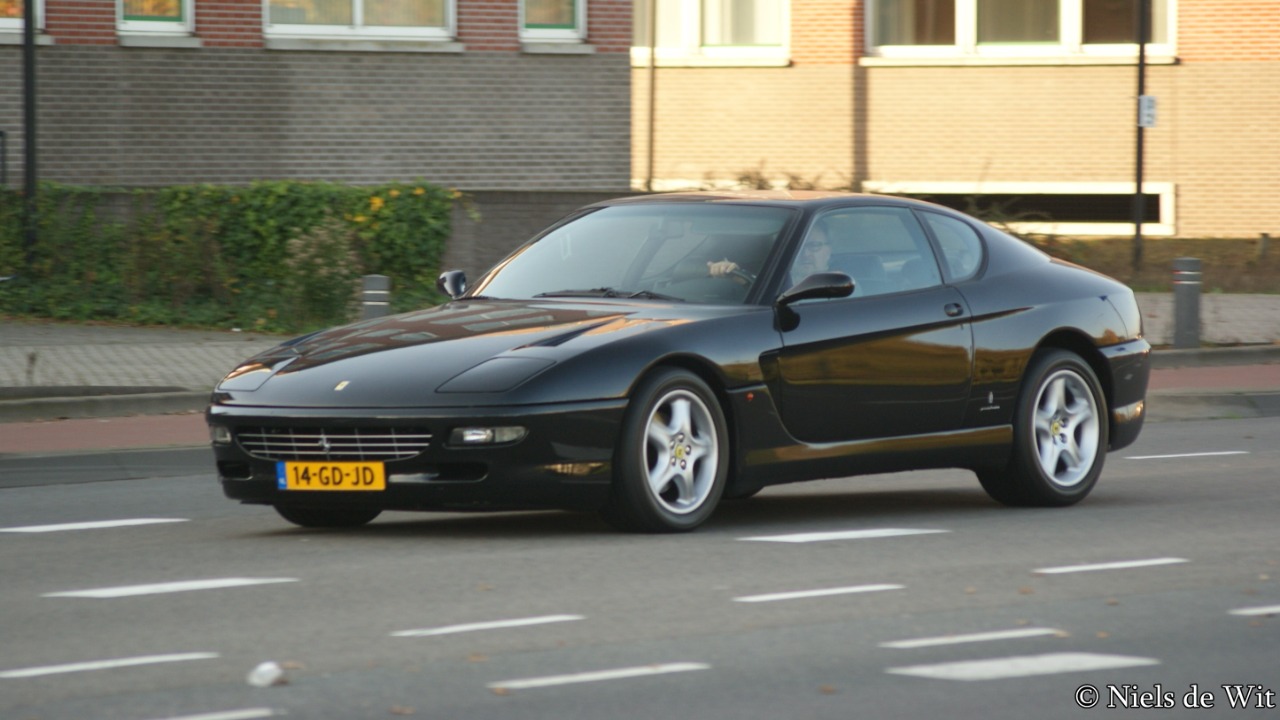

The Ferrari 456 GT sits in a strange corner of Maranello history, a front‑engined V12 grand tourer that quietly bridged the analog nineties and the modern era while louder, mid‑engined exotics stole the spotlight. As the brand leans into a new generation of twelve‑cylinder flagships in an Electric Era The of hybrids and EVs, this understated 2+2 looks less like an oddity and more like the missing link that explains how Ferrari’s V12 GT tradition survived. I want to trace how a car so thoroughly overlooked became a touchstone for today’s collectors, and why its blend of usability, performance, and design still matters in a market obsessed with lap times and social‑media theatrics.
The V12 GT Ferrari tried to hide in plain sight
When most people picture a Ferrari, they see a scarlet, mid‑engined berlinetta or a stripped‑back track special, not a long‑bonnet coupe with four seats and a discreet badge on the trunk. Yet the 456 GT was conceived precisely to serve that quieter clientele, reviving the classic front‑engined V12 layout that had defined earlier grand tourers while the rest of the range chased ever more extreme performance. As one detailed look at Ferrari’s forgotten V12 GT Supercar notes, When enthusiasts talk about the brand’s icons they usually jump from sixties legends straight to modern halo cars, skipping over the nineties 2+2 that tried to keep the old‑world GT flame alive, which is why it has become Ferrari’s forgotten V12 GT Supercar in the popular imagination.
That low profile was partly intentional. The car was designed to be driven long distances, often by owners who preferred anonymity to pit‑lane adulation, and its styling reflected that brief with clean Pininfarina lines rather than flamboyant aero. In period, it was one of the most expensive models in the catalog, yet it was marketed more as a family‑capable express than a poster‑car idol, which helps explain why even dedicated fans sometimes struggle to recall its silhouette compared with the mid‑engined rockets that dominated magazine covers, as highlighted in the analysis of how When most people think of a Ferrari they overlook Ferrari’s forgotten V12 GT Supercar.
Design that whispers, not shouts
The 456 GT’s styling is a study in restraint, especially by the standards of nineties supercars that often relied on wings and vents to telegraph speed. Its long hood, short rear deck, and gently rising beltline echo classic Pininfarina proportions, but the surfacing is smooth enough that, at a glance, it can pass for a well‑heeled luxury coupe rather than an exotic. In a detailed walk‑around of a 1995 example, the presenter points out that this 456 G does not have the exotic look of most other Ferrari models, yet that understatement is precisely what gives it a timeless presence on modern roads, where it blends into traffic until the V12 clears its throat.
Inside, the same philosophy continues with a cabin that prioritizes comfort and usability over drama, from the straightforward dashboard layout to the genuinely usable rear seats that justify its 2+2 billing. The ergonomics feel closer to a high‑end GT than a stripped‑back racer, which was deliberate for a car intended to devour continents rather than racetracks. Watching how the 456 G is presented in that 1995 Ferrari 456 GT review, with emphasis on its subtle lines and practical touches, underlines how far it diverged from the brand’s more theatrical designs of the era while still carrying unmistakable Ferrari cues in its proportions and detailing.
“A very forgettable car” – and why that criticism misses the point
Not everyone has been kind to the 456 GT, and some of its harshest critics come from within the enthusiast community that usually champions obscure Ferraris. Ben Clymer once described it bluntly as a very forgettable car, arguing that if you saw that car and it did not have a prancing horse badge, you might not give it a second glance on the street. That assessment, captured in a reflective piece on why we always forget the 456, speaks to how thoroughly the model’s quiet design and family‑friendly packaging clashed with expectations of what a nineties Ferrari should be.
I see that forgettability less as a flaw and more as a clue to its purpose. The 456 GT was built for owners who wanted to cross countries at high speed without attracting a crowd at every fuel stop, and in that context its anonymity becomes a feature rather than a bug. The same analysis that quotes Ben Clymer’s “very forgettable car” line also acknowledges that at the speed it was designed to cruise, subtlety and stability mattered more than visual fireworks, which is why its appeal has grown as collectors look beyond obvious icons to cars that quietly defined how Ferrari customers actually used their machines.
From unloved to doubling in value
For years, the 456 GT languished in the used market, overshadowed by both older classics and newer, more aggressive models, and it became a textbook example of a Ferrari that nobody wanted to touch once depreciation set in. Enthusiasts noticed how these cars sat in the doldrums, often neglected and under‑maintained, because buyers were wary of complex V12 running costs attached to a shape that did not carry the same bragging rights as a mid‑engined supercar. A recent video framed it as the forgotten and unloved Ferrari that is now doubling in value, capturing the moment when long‑suppressed demand finally began to catch up with limited supply.
That shift reflects a broader reappraisal of nineties GTs, but the 456 GT’s story is particularly stark because it started from such a low base of enthusiasm. As more people discover its blend of performance, comfort, and rarity, the market has begun to correct what now looks like an overreaction to its understated styling and 2+2 layout. The same commentary that calls it the forgotten and unloved Ferrari now doubling in value points out that once buyers experience the car’s character on the road, the old prejudices about four‑seat Ferraris fade quickly, replaced by an appreciation for how much analog V12 experience it offers for the money.
The V12 bargain that should never have been this cheap
Even as values rise, the 456 GT still carries a reputation as one of the great V12 bargains of the modern era, a situation that would have seemed unthinkable when it was new and priced at the top of Ferrari’s range. Despite the 456’s hefty price when it left the factory, you can now pick one up for a reasonable amount on the secondary market, with some examples changing hands for as little as $47,000, a figure that would barely buy a well‑optioned hot hatch today. That pricing anomaly, highlighted in a detailed breakdown of why the 456 is now a V12 bargain, underscores how far perception lagged behind the car’s intrinsic qualities.
Of course, the purchase price is only part of the equation, and anyone tempted by a $47,000 V12 Ferrari needs to budget for maintenance that still reflects its original status as a flagship GT. Yet even with that caveat, the amount of performance, craftsmanship, and heritage on offer remains striking compared with newer, less charismatic machinery at similar money. The same analysis that opens with Despite the 456’s hefty price when new also stresses that careful buyers who prioritize documented service histories can enjoy a front‑engined V12 experience that does not have to cost a fortune, especially if they are willing to live with the car’s idiosyncrasies and occasional big‑ticket repairs.
How the 412 and 456 refined Ferrari’s family‑friendly V12 formula
The 456 GT did not appear in a vacuum; it was the heir to a line of front‑engined 2+2s that Ferrari had been refining for decades, including the 412 that quietly experimented with blending supercar performance and everyday usability. In the 412, Ferrari was trying to mix the idea of supercar performance with that of everyday usability, an unusual combination at the time that laid the groundwork for later models that could carry four people and luggage at high speed without sacrificing too much comfort. That car’s boxy styling and eighties aesthetic kept it under the radar, but it proved there was a clientele for a V12 manual GT with practicality, one that collectors now quietly covet.
The 456 GT took that template and modernized it, wrapping the same basic mission in sleeker Pininfarina bodywork and updating the chassis and drivetrain to match contemporary expectations. Where the 412 felt like a product of its decade, the 456 GT aimed for a more timeless look and a broader appeal, while still offering a manual gearbox and long‑legged gearing that rewarded high‑speed touring. The evolution from the 412 to the 456, as outlined in the examination of how Ferrari was trying to mix supercar performance with everyday usability in the 412, shows a clear throughline: a willingness to prioritize real‑world livability even when it meant building Ferraris that did not fit the stereotypical supercar mold.
A Pininfarina masterpiece hiding in the classifieds
Look closely at a well‑preserved 456 GT and the depth of its design and engineering becomes obvious, especially in rare manual examples that showcase the car at its purest. This Ferrari 456 GT has been described as one of the best balances between luxury, comfort, modernity and performances, matching exactly with Maranello tradition for front V12 GT, a verdict that captures how successfully it straddles the line between old‑school craftsmanship and nineties technology. The Pininfarina bodywork, with its subtle creases and carefully judged overhangs, gives the car a presence that photographs often fail to convey, particularly when paired with classic color combinations.
Under the skin, the 456 GT’s naturally aspirated V12 and rear‑mounted transaxle deliver the kind of weight distribution and throttle response that define great grand tourers, while the interior mixes leather‑lined luxury with the mechanical tactility of a gated shifter in manual cars. The detailed description of that matching‑numbers 456 G example, introduced with the phrase This Ferrari 456 GT is one of the best balance between luxury, comfort, modernity and performances, reinforces how collectors are starting to recognize the model as more than just an affordable way into Ferrari ownership; it is increasingly seen as a coherent, well‑executed GT in its own right.
The 456 GT as the last analog link to Ferrari’s golden age
Beyond its individual merits, the 456 GT occupies a symbolic place in Ferrari history as one of the last front‑engined V12s to combine traditional styling cues like pop‑up headlights with a manual gearbox and relatively unfiltered driving dynamics. One evocative description calls it a proper front‑engined, V12‑powered grand tourer designed to devour motorways with the effortless grace of Luciano Pavarotti hitting a high note, powered by a 440‑horsepower, 5.5‑litre V12 that sings as though auditioning for an operatic tribute to the golden age of internal combustion. In that same account, the exposed metal‑gated manual is described as a symphony on wheels, underlining how central the tactile shift action is to the car’s appeal.
The details of a specific 1994 456 GT, delivered new through Maranello Concessionaires to Gray Paul Motors in Loughborough and finished in Rosso Corsa over Crema leather, highlight how closely it channels classic Ferrari cues while offering modern usability. With just 28,000 miles and the highly sought‑after gated manual transmission, it is presented as a true collector’s dream, complete with one of Ferrari’s most charming touches: pop‑up headlights that mark it as one of the last models to feature them, a worthy successor to the legendary Ferrari 365 GTB/4 Dayto that defined an earlier era of front‑engined V12s, as noted in the description that links the 456 G directly to the 365 G GTB Dayto lineage.
Why the 456 GT matters in the Electric Era The of Ferrari’s V12 future
As Ferrari unveils new twelve‑cylinder flagships like the 12Cilindri, the company is explicit about positioning them as a Statement in the Electric Era The automotive industry is accelerating toward electrification, with manufacturers unveiling hybrids and full EVs even in segments once dominated by big engines. The 12Cilindri is framed as the return of the naturally aspirated V12 and a new mechanical masterpiece, a clear signal that Maranello still sees value in the emotional pull of a high‑revving twelve even as regulations and market forces push toward batteries and turbos. That positioning only makes sense when viewed against the backdrop of cars like the 456 GT, which kept the front‑engined V12 GT tradition alive through less glamorous decades.
In that context, the 456 GT matters not just as a collectible but as a philosophical bridge between the analog past and a more complex future. It demonstrated that a Ferrari could be genuinely usable, with four seats and real luggage space, without sacrificing the character of a naturally aspirated V12 or the engagement of a manual gearbox, lessons that continue to inform how the brand balances performance, emotion, and practicality. The analysis of the 12Cilindri as a Statement in the Electric Era The underscores that Ferrari is not abandoning its heritage but reinterpreting it, and the once‑forgotten 456 GT now looks like a crucial chapter in that ongoing story of how a V12 GT can evolve without losing its soul.
More from Morning Overview