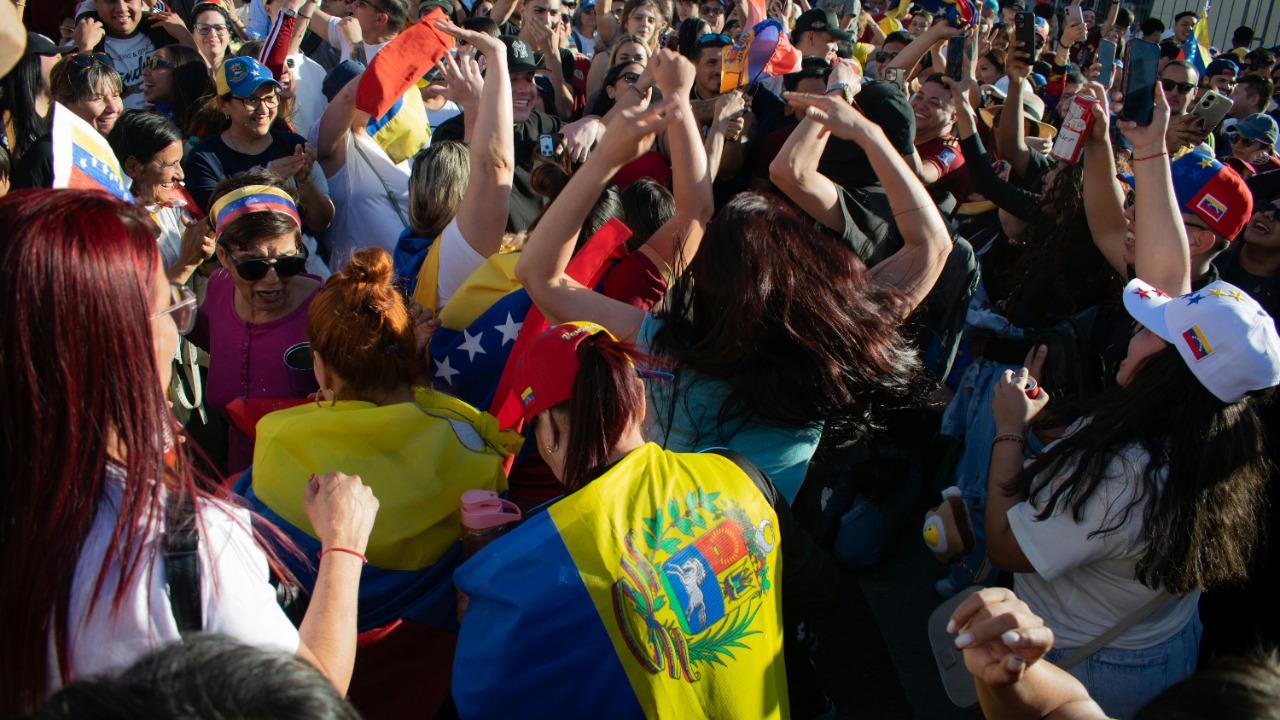

The viral clip of “happy Venezuelans” sobbing with joy after Nicolás Maduro’s capture looks like the perfect symbol of a country celebrating a turning point. It is not. The footage is a synthetic product of generative AI, stitched together to ride the shock of a real U.S. operation and to steer the story in a direction its creators preferred.
I see this video as a case study in how quickly AI tools can manufacture convincing emotional realities around fast-moving events, and how easily those fabrications can be amplified by powerful accounts. The stakes are not just about one fake crowd, but about whether anyone can still trust what they see in the first hours after a crisis.
How the “happy Venezuelans” video exploded online
The clip that flooded feeds shows a dense crowd of Venezuelan flags, people crying, hugging and waving banners as if a long nightmare had ended. It surfaced in the immediate aftermath of the shock capture of Venezuelan leader Nicolás Maduro from Caracas by U.S. forces, a moment when genuine footage of street reactions was still scarce and social media users were desperate for images that matched the drama of the headlines. In that vacuum, a minute-long video of jubilant faces and confetti offered a simple, emotionally satisfying narrative of a country united in celebration.
According to fact-checkers who traced its spread, one of the earliest and most influential posts came from the account Wall Street Apes on Twitter, which shared the clip with triumphant commentary and helped it rack up more than five million views in short order. That post framed the video as raw proof of ordinary Venezuelans rejoicing after Maduro’s removal, even though the footage itself carried none of the hallmarks of an authentic news recording and instead showed the telltale distortions of AI generation, from warped limbs to impossible flags, that later investigations would highlight in detail.
AI fingerprints hiding in plain sight
Once the initial wave of excitement passed, closer inspection revealed that the “happy Venezuelans” were not quite human. Faces in the crowd seemed to melt at the edges, hands fused into flagpoles, and clothing blurred into the background in ways that standard smartphone compression does not produce. Some flags in the frame were nonsensical, with colors and emblems that do not correspond to any country, a classic sign that a generative model has tried and failed to recreate a familiar symbol from its training data. These visual glitches are subtle enough to slip past a casual viewer, but obvious when you pause and look frame by frame.
Analysts who specialize in synthetic media pointed to these anomalies, along with the uncanny uniformity of the crowd’s movements, as strong evidence that the clip was created by an AI system rather than filmed on the streets of Caracas. One review noted that the figures share repeated facial structures and body types, a pattern that often appears when a model is prompted to generate “crowds” and ends up cloning and slightly mutating a handful of base characters. Another highlighted how the camera motion feels artificially smooth, as if rendered in software rather than jostled by a human operator in the middle of a chaotic celebration.
Elon Musk’s megaphone and the amplification problem
The video might have remained a fringe curiosity if it had stayed within the usual conspiracy and hype circles. Instead, it was propelled into the mainstream when Elon Musk reshared the AI-generated Venezuelan celebration clip to his tens of millions of followers, treating it as evidence of popular support for the U.S. operation. His repost gave the footage a powerful endorsement effect, encouraging users who trust his judgment to accept the scene as real and to spread it further across platforms. In the attention economy of social media, that kind of amplification can matter more than any watermark or disclaimer.
Reporting on the episode has detailed how Musk’s engagement helped the clip jump from niche accounts into broader political discourse, even as independent users and fact-checkers were already flagging its inconsistencies. One analysis of the reshared video noted that user-generated input from X’s own community fact-check system eventually attached context explaining that the clip was AI-generated and not filmed in Venezuela, but those corrections arrived only after the footage had already gone viral. By then, the emotional impression of joyful crowds had taken root in the minds of viewers who would never see the later clarifications.
Fact-checkers trace the video’s murky origins
Behind the scenes, verification teams set out to answer a basic question: where did this video actually come from? CNBC was unable to confirm the origin of the clip, but fact-checkers at BBC and AFP identified what they described as the earliest known version circulating on social media, which appeared without any clear attribution or on-the-ground context. That lack of provenance is itself a red flag, especially for footage that purports to show a major public event in a capital city that is otherwise saturated with cameras and smartphones.
One detailed fact-check described how investigators compared the clip’s background buildings, street layouts and lighting conditions with known locations in Caracas and found no match, reinforcing the conclusion that the scene was not filmed in any identifiable Venezuelan neighborhood. They also noted that the crowd’s chants are indistinct and do not contain recognizable Spanish slogans, another common trait of AI-generated audio that is designed to sound like a generic celebration without conveying specific, verifiable speech. The result is a video that feels emotionally specific but is geographically and linguistically vague, a perfect vessel for whatever story its sharers want to tell.
Real celebrations, real fear, and a wave of fakes
The irony is that there were genuine scenes of Venezuelans reacting to the U.S. operation, including people who took to the streets to cheer Maduro’s removal and others who gathered to protest foreign intervention. Minutes after Donald Trump announced a “large-scale strike” against Venezuela early on Saturday, false and misleading AI content began to mix with authentic footage, creating a confusing blend of reality and fabrication. Opposition leader María Corina Machado, who has vowed to return to Venezuela, has had to navigate this information fog while trying to communicate with supporters and the international community about what is actually happening on the ground.
Coverage of the unfolding crisis has described how the initial shock of the operation from Caracas was quickly followed by a subsequent wave of misinformation, with AI-generated videos of crowds celebrating Maduro’s removal going viral alongside real clips of street gatherings. Some of those synthetic videos were relatively crude, while others, like the “happy Venezuelans” montage, were polished enough to fool large audiences. The effect is to flatten a complex national mood into a single, triumphant image that erases the fear, uncertainty and political division that many Venezuelans are actually experiencing.
AI propaganda is not new, but it is getting sharper
What is unfolding around Venezuela fits into a broader pattern of AI being used to shape narratives in conflict and crisis zones. Earlier coverage of information warfare has documented how state and non-state actors have pushed unfounded claims about biological weapons labs in Ukraine, using a mix of doctored documents, misleading translations and speculative commentary to suggest that Western governments are hiding secret programs. In that case, investigators found no evidence to support the allegations, but the claims still spread widely online and were amplified by sympathetic media ecosystems that treated them as plausible.
Those earlier episodes showed how quickly conspiracy theories can latch onto complex geopolitical events, from the Ukraine war to protests in Iran that drew comments from figures like Trump and prompted accusations of “reckless” interference from Iranian officials. The Venezuelan deepfake celebrations are a more visually sophisticated extension of the same playbook, using generative models instead of grainy screenshots or miscaptioned photos. The goal is similar: to flood the zone with content that supports a preferred narrative, whether that is about secret labs, foreign plots or a supposedly unanimous public rejoicing at a leader’s downfall.
Why the “happy Venezuelans” myth is so persuasive
Part of what makes the fake celebration clip so sticky is that it tells viewers what they want to believe. For audiences who see Maduro as an illegitimate strongman and the U.S. operation as a liberation, the idea of Venezuelans weeping with joy in the streets feels emotionally right, even if the specific footage is fabricated. The video compresses years of suffering, sanctions and political stalemate into a single cathartic moment, offering a clean moral arc that reality rarely provides. That emotional resonance can override the small visual oddities that might otherwise trigger skepticism.
There is also a powerful social incentive to share content that signals alignment with a particular side. When a clip like this appears in a feed, reposting it becomes a way to declare support for Venezuelan democracy or for Trump’s decision to authorize the strike, regardless of whether the pixels themselves are genuine. The fact that the video is AI-generated can even become part of its appeal for some users, who see synthetic media as just another tool in the meme arsenal rather than a serious threat to public understanding. In that environment, fact-checks and corrections struggle to compete with the instant gratification of a viral, emotionally charged image.
How investigators actually debunked the clip
Behind the simple verdict that the video is fake lies a methodical process that is worth understanding, because it offers a template for spotting similar content in the future. Analysts began by isolating individual frames and examining them for inconsistencies, such as hands with too many fingers, earrings that vanish between frames, or flags that morph shape as they wave. They then looked at the crowd as a whole, searching for repeated faces or body positions that suggest the model has duplicated and slightly altered the same figure multiple times to create the illusion of a dense gathering.
They also compared the clip’s visual style with known examples of AI-generated “slop” that have circulated in other contexts, such as synthetic protest scenes and fake disaster footage. One investigation into the Venezuelan video noted that the figures in the clip share the same plasticky skin texture and slightly off-kilter eye alignment that have become recognizable characteristics in AI-generated media. Another pointed out that the lighting on the crowd does not match any plausible outdoor environment, with shadows that fall in conflicting directions and highlights that seem to come from nowhere. These technical clues, combined with the lack of verifiable metadata or eyewitness corroboration, led experts to conclude that the video was not a real recording of events in Caracas.
Platforms, policy and the limits of community notes
The “happy Venezuelans” episode also exposes the uneven response of social platforms to AI-driven misinformation. On X, user-generated input through the Community Notes system eventually flagged the clip as synthetic and added context about its likely AI origin, but that label arrived only after the video had been reshared by high-profile accounts and viewed millions of times. There was no automatic detection or preemptive warning, even though the footage contained multiple hallmarks of generative media that current detection tools are designed to catch. The platform’s reliance on volunteer annotators meant that the correction lagged behind the virality curve.
Other platforms faced similar challenges, with some users reposting the clip to Instagram, TikTok and Telegram channels without any indication that it was fabricated. The lack of consistent labeling standards across services allowed the same piece of AI content to appear trustworthy in one context and contested in another, depending on whether local communities had flagged it. That patchwork approach stands in contrast to the more coordinated efforts that some platforms have deployed against other forms of misinformation, such as coordinated campaigns around elections or public health, and raises questions about whether current policies are adequate for the speed and scale of generative AI.
What this means for the next crisis
The fake Venezuelan celebration video is not an isolated curiosity, it is a preview of how future conflicts and political shocks will be narrated in real time. As generative tools become more accessible, it will be trivial for motivated actors to produce convincing footage of crowds, speeches or even battlefield scenes within minutes of a breaking event, tailored to whatever storyline they want to push. In the Venezuelan case, AI-generated videos of crowds celebrating Maduro’s removal went viral so quickly that they shaped early impressions of public sentiment before journalists and observers could document the real reactions on the ground.
For audiences, the lesson is uncomfortable but necessary: emotional plausibility is not evidence. A clip that feels right, that seems to capture the spirit of a moment, can still be entirely synthetic. I find that the only reliable defense is a mix of skepticism and patience, resisting the urge to share the most dramatic footage until there is some independent confirmation of where it came from and who is in it. For platforms and policymakers, the Venezuelan deepfake wave is a warning that current guardrails are not enough, and that without stronger verification systems and clearer labeling, the next “happy crowd” could be even harder to debunk before it shapes public opinion.
Lessons from earlier information wars
Looking back at previous disinformation campaigns helps clarify what is new and what is familiar about the Venezuelan case. When Russian officials and aligned media pushed claims about secret biological weapons labs in Ukraine, they relied on a mix of misinterpreted documents, out-of-context images and speculative commentary to build a narrative that Western governments were hiding dangerous programs. Investigators who examined those allegations found no credible evidence to support them, but the story still gained traction among audiences predisposed to distrust official statements, illustrating how quickly a false narrative can harden once it finds a receptive community.
Similar dynamics played out around protests in Iran, where statements from figures like Trump were seized upon by Iranian authorities as proof of foreign meddling and used to frame domestic unrest as a Western plot. In both cases, the core tactic was to flood the information space with content that supported a preferred storyline, regardless of its factual basis. The Venezuelan AI celebration clip follows the same logic, but with more advanced tools: instead of miscaptioning real photos, its creators conjured an entire scene from scratch, confident that in the chaos after a major operation, many viewers would not look closely enough to notice the seams.
More from Morning Overview