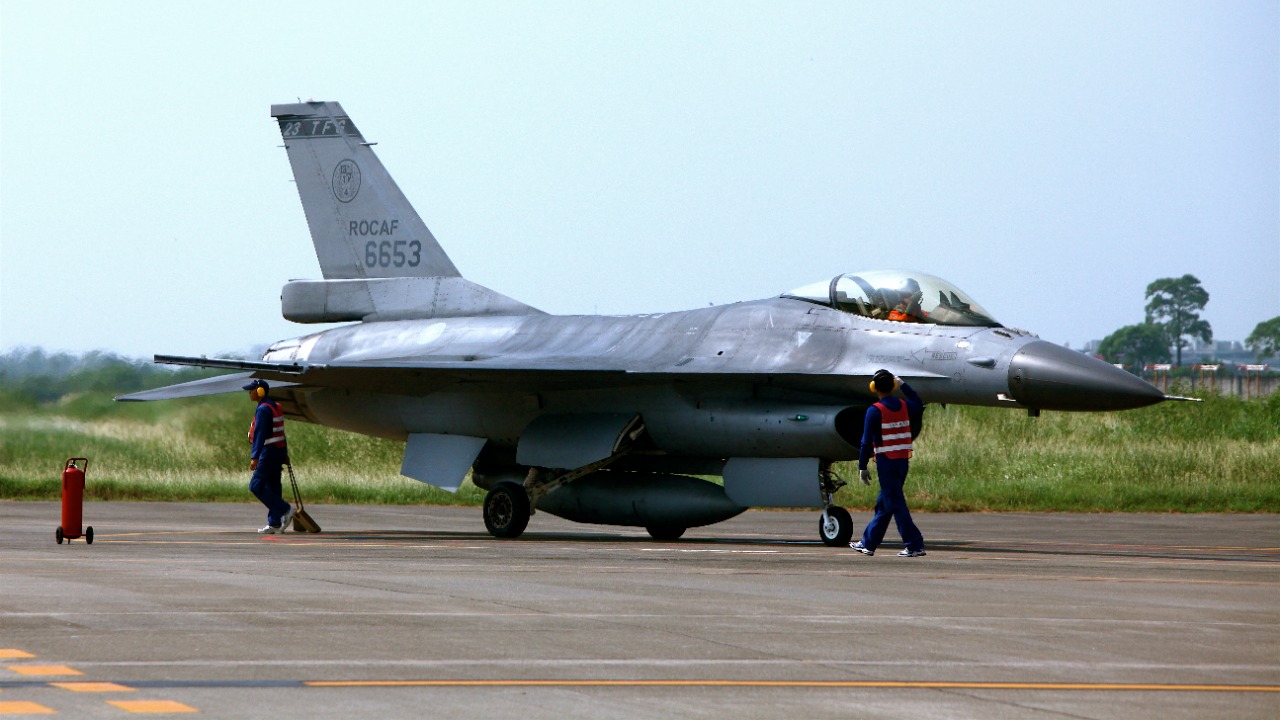

A Taiwan F-16V fighter jet plunged into the sea during a nighttime training mission off the island’s east coast, triggering an intensive search for the missing pilot and fresh scrutiny of the risks that come with high-tempo air operations. The incident near Hualien has unfolded against a backdrop of regional tension and a major modernization drive for Taiwan’s air force, turning a single crash into a wider test of readiness, rescue capacity, and political resolve.
As crews battle rough seas and cold winds to find the aviator, officials are racing to piece together what went wrong in the minutes between takeoff and the jet’s disappearance from radar. The loss of an advanced F-16V in these conditions is more than a technical mishap, it is a reminder of how unforgiving the environment is around Taiwan’s eastern coastline and how narrow the margin for error can be during night sorties over open water.
Night mission turns into emergency off Hualien
The F-16V was flying a routine nighttime training mission from Hualien Air Base when it went missing over the Pacific, turning a standard sortie into a full-scale emergency. According to official accounts, the aircraft lost contact with controllers not long after departure and was later confirmed to have crashed into the sea off the coast of Hualien, a stretch of water that Taiwanese pilots know for its sudden weather shifts and limited visual cues after dark. The jet’s disappearance has focused attention on how quickly a familiar training profile can become life threatening when something goes wrong at night over the ocean.
Authorities responded by launching extensive Rescue operations off Hualien, deploying aircraft and ships to the area where the F-16V was believed to have gone down. Officials described a rapid mobilization once the alarm was raised, with search units converging on the suspected crash zone to look for debris and any sign of the pilot. The scale and speed of that response underscored how seriously the military treats any incident involving its front line fighters, particularly when it unfolds so close to a major base and in waters that are both strategically important and notoriously difficult to work in at night.
Timeline of the disappearance and suspected ejection
From the first radar anomaly to the confirmation of a crash, the timeline that night unfolded in a matter of minutes. The F-16V took off from Hualien Air Base for what was described as a routine training mission, then lost contact shortly afterward, leaving controllers with only a narrow window of data to reconstruct the final moments of the flight. Reports indicate that the pilot is believed to have ejected before the jet hit the water, a critical detail that shifted the focus from wreckage recovery to a race against time to find a survivor in the dark.
Officials later specified that the pilot was suspected to have ejected about 10 nautical miles east of Fengbin Township in Hualien County, a precise location that has since become the center of the search grid. That account of the suspected ejection point, tied to the 7:29 pm marker, has guided naval and air units as they sweep the area east of Fengbin Township in Hualien County, looking for any trace of the pilot or the aircraft. The combination of a clear time stamp and a relatively tight radius has helped structure the operation, but it has not lessened the difficulty of finding a single person in rough seas after dark.
Massive search effort in harsh conditions
Once the crash was confirmed, Taiwan moved quickly to mount a large-scale search and rescue effort that stretched through the night and into the following days. Military aircraft, coast guard vessels, and other assets were directed to the area east of Hualien, with instructions to prioritize the hunt for the missing aviator above other tasks. Officials described the operation as a massive night rescue, highlighting how agencies across Taiwan were ordered to focus on the search and to treat every hour as critical.
Despite that mobilization, the conditions at sea have made progress painfully slow. The search has been complicated by cold weather, strong winds, and waves reaching 3 meter heights, factors that reduce visibility, batter small craft, and sap the strength of anyone in the water. Officials involved in the Search for the pilot have stressed how those 3 meter swells and low temperatures narrow the survival window and force rescuers to balance speed with safety. The combination of cold spray, gusting winds, and churning seas has turned an already urgent mission into a grueling test of endurance for the crews on scene.
Official response and political stakes
The crash has drawn immediate attention from Taiwan’s political leadership, which has framed the search for the missing pilot as a top national priority. Premier Cho Jung-tai called for Taiwan’s coastguard and nearby fishing vessels to assist in the search and rescue effort, urging them to coordinate closely with the military and to keep scouring the waters off Hualien. His directive emphasized that the authorities should exhaust the island’s armed forces and civilian resources in support of the mission, a signal that the government sees the fate of one pilot as a matter of national concern rather than a routine accident response.
That message has been reinforced by broader calls for an all out search, with agencies across Taiwan instructed to prioritize the operation. The political stakes are clear, the loss of an advanced fighter jet and the possible death of a trained aviator would be a blow to morale at a time when the island is under sustained pressure to demonstrate readiness and resilience. By putting Premier Cho Jung-tai’s name and office behind the rescue push, the government has tied its own credibility to the outcome, signaling that it understands both the human cost and the symbolic weight of what happens next in the waters off Hualien.
What is known about the pilot and ejection
While officials have not released extensive personal details about the aviator, the available reporting converges on one crucial fact, the pilot is believed to have ejected before the F-16V hit the sea. That assessment is based on signals and observations gathered in the minutes around the 7:29 pm mark, when the aircraft disappeared from radar east of Fengbin Township. The assumption of a successful ejection has shaped every aspect of the response, from the deployment of life raft capable helicopters to the pattern of surface searches designed to track currents and drift from the suspected ejection point.
Accounts of the incident describe a Taiwan Air Force F-16 fighter jet that crashed into the sea during a routine training mission, with the pilot ejecting safely but still unaccounted for in the aftermath. The jet had taken off from Hualien Air Base and lost contact shortly after, leaving only a narrow window in which the ejection could have occurred. That sequence, a standard departure, sudden loss of contact, and a presumed ejection over water, has been repeated in official briefings and in public explanations of why the search remains focused on finding a living pilot rather than only recovering wreckage from the Taiwan Air Force F-16. For the families of aircrew and the wider public, that distinction between a presumed ejection and a confirmed loss is the thin line that keeps hope alive as the days pass.
Rescue tactics and the challenge of night over water
Searching for a single pilot at sea is always difficult, but doing so at night off Taiwan’s east coast adds layers of complexity that even experienced crews struggle to overcome. The waters east of Hualien drop off quickly into deep ocean, with strong currents that can carry a person or debris far from the initial impact point in a matter of hours. At night, visual cues vanish, leaving rescuers to rely on infrared sensors, radar, and flares to pick out small targets against a background of black water and whitecaps. Every extra knot of wind and every additional meter of wave height cuts into the effectiveness of those tools and increases the risk to the rescuers themselves.
Reports from the scene describe how cold weather, winds, and 3 meter waves have complicated the Rescue, forcing search coordinators to adjust flight patterns and ship routes to keep crews within safe operating limits. In practice, that has meant rotating assets more frequently, expanding the search box to account for drift, and leaning on both military and civilian vessels to cover as much water as possible. The combination of technology, seamanship, and sheer persistence is what keeps the operation going, but the environment remains unforgiving, a reality that every pilot who flies over these waters understands long before an incident like this occurs.
F-16V fleet, modernization, and safety record
The loss of an F-16V is particularly sensitive because the type sits at the heart of Taiwan’s ongoing effort to modernize its air force. The F-16V variant, with upgraded avionics and sensors, is a key part of the island’s defensive capability, intended to keep pace with more advanced aircraft in the region. The crash off Hualien has therefore raised questions not only about the specific jet involved but also about how the fleet is being flown, maintained, and supported under the strain of frequent training and patrol missions.
Earlier reporting on the incident has stressed that the crash came as Taiwan continues to modernise its air force, with the F-16 forming a key part of its defensive capacity. A Taiwanese F-16 fighter plunging into the sea during training is therefore more than an isolated mishap, it is a data point in the broader balance between readiness and risk. Every accident triggers technical investigations and safety reviews, but it also feeds into public debates about whether the pace of modernization and the intensity of operations are sustainable without putting unacceptable pressure on pilots and machines.
Regional messaging and competing narratives
Beyond the immediate rescue, the crash has become part of a wider information contest over Taiwan’s military competence and vulnerability. Domestic and international coverage has focused on the professionalism of the search effort and the human drama of a missing pilot, but media on the Chinese mainland have framed the same facts in a different light. For audiences across the strait, the loss of an F-16 at sea is being used to question the reliability of Taiwan’s forces and to highlight the risks of relying on advanced but aging platforms in a high stress environment.
One prominent account described how Taiwan’s F-16 fighter jet crashed at sea, presenting the incident as a sign of weakness and using it to reinforce a narrative about the island’s military limitations. That coverage, which noted that an F-16 fighter jet of the air force on the island had gone down, folded the accident into a broader argument about cross strait power dynamics and the balance of air power. By pointing to Taiwan’s F-16 fighter jet crash as evidence of systemic problems, such narratives aim to undercut confidence in Taiwan’s defenses at the very moment when its leaders are emphasizing resolve and resilience in the face of mounting pressure.
Unanswered questions and the investigation ahead
For now, the central mystery remains why a modern F-16V on a routine training mission ended up in the sea off Hualien. Officials have been clear that the cause remains unknown as the search for the aviator continues, and they have avoided speculating about whether mechanical failure, human error, or environmental factors played the decisive role. That caution reflects both the limited data available from the final minutes of the flight and the high stakes attached to any preliminary judgment about the performance of a front line fighter.
Investigators will eventually draw on radar tracks, maintenance records, and any recovered debris to reconstruct what happened, but those efforts are likely to take time and may depend on how much of the wreckage can be located in deep water. In the meantime, Taiwan has launched a large-scale search operation late at night and into subsequent days, with officials repeatedly stressing that the cause remains unknown as they continue to look for the pilot. That dual focus, on an ongoing rescue and a future inquiry, is captured in accounts that describe how Taiwan launched an extensive search after the F-16V pilot ejected over the eastern coast during training, even as officials acknowledged that they do not yet know why the jet went down. Until those answers emerge, the crash will stand as both a human tragedy and a stark reminder of the risks that come with defending an island whose security increasingly depends on complex machines flying at the edge of their envelopes over unforgiving seas.
More from Morning Overview