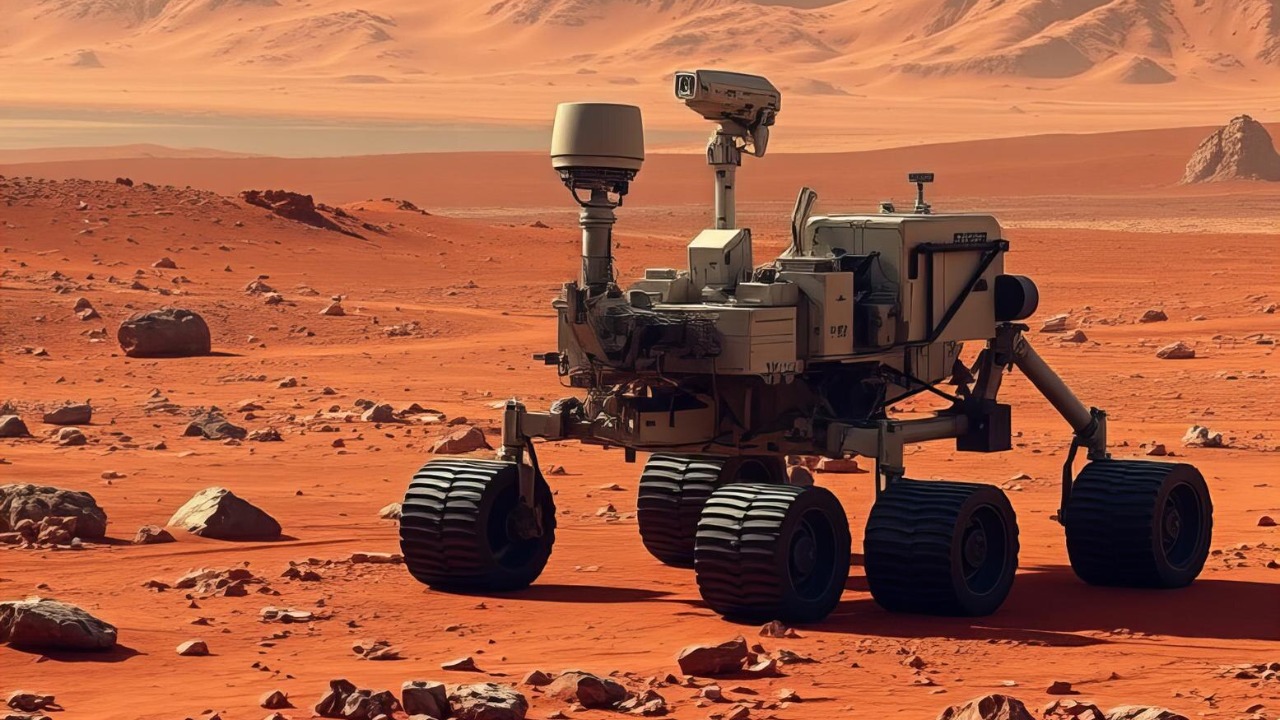

When Spirit dropped through the thin Martian air and bounced to a stop inside Gusev Crater, it did more than survive a high‑risk landing. It opened a new era in which rovers became the primary way humanity studies other worlds, reshaping how engineers design missions and how scientists think about Mars itself. Two decades later, the impact of that landing still runs through every major surface mission that has followed.
The robot officially known as a Mars Exploration Rover was built for a short campaign, yet its performance, personality and science output rewrote expectations for what a small machine could do on another planet. Spirit’s journey from daring touchdown to silent final images changed space exploration by proving that long‑lived, mobile laboratories could systematically read the Martian landscape like a field geologist, and by forcing mission teams to invent techniques that are now standard practice across the solar system.
From risky touchdown to working laboratory
The landing that delivered Spirit to the surface was a high wire act that had to work the first time, with no chance for repair. Engineers relied on a complex sequence of atmospheric entry, parachutes, retrorockets and airbags to get the rover safely into Gusev Crater, a basin that had been chosen because it looked like an ancient lakebed but had never been visited on the ground. The team that handled entry, descent and landing, led by JPL engineer JPL, Rob Manning, had to tune that sequence so precisely that Spirit could hit a narrow target zone and still arrive with its instruments intact, turning a terrifying few minutes into the foundation for years of science.
Once the airbags deflated and the petals of the lander opened, Spirit transformed from a vulnerable payload into a functioning field station. The rover’s mast cameras, spectrometers and rock‑grinding tools were designed to operate for a short primary mission, but they were also arranged so that the vehicle could act like a geologist on wheels, reading layers of rock and soil for clues to past water. That shift, from a static lander to a mobile laboratory, is what made the landing so consequential: it proved that a carefully targeted touchdown could be the starting point for a wide‑ranging campaign rather than a single fixed experiment, a lesson that still shapes how mission planners think about where and how to arrive on Mars.
A 90-day plan that turned into a multi-year odyssey
On paper, Spirit was supposed to be a short‑lived visitor. Mission planners expected the rover to operate for roughly one Martian season, with a design life of just a 90 M period of primary operations. That conservative estimate reflected the harsh realities of dust, cold and limited power on Mars, and it shaped early expectations about how much ground Spirit could realistically cover. The rover’s survival beyond that window, and its ability to keep returning data, quickly turned the mission into a case study in how to stretch hardware far beyond its original brief.
Spirit’s endurance was not an accident, it was the result of careful engineering and constant adaptation. The rover, formally described as Spirit, MER, Mars Exploration Rover, kept working on Mars for years, long after its initial warranty had expired. That longevity forced the team to rethink what a “short” mission really meant, and it set a new bar for future rovers that would be expected to operate not for months but for many Martian years. The fact that a machine built for a 90‑day sprint could sustain a marathon of exploration changed how agencies budgeted, staffed and designed subsequent surface campaigns.
Spirit and Opportunity: twin rovers, shared revolution
Spirit did not change Mars exploration alone. It launched as One of a pair of identical robots, and its twin, Opportunity, landed on the other side of Mars to sample a very different environment. Together, While Spirit and Opportunity were operating, engineers and scientists developed a playbook for surface exploration that is still in use, from how to prioritize targets to how to drive safely across unknown terrain. The two missions were conceived as a matched experiment, and the fact that both survived their landings and began returning data gave the team a rare chance to compare two Martian regions in detail.
The twin design also amplified the impact of each rover’s discoveries. When Spirit found evidence of past water in one setting and Opportunity found complementary clues in another, the combined result was far more powerful than either mission could have achieved alone. Over time, the phrase Key Takeaways, NASA, Spirit and Opportunity came to stand for a broader shift in Mars science, in which mobile rovers were no longer experimental one‑offs but central tools for understanding the planet’s history. Spirit’s landing was the first half of that twin success, and its performance validated the idea that paired missions could deliver a richer, more resilient science return.
Rewriting Mars science from the ground up
Before Spirit, much of what scientists knew about Mars came from orbiters and a handful of landers that could only sample their immediate surroundings. The arrival of a rover in Gusev Crater changed that by allowing researchers to trace rock layers, soil deposits and surface textures across a landscape, building a narrative of environmental change over distance as well as time. Spirit’s instruments were tuned to look for signs of past water, and its traverses across the crater floor and nearby hills helped show that Mars had once been more geologically active and chemically varied than earlier models suggested.
Those findings fit into a broader strategy that had guided Mars exploration for decades, in which For decades, NASA, Mars missions were told to “follow the water.” Spirit’s ground‑level view of rocks altered by liquid, and of soils that had been chemically processed in wet conditions, gave that mantra concrete support. By tying orbital observations to specific outcrops and textures on the surface, the rover helped scientists calibrate remote sensing data and refine their maps of where ancient lakes, hot springs or hydrothermal systems might once have existed. That, in turn, influenced where later missions would be sent and what kinds of instruments they would carry.
Engineering lessons that shaped every rover since
Spirit’s landing and long survival forced engineers to invent new ways of operating a robot on another world. During the cruise to Mars and the early months on the surface, They, Spirit and Opportunity, Mars and each received software upgrades that expanded their capabilities, allowing the rovers to perform more of their field duties autonomously and to handle increasingly complex driving and targeting tasks. Those updates, described in detail in They, Spirit and Opportunity, Mars and, showed that a planetary mission could evolve significantly after launch, with new code unlocking new science.
The hardware story was just as important. According to the mission overview titled About the, One of, Mars and, Spirit, the rover far outlasted its original expectations, surviving dust storms, mechanical wear and the gradual decline of its power system. In May 2009, the rover became stuck in soft soil, and despite extensive recovery efforts it eventually ceased communication, with the mission formally ending in 2011. That arc, from robust performance to a final immobilization, taught engineers how to design stronger wheels, more flexible mobility systems and more robust power management for later rovers. Every subsequent mission that has rolled onto Mars has drawn on those hard‑won lessons about what works, what fails and how to keep a robot alive in an unforgiving environment.
From Spirit’s autonomy to modern AI on other worlds
One of the quiet revolutions that began with Spirit’s mission was the steady increase in autonomy on planetary rovers. The need to navigate safely across rocks, slopes and sand with long communication delays meant that Spirit’s team had to give the rover more decision‑making power over time, letting it choose safe paths within constraints set from Earth. That approach foreshadowed the broader use of artificial intelligence in space, where Another critical technology is autonomous navigation, and AI is used to guide spacecraft to their destinations and avoid obstacles despite the significant communication delay with Earth, as described in Another.
Modern missions have taken that concept much further, with systems in which The AI‑powered navigation system allows the rover to navigate autonomously, avoiding obstacles and selecting optimal paths to reach scientific targets, a capability outlined in The AI. Spirit’s experience, including the times when it became bogged down or had to thread its way through hazardous terrain, provided the real‑world data that helped engineers understand what kinds of algorithms and sensors were needed to keep a rover safe without constant human steering. In that sense, the landing that put Spirit on Mars was also the starting point for a long technological arc that now reaches into AI‑driven exploration across the solar system.
How Spirit’s story paved the way for bigger, bolder rovers
Spirit’s success did not just validate a particular landing system or instrument suite, it opened the door for a new generation of much larger vehicles. The legacy of Spirit and Opportunity paved the way for larger rovers like Spirit and Opportunity, Curiosity and Perseverance, which carry more advanced laboratories and can travel farther across the Martian surface. Engineers were willing to invest in those SUV‑scale machines because Spirit had shown that a rover could survive long enough, and deliver enough science, to justify the complexity and cost of a rolling science platform.
That scaling up is evident in the way later missions are described as Jan, SUV, Mars sized rovers that continue the work of exploring for the chemical ingredients needed for life. Spirit’s landing, and the years of operations that followed, gave mission planners the confidence to design vehicles that are not just bigger but more specialized, with instruments tailored to questions about organics, climate history and potential biosignatures. Without the proof of concept that Spirit provided, it is hard to imagine such ambitious surface laboratories being approved, built and sent to Mars.
A mission that redefined “short” and “long” on Mars
Spirit’s extended life also changed how scientists and engineers think about mission timelines. Earlier this year, retrospectives on the twin rovers emphasized that their durability surpassed the wildest dreams of the teams that had only expected localized exploration during their expected Jan 90‑day mission. Spirit’s ability to keep working turned a brief reconnaissance into a long‑term observatory, capturing seasonal changes, dust storm cycles and slow‑moving geological processes that would have been invisible in a shorter campaign.
That shift in expectations has had ripple effects across planetary science. When new missions are proposed now, they are often framed in terms of multi‑year baselines, with plans for extended operations built in from the start rather than treated as a bonus. Educational resources that look back on the mission note that Not only did Spirit and Opportunity add to our understanding of Mars, but also the rovers set the stage for future exploration in new and exciting ways, a point highlighted in Not, Spirit and Opportunity, Mars. Spirit’s landing, in other words, marked the beginning of a new standard in which “short” missions can still be expected to deliver long arcs of discovery.
The human connection: from Cape Canaveral to Spirit’s last images
Spirit’s story is also a human one, stretching from the launch pad to the final silent frames. The rover began its journey when a rocket lifted off from Cape Canaveral Florida, Mars, carrying a compact, folded‑up machine that would soon unfold into a six‑wheeled explorer on another world. That launch represented years of work by engineers, scientists and technicians who had to trust that their creation would survive the trip and the landing to become a functioning partner in discovery. The emotional stakes of that gamble became clear as the mission unfolded and the rover’s personality emerged through its daily reports and images.
By the time Spirit sent back its final pictures, the connection between the team and the machine was unmistakable. A widely shared video reflecting on those last transmissions notes that 344 M Martian days or sols had passed since Spirit’s mission began when the final images arrived, capturing a quiet, dust‑covered landscape that many on Earth had come to know intimately. Those images, and the knowledge that no more would follow, underscored how much the landing years earlier had mattered: it had not only changed the trajectory of Mars science, it had created a shared narrative in which a small robot’s journey across another planet became part of our collective memory.
A legacy carried forward in science, technology and culture
Two decades on, Spirit’s influence is visible in technical briefings, public talks and popular retrospectives. In a recent Von Karman lecture, host Jan, Von Karman, Nikki Hyurrick, JPL, Office of Communica framed the twin rover missions as a turning point that continues to shape how JPL approaches new projects, from instrument selection to outreach. The way Spirit’s team communicated its challenges and triumphs, including stuck wheels and daring drives, helped set expectations for transparency and storytelling in later missions, making complex engineering more accessible to the public.
Educational materials and anniversary features now routinely describe how Jan 20 years after landing, the twin rovers continue to influence Mars science and mission design. Spirit’s landing is remembered not just as a technical success but as the moment when rovers became central characters in humanity’s exploration of other worlds. From the first bounce in Gusev Crater to the final silent panorama, the mission showed that a small, solar‑powered machine could change how we explore, how we plan and how we imagine our place on Mars, and that legacy now runs through every wheel track that has followed.
More from MorningOverview