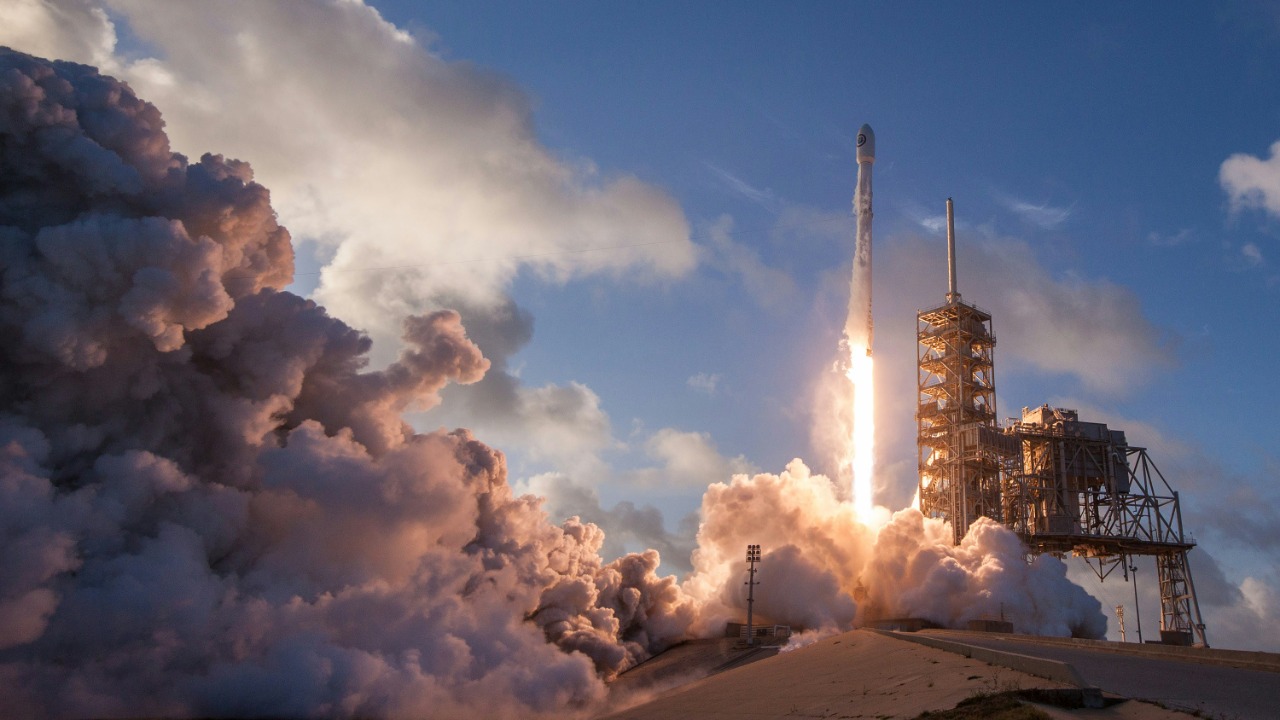

SpaceX ended 2025 in the same mode it has cultivated for years, trading victory laps for more launches and quietly resetting what “normal” looks like in orbital flight. The company’s latest run of missions toppled yet another internal record and signaled that the cadence of 2025 is not a peak but a new baseline for how often rockets can fly.
That relentless tempo is reshaping everything from coastal communities in Florida and California to the economics of satellite broadband and deep space exploration. As I look across the numbers, the new Starship design, and the packed 2026 manifest, the pattern is clear: SpaceX is not easing off the throttle, it is building an industrial-scale launch machine.
Another launch record, and what it really means
The headline figure from 2025 is stark: SpaceX pushed its annual tally of orbital missions to 167, a number that would have sounded fanciful only a few years ago. That total, which includes flights of Falcon 9, Falcon Heavy, and Starship, reflects a system that has moved beyond experimental cadence into something closer to airline-style operations, with rockets lifting off every couple of days and recovery ships treating booster landings as routine.
Behind that number is a broader shift in how orbital access is supplied and consumed. A large share of those 167 launches carried batches of Starlink satellites, turning the company’s own broadband network into both anchor customer and stress test for its fleet, while crewed flights, government payloads, and commercial spacecraft filled out the manifest. The scale of this activity is captured in reporting that notes how SpaceX continued to shatter its own launch totals as 2025 drew to a close, turning what used to be a global record into a company benchmark.
Starlink’s quiet role as the engine of cadence
If the raw launch count is the headline, Starlink is the subtext that explains how SpaceX can keep its pads so busy. The company closed out the year with what one year-end brief described as record-breaking launches paired with significant growth in its satellite internet constellation, underscoring how the broadband business and the launch business now reinforce each other. Every batch of spacecraft lofted to low Earth orbit both expands coverage and keeps the Falcon 9 production and refurbishment pipeline humming.
That feedback loop is not just about revenue, it is about learning. Each Starlink mission gives engineers another data point on booster performance, fairing recovery, and on-orbit operations, which in turn feeds into the company’s broader ambitions for deep space and high-mass payloads. A summary of the company’s year notes that SpaceX concluded 2025 with record-breaking launch activity and Starlink growth, framing the constellation as a central pillar in its 2025 progress report rather than a side project.
Falcon 9 reuse hits new durability milestones
The other quiet revolution inside those launch statistics is how often individual Falcon 9 boosters are flying. Late in the year, SpaceX sent a Falcon 9 first stage with tail number 1063 back to orbit for its 30th mission, a milestone that would have sounded implausible when the company first started landing rockets on drone ships. The nine Merlin 1D engines at the base of that booster lit up at 7:27 a.m. PST for another Starlink flight, turning what used to be a one-and-done piece of hardware into something closer to a workhorse airframe.
That 30-flight mark matters because it validates the company’s thesis that reuse can be pushed far beyond the single-digit counts that were once considered ambitious. It also hints at lower marginal costs per launch, since the same hardware is amortized over dozens of missions rather than a handful. Reporting on that Starlink mission notes that the Merlin 1D engines on booster 1063 carried it through its 30th flight at 7:27 a.m. PST, a detail that underlines how routine high-count reuse has become for Falcon 9 operations.
Pad turnaround records and the race against the clock
Hardware reuse is only half the story; the other half is how quickly SpaceX can reset its launch pads. In December, the company broke its own pad turnaround record at Cape Canaveral, flying a Falcon 9 mission just two days after the NROL-77 launch from the same site. That kind of tempo used to be the stuff of Cold War competition, yet it is now being driven by a single commercial operator trying to keep up with its own manifest.
The new benchmark for time between Falcon 9 launches from the same pad was clocked at 2 days 2 hours 44 m and 55 seconds, a figure that captures how granularly the company tracks and optimizes its ground operations. One report on the Starlink mission that set the pad record notes that the liftoff followed the NROL-77 flight by only two days, breaking a standard that had been in place since October, while another breakdown of the feat highlights the 2 days 2 hours 44 m and 55 second interval as part of a broader look at how Falcon pad performance is tightening. The earlier coverage of the launch itself underscores that the liftoff broke the pad turnaround record for SpaceX after the NROL-77 mission, resetting a mark that had stood since October and illustrating how quickly the company is learning from each Cape Canaveral rotation.
Starship’s next act after the B18 incident
While Falcon 9 and Falcon Heavy carried the bulk of 2025’s flights, the company’s long-term ambitions still hinge on Starship, and that program is entering a new phase. After the B18 incident, SpaceX laid out a revised launch schedule that points toward Starship Flight 12 as a key milestone, since it is expected to be the first test of the new Starship Block 3 design. That hardware shift is not cosmetic; it represents another iteration in the company’s attempt to build a fully reusable, high-mass launch system that can handle everything from lunar landings to Mars cargo runs.
The regulatory filings around that schedule make clear that the timeline is not definitive, but they do show how SpaceX is already planning for a series of higher energy flights that push Starship closer to operational status. A detailed breakdown of the post-B18 roadmap notes that Starship Flight 12 is slated to debut the Starship Block 3 configuration, while also cautioning that the schedule is not a firm launch calendar, a reminder that even for SpaceX, development programs move at the pace of testing and approvals rather than pure ambition. Those nuances are captured in a video analysis that walks through the Starship Flight 12 and Starship Block 3 plans in the context of the B18 setback.
2026: a new Starship design and a busier deep space calendar
The next twelve months are set to test whether SpaceX can maintain its Falcon cadence while also ramping up Starship. Over the course of 2025, the company flew Starship five times, a modest count compared with Falcon 9 but a significant step for a vehicle of that scale. In 2026, SpaceX is expected to debut a new design of the massive spacecraft, a configuration aimed at improving reliability and expanding its capability to reach more distant destinations.
That evolution is not happening in a vacuum. The broader 2026 spaceflight calendar includes a mix of lunar missions, new rockets from competitors, and NASA programs that depend on heavy lift capacity, all of which will be watching how Starship performs. Coverage of upcoming missions notes that SpaceX, which launched its Starship rocket five times in 2025, is preparing to roll out a new design of the vehicle in 2026 to enhance its capability to reach distant destinations, positioning the system as a central player in a year that also features other high profile missions.
California’s launch boom and the Vandenberg factor
On the U.S. West Coast, communities around Vandenberg Space Force Base are bracing for a sharp increase in launch activity as SpaceX leans more heavily on its California pads. Local officials have outlined plans for Falcon 9 and Falcon Heavy missions from the site to roughly double, a shift that will bring more sonic booms, more night sky streaks, and more economic activity tied to the launch industry. For Southern California, that means the space business is no longer just a distant spectacle from Florida but a regular part of coastal life.
The details of that ramp-up show how tightly choreographed the expansion will be. Reporting on the Vandenberg plans notes that SpaceX missions are expected to double from the current rate to as many as 72 per year, according to base officials, with launches visible across Southern California and along the West Coast as Falcon 9 and Falcon Heavy flights increase. Those projections are laid out in a guide that explains how launches from Vandenberg will affect residents across Southern California and the broader West region.
Florida’s Space Coast and the new normal in low Earth orbit
On the opposite side of the country, Florida’s Space Coast has already felt the impact of SpaceX’s record-setting year. The region shattered its own launch record in 2025, with rockets lifting off from Cape Canaveral and Kennedy Space Center at a pace that would have been unthinkable a decade ago. Local experts say that tempo is unlikely to slow in 2026, as more missions to low Earth orbit, the moon, and beyond crowd onto the schedule.
One aerospace professor at Florida Tech, Dr. Don Platt, told Channel 9 Eyewitness News that the pace is not expected to let up, pointing to a future in which dozens of missions to low Earth orbit and lunar destinations are simply part of the annual rhythm. Coverage of the region’s record year notes that the Space Coast shattered its launch totals and that, as Dr. Don Platt explained to Eyewitness News, the pace is not expected to ease by the end of the year, with additional players like ULA also preparing missions to the moon and a growing number of flights planned for low Earth orbit in 2026, according to local reporting on the Space Coast.
The 2026 manifest: CSG-3, Starlink, and a crowded launch log
Looking ahead from the first days of 2026, the near-term manifest suggests that SpaceX intends to keep its foot firmly on the accelerator. The company’s upcoming schedule includes missions like CSG-3, a payload for the Italian Space Agency that will fly on a Falcon 9 Block 5 booster designated B1081.21 from Vandenberg Space Force Base’s SLC-4E pad. That launch is slated for 5:59:00 p.m. PST into a sun-synchronous orbit, with a landing planned at LZ-4, a profile that reflects how comfortable the company has become with precision timing and recovery.
Hot on its heels is another Starlink deployment, Starlink Group 6-88, which will lift off from Cape Canaveral Space Force Station using a different Falcon 9 Block 5 booster and continue the steady drumbeat of constellation expansion. A live schedule that tracks these missions lists CSG-3 By ASI on Falcon 9 Block 5 B1081.21 from VSFB SLC-4E at 5:59:00 p.m. PST into SSO with a landing at LZ-4, followed by Starlink Group 6-88 from CCSFS, illustrating how tightly packed the early 2026 calendar already is for CSG-3 and Starlink Group 6-88.
Why the records keep falling
Taken together, the record launch count, the Starlink-driven cadence, the 30-flight Falcon 9 booster, the pad turnaround milestones, and the evolving Starship program all point in the same direction. SpaceX is not simply chasing individual records, it is building an industrial system that treats orbital access as a high-frequency service rather than a bespoke event. Each new benchmark, whether it is 167 launches in a year or a 2 day 2 hour 44 m and 55 second pad reset, becomes a stepping stone to an even more aggressive target.
That approach carries risks, from regulatory scrutiny to the operational strain on teams and infrastructure, but it also explains why the company keeps resetting expectations for what is possible in launch. As I weigh the numbers and the near-term manifest, I see a company that views its 2025 performance not as a capstone but as a floor, with Starlink, Starship, and a growing roster of government and commercial customers all pushing it toward an even busier 2026. The records that fell in the latest run are unlikely to stand for long, because for SpaceX, the real goal is to make such milestones feel unremarkable.
More from MorningOverview