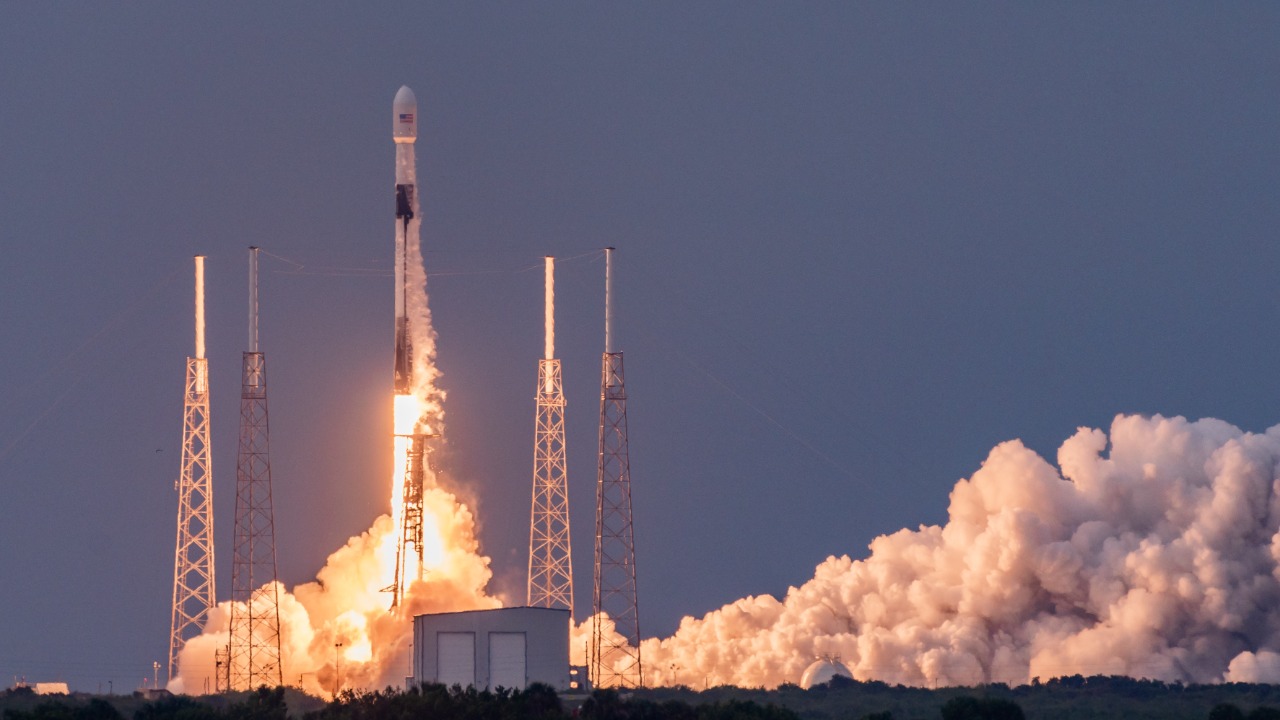

SpaceX has added another cluster of broadband spacecraft to its growing Starlink constellation, lofting 29 satellites from Florida and extending a rapid cadence of Falcon 9 missions to low orbit. The latest flight reinforces how central Florida’s Space Coast has become to the company’s internet ambitions and to the broader commercial launch economy.
The mission also underscores how routine orbital access is starting to look, even when each countdown still carries high technical stakes. With every successful ascent, burn, and landing, SpaceX tightens its grip on the global launch market while pushing Starlink closer to truly worldwide coverage.
Another 29 satellites, another step for Starlink
The newest batch of 29 Starlink satellites rode a Falcon 9 from Cape Canaveral toward low Earth orbit, adding to a network that is already approaching 9,500 active spacecraft. Earlier this year, a Starlink Mission identified as Group 6-96 saw Falcon 9 carry 29 satellites to low Earth orbit at 4:41 p.m. ET, illustrating the template that the latest Florida launch followed in both scale and profile. Each cluster of 29 represents a small fraction of the total constellation, but together they steadily thicken the mesh of coverage that beams connectivity down to users on the ground.
SpaceX describes Starlink as a way to provide broadband internet in regions where terrestrial infrastructure is sparse or nonexistent, and its network, which is approaching 9,500 active satellites, now dominates low Earth orbit. The latest 29 spacecraft join earlier 2026 missions that also carried 29 satellites at a time, including a launch that lifted off at 4:41 p.m. ET on a Friday in Jan as SpaceX’s third mission of the year, according to a detailed mission description. I see this repetition in payload size and timing as a sign that Starlink launches have become a finely tuned production line in orbit.
Florida’s launchpad and a busy January cadence
The latest flight continues a dense run of Starlink activity from Florida’s Space Coast, where a Starlink Mission on a Friday in Jan sent 29 satellites to low Earth orbit from Space Launch Complex 40 at Cape Canaveral Spac. That earlier mission used a Falcon 9 identified as B1078-25 and highlighted the pad’s role as a workhorse for the constellation, as documented in a short launch reel. The new launch again leaned on Florida’s coastal geography, which offers clear corridors over the Atlantic for both ascent and booster recovery.
Local coverage has treated these missions as part of the region’s weekly rhythm, with Jan listings flagging a SpaceX rocket launch from Florida and explaining where and when to watch along the coast. One guide framed a SpaceX Falcon 9 launch from Cape Canaveral as a marquee event for residents and tourists, pointing readers to the best vantage points in Florida. Another schedule noted that on Wednesday, January 14, a SpaceX Starlink 6-98 Mission would see a Falcon 9 send 29 Starlink internet satellites into low Earth orbit, underscoring how tightly packed the Starlink manifest has become in mid Jan.
Falcon 9 performance, landing, and reusability
From liftoff to landing, the latest mission followed a now familiar Falcon 9 choreography that still hinges on precise engineering. During ascent, the rocket passed through the region of maximum aerodynamic pressure, a milestone often called Max Q, as the Vehicles went supersonic and controllers tracked each callout. A broadcast of a recent Starlink launch from Cape Canaveral captured this sequence in detail, with commentary noting Max and the moment of main engine cutoff, or what the caption rendered as Mainaging cut off, before Stage separation confirmed the handoff to the upper stage, all documented in a launch clip. The new flight mirrored that profile, with the upper stage then steering the 29 satellites toward their deployment orbit.
Reusability remains central to the economics of these missions, and the booster again returned to a droneship in the Atlantic Ocean after completing its work. On a recent Starlink flight, Following stage separation, the first stage landed on the Just Read The Instructions droneship stationed in the Atlantic Ocean, a recovery that was highlighted in another segment. A separate mission earlier in Jan saw a booster make its 25th flight while carrying a Starlink batch, a milestone celebrated in a short Blastoff video. I see these repeated landings as the quiet backbone of Starlink’s business case, allowing SpaceX to fly often without building a new first stage for every 29-satellite stack.
What the growing constellation means on the ground
For users, the significance of another 29 satellites is less about the spectacle of launch and more about incremental improvements in coverage and capacity. A recent X Report 13 Jan 2026 noted that SpaceX successfully launched 29 Starlink satellites while U.S. and Chinese launches were on the horizon, framing the mission as part of a competitive landscape in which Starlink is measured against other satellite internet providers. That Report emphasized how each batch strengthens the network’s ability to deliver broadband in remote regions, a point echoed in technical briefings that describe Starlink’s role in filling gaps where fiber and cellular networks fall short.
On the ground in Florida, the launches themselves have become part of the local experience, drawing crowds who treat each liftoff as both a community gathering and a photo opportunity. A guide produced by Lianna Norman Jennifer Sangalang Rick Neale Brooke Edwards for the USA TODAY NETWORK in Florida described how spectators in coastal towns like Daytona Beach and Oak Hill plan around the timing of a SpaceX rocket launch, noting that the glow of a Falcon 9 rising over the ocean makes for a great photo, as captured in a local guide. I find it telling that a project designed to connect rural users worldwide is also reshaping civic life along Florida’s coast, where residents now schedule beach trips around the next countdown.
From local spectacle to global infrastructure
Viewed from the causeways and beaches, a Starlink launch is a brief spectacle of fire and sound, but in orbital terms it is one node in a sprawling infrastructure buildout. A recent overview of SpaceX’s Starlink activity explained that the company launched 29 satellites on its third mission of 2026, with liftoff at 4:41 p.m. ET on a Friday in Jan, and noted that the Falcon 9 upper stage has now flown dozens of times on dedicated Starlink flights, according to a detailed account. Another mission profile described how, on Monday, January 12 at 4:08 p.m. ET, Falcon 9 launched 29 Starlink satellites to low Earth orbit from Spac, reinforcing the pattern of near back to back Starlink Mission launches in early Jan, as outlined in a separate briefing.
Even the way people follow these launches is evolving, with high resolution imagery and mapping tools letting viewers track trajectories and pads in detail. An online place viewer that highlights Cape Canaveral and the surrounding area gives a sense of how tightly clustered the launch complexes are along the coast, as seen in a mapping view. Video compilations titled simply Blastoff capture Falcon 9 arcs from multiple angles, including one clip that shows 29 Starlink satellites departing Florida and a Fal coning through the sky before the booster returns to a droneship, as seen in a popular Blastoff montage. I see these tools and videos as part of the same story as the satellites themselves: a world where spaceflight is not just a rare national event but a regular, trackable part of daily digital life.
More from Morning Overview