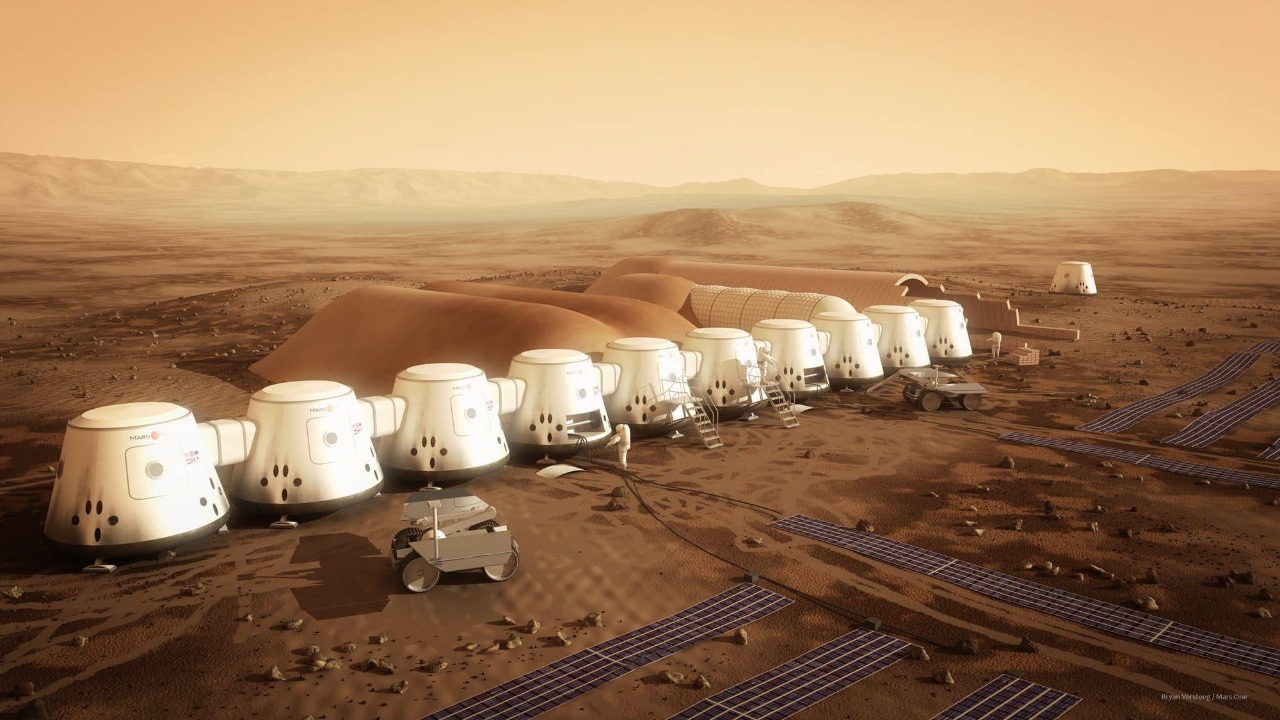

For decades, the idea of people living on Mars has felt like a distant fantasy, limited by the brutal cost of hauling everything from Earth and the difficulty of building safe shelters on a hostile world. That picture is starting to shift as engineers quietly solve the hardest part of the problem: how to construct real infrastructure using Martian soil itself. A cluster of new techniques for making bricks, concrete and even self-assembling structures from local material is turning the dream of a permanent foothold on the Red Planet into a practical engineering challenge rather than a science fiction plot.
The new Martian brick that changes the equation
The most striking development is a method that lets future settlers turn raw Martian dust into solid building blocks without importing heavy equipment or binders from Earth. NASA scientists have announced a way to create robust bricks on Mars using only local dust, minerals and a small amount of human sweat, effectively turning the grit under an astronaut’s boots into structural material. In reports shared in Jul, the agency described how this process could produce dense, durable bricks that lock together into walls and radiation shields, cutting out the need to ship conventional construction materials across interplanetary space.
What makes this so disruptive is not just the chemistry, but the logistics. Launching one kilogram of cargo from Earth is already expensive, and a settlement would need thousands of tons of material for habitats, storage and shielding. By relying on Martian dust and minerals, the NASA approach slashes that mass requirement and lets crews scale up construction as they go, brick by brick, instead of waiting for resupply. The technique, detailed in a Facebook group post on NASA scientists, frames human presence not as a fragile outpost, but as a growing worksite where the planet itself becomes the raw stock for expansion.
From improvised shelters to full Martian communities
Once you can make a single brick, the next question is whether you can build entire neighborhoods. Follow up work has shown that scientists have successfully created bricks strong enough to support not just small test structures, but the foundations of full-scale habitats. Using similar principles that combine Martian dust with minimal additives, researchers have demonstrated blocks that could be stacked into domes, tunnels and multiroom shelters capable of housing crews for months at a time. The same Jul reporting on NASA’s work has been echoed in other technical communities, where engineers argue that these bricks could underpin entire communities on Mars rather than just emergency bunkers.
That shift in ambition matters because it changes how mission planners think about timelines. Instead of shipping prefabricated modules for every new crew, agencies could send a compact starter kit of tools and rely on local brick production to expand living space, storage and even agricultural enclosures. The idea that settlers might one day walk through streets lined with structures made from Martian dust is no longer a poetic metaphor, but a scenario grounded in lab-tested materials. One widely shared discussion of how scientists have successfully created bricks robust enough for entire communities captures how quickly the field has moved from proof of concept to city-scale thinking.
Self-building tech and shape-optimized structures
Material is only half the story. The other half is how to assemble it in a place where human labor is scarce, dangerous and expensive. In June, a study from Texas A&M University, working with the University of Nebraska-Lincoln, introduced a self-building technology that could let habitats on Mars assemble themselves from modular components. The concept uses robotic systems and smart joints that lock together autonomously, guided by algorithms that account for Martian gravity and the properties of regolith, which consists of dust, sand and rocks. Instead of astronauts spending weeks in bulky suits stacking bricks, swarms of machines could raise walls and roofs while crews focus on science and survival.
At the same time, structural engineers are rethinking what Martian buildings should look like in the first place. Rather than copying Earth-style boxes, they are designing shape optimized structures that use arches, shells and curved forms to handle pressure differences and radiation with far less material. One detailed analysis shows that such structures can remarkably reduce the energy and material required for construction, while also eliminating the need for large imports from Earth. The study argues that these optimized geometries, when combined with in situ concrete and regolith-based bricks, can lead to sustainable colonization on Mars by aligning architecture with the physics of the environment. The case for these designs is laid out in research that notes how Such structures reduce both energy and imported mass, a crucial advantage when every kilogram counts.
When I put these threads together, the picture that emerges is of a construction ecosystem that is both automated and highly efficient. Self-building systems from Texas and the University of Nebraska, Lincoln can handle the assembly, while shape optimized shells minimize the amount of Martian material that needs to be processed in the first place. That combination does not just make habitats cheaper, it makes them faster to deploy, which is vital in the narrow windows when launch trajectories and Martian seasons line up in favor of new arrivals.
Concrete, 3D printing and the rise of in situ manufacturing
Bricks and shells are powerful tools, but long term settlements will also need heavy duty infrastructure: landing pads, radiation bunkers, pressure locks and industrial floors. Here, researchers are turning Martian soil into a kind of waterless cement known as AstroCrete. Studies of future Mars settlements, often described as the Red Planet’s first towns, point out that All the key ingredients for this material, including regolith, certain salts and even biological components, will be available in relative abundance in Martian environments. AstroCrete made from Martian regolith and human byproducts behaves like a tough concrete that can be cast into slabs and beams without relying on scarce water, which is too valuable to waste on construction. One technical overview notes that All of these components can be sourced locally, making AstroCrete a cornerstone of Martian civil engineering.
Alongside concrete, 3D printing is emerging as the workhorse for turning raw regolith into precise parts. Techniques originally developed for products as mundane as an airless basketball are being adapted to extraterrestrial construction. One analysis of advanced additive manufacturing notes that this approach not only reduces the need for carrying heavy payloads from Earth, but also offers the potential for rapid prototyping and adaptability to the unique Martian environment. The same logic that lets engineers print a complex lattice for a sports ball can be applied to printing pressure vessels, support trusses and custom connectors on Mars, all tuned to local gravity and temperature swings. The broader promise of this method is captured in work showing how 3D printing can cut launch mass from Earth while boosting flexibility on site, a point underscored in coverage of how printing directly from regolith reduces the need to ship bulky components from Earth.
A broader blueprint for sustainable colonization
Behind these individual breakthroughs sits a larger strategic shift in how space agencies and researchers think about Mars. Instead of treating each mission as a one-off expedition, planners are sketching a comprehensive blueprint for colonization that assumes permanent, growing infrastructure. A recent synthesis of this thinking argues that Technological evolution is central to making Mars habitable in a sustainable way. It highlights Key advancements in propulsion, in situ resource utilization, closed-loop life support systems and advanced robotics as the pillars of a long term presence. In that framework, construction technologies like regolith bricks, AstroCrete and self-building habitats are not side projects, but core enablers of a settlement that can expand without constant resupply. The same work on Technological evolution on Mars makes clear that construction, life support and robotics must advance together if colonization is to move beyond flags and footprints.
Self-building systems, shape optimized structures and in situ materials are already being woven into that broader roadmap. In June, the work from Texas and the University of Nebraska, Lincoln on self-assembling habitats was framed explicitly as a bridge from science fiction to operational reality, showing how regolith-based modules could be deployed in advance of human crews. Combined with NASA’s Jul breakthroughs on Martian bricks and the growing body of research on sustainable concrete, these developments suggest that the hardest part of colonizing Mars may no longer be the rockets, but the patience to test and refine the tools that will turn dust into cities. As I look across the emerging blueprint, the shocking part is not that colonization is possible, but that the practical pieces are arriving faster than the public conversation has caught up, quietly making a permanent human presence on Mars feel less like a fantasy and more like an engineering deadline.
More from Morning Overview