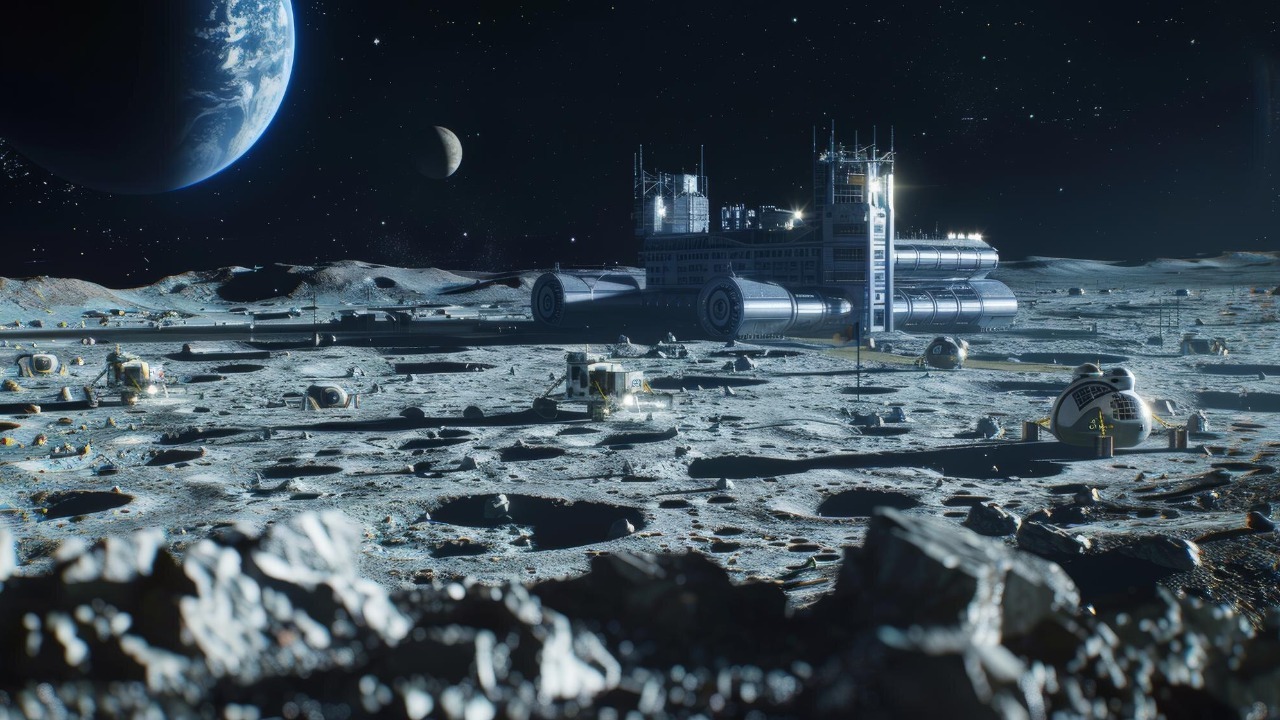

For decades, the Moon was treated as a dead end, a place where flags and footprints marked the limits of human reach. Now scientists and mission planners are recasting it as a working outpost, a place to mine water, make fuel, and rehearse the hardest parts of deep space travel. The idea is simple but radical: if crews can treat the lunar neighborhood as a cosmic pit stop, Mars and more distant worlds start to look far less remote.
That shift is reshaping space policy, industrial plans, and the timelines for human exploration. Instead of launching everything from Earth, agencies and companies want to tap lunar resources, build infrastructure in orbit, and turn the Moon into a logistics hub that lowers the cost and risk of going farther.
Why the Moon is suddenly prime real estate
The modern case for the Moon starts with physics and proximity. It sits just three days away, close enough for rapid rescue yet far enough to operate outside Earth’s protective magnetic cocoon. That makes it a natural test bed for life support, radiation shielding, and surface operations that will be essential on Mars. NASA has argued that The Moon presents numerous exciting engineering challenges, from dust management to thermal extremes, that can sharpen technologies and procedures before crews commit to multi‑year journeys.
Strategists also see the Moon as a way to break the tyranny of Earth’s gravity. Every kilogram launched from the ground has to fight through a deep gravity well, which is why propellant dominates most rocket mass. By shifting some of the work of storing supplies, assembling spacecraft, and eventually producing fuel to cislunar space, planners hope to move those essentials off the Earth and into a more efficient staging area. That logic underpins NASA’s view that long‑term exploration and development of the Moon will give us the experience for the next giant leap, including human missions to Mars and destinations beyond.
Turning lunar ice into rocket fuel
The most transformative idea in this new lunar economy is to make propellant on site. Remote sensing and impact experiments have revealed water ice in permanently shadowed craters near the poles, and researchers have also found evidence of water on the Moon’s sunlit surface. One analysis reported that Researchers found evidence of water that could support colonization and a pit stop for manned missions to Mars. If that ice can be mined and split into hydrogen and oxygen, the Moon stops being just a destination and starts to look like a refueling depot.
Scientists have begun to sketch out how such a depot might work in practice. One concept envisions robotic excavators hauling icy regolith to processing plants, where solar or nuclear power would drive electrolysis to produce liquid oxygen and hydrogen. A detailed proposal described how, to explore space, scientists want to turn the Moon into a gas station, with Payne Institute Faculty Fellow George Sowers arguing that propellant made from lunar ice could be stored in orbit and sold to passing spacecraft. A complementary analysis of moon water ice as rocket fuel has reinforced the point that using local resources could turn the Moon from a scientific research post into a critical node in a broader spacefaring network.
Practicing for Mars with Artemis and The Gateway
NASA’s Artemis program is the backbone of this pit‑stop strategy. The agency plans a sequence of missions that build from flyby to landing, with Artemis II set as the first crewed test flight of the Space Launch System, known as SLS, and the Orion spacecraft. That mission will carry four crew members on a lunar flyby, validating deep space navigation, communications, and life support before later flights attempt landings near the south pole. After decades of shifting plans and delays, reporting has noted that Now, NASA is positioning 2026 as the year humanity finally goes back to the Moon in earnest, with crews expected to see the lunar surface up close again.
Orbiting above that surface, The Gateway is planned as the first space station beyond low Earth orbit, a small but powerful platform in a near‑rectilinear halo orbit around the Moon. According to program descriptions, The Gateway will support science disciplines from heliophysics to human physiology and serve as a staging point for landers and deep space vehicles. Earlier this year, NASA reported that engineer Briana Zamora and colleagues started up Gateway’s Power and Propulsion Element, or PPE, which uses advanced BHT‑6000 thrusters to provide efficient solar electric propulsion. That kind of infrastructure is what will allow crews to dock, refuel, and depart for Mars without hauling every kilogram of propellant from Earth.
The Moon as a training ground and logistics hub
Beyond hardware, the Moon offers a way to rehearse the choreography of interplanetary travel. Space policy expert John Logsdon has argued that “the moon makes sense as a way to practice for Mars,” noting that crews can test habitats, rovers, and surface operations in a place where help is still only days away. In that context, NASA’s planners see the lunar campaign as a way to move those essentials off the Earth and into a sustainable supply chain. A detailed overview of NASA’s Mars ambitions explained that Mars, John Logsdon, Space Policy Institute thinking has helped frame the Moon as a proving ground where mistakes are survivable and lessons can be fed directly into Mars mission design.
Logistics experts have reached similar conclusions from a different angle. One analysis asked, Could the Moon act as a kind of space‑faring pit stop on the way to Mars, and answered that the real challenge is a logistics and resupply problem. Writer Could the argument, drawing on work by Samantha Larson from The Smithsonian, emphasized that staging fuel and supplies in lunar orbit or on the surface could dramatically cut the mass that has to leave Earth. In a separate technical study, researcher de Weck noted that “the idea of taking a detour into the lunar system … it’s very unintuitive,” but from an optimal network perspective it can be the cheapest way to get humans to Mars. That analysis of a Lunar Pit Stop concluded that what looks like a detour on a map can be a shortcut in terms of energy and cost.
A crowded cislunar future
The vision of the Moon as a service station is arriving just as launch capabilities and commercial interest are ramping up. Analysts have described 2026 as the year spaceflight reaches for the Moon and beyond, with SpaceX targeting an orbital refueling demonstration around mid‑year and a simplified architecture for NASA’s human landing plans. That roadmap highlights how NASA intends to rely on commercial heavy lifters and in‑space refueling to support Artemis. A separate preview of upcoming missions noted that the next big step on SpaceX’s Starship roadmap is a refueling demo, with odds of it happening in 2026 estimated at 50 percent, underscoring how central Starship is to the broader lunar logistics picture.
At the same time, the Moon itself is about to get busy. A survey of upcoming missions described a “Moon rush,” with multiple private spacecraft planning lunar landings in 2026, a sign that commercial players are eager to test landers, prospect for resources, and offer delivery services. One report on this Moon rush: These private spacecraft emphasized that launch schedules and mission readiness will determine how many actually reach the surface. In parallel, planners have scheduled Blue Ghost Mission 2, a collaboration between NASA, Firefly Aerospace, Blue Ghost Mission, Moon, to land on the far side near the south pole in late 2026, targeting the same icy regions that could one day feed lunar fuel plants.
All of this activity points toward a near future in which the Moon is no longer a quiet backdrop but a working crossroads. If the ice is as accessible as early data suggest, and if systems like SLS, Orion, The Gateway, and commercial refueling demos perform as planned, the idea of a cosmic pit stop will shift from theory to infrastructure. At that point, the question will not be whether to use the Moon as a waystation, but how quickly that new cislunar economy can scale to support the first sustained human journeys to Mars.
More from Morning Overview