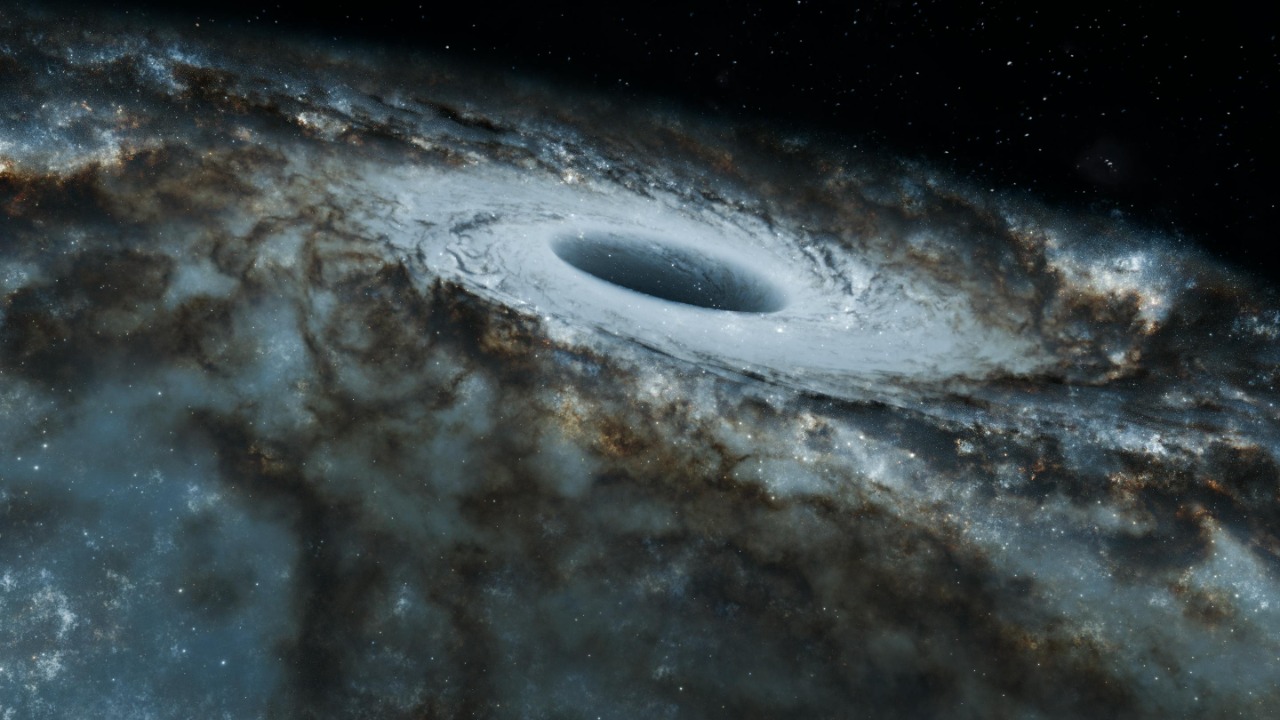

Physicists are increasingly entertaining a radical possibility: our familiar universe of three dimensions of space and one of time might be only part of a larger structure, with a hidden fifth dimension subtly influencing everything from gravity to the fate of galaxies. Instead of a clean separation between our reality and any extra dimensions, some researchers argue that energy and particles could be bleeding across that boundary. If they are right, the strange forces we label dark matter and dark energy might be the fingerprints of a deeper, five-dimensional cosmos.
In this view, the cosmos is not just expanding, it is interacting with a larger geometric arena, and the evidence could already be in the data from telescopes and particle accelerators. The idea is speculative but not whimsical, rooted in decades of work on higher dimensional theories and sharpened by new models that try to connect the fifth dimension to concrete observables like particle masses, galactic rotation and the accelerating expansion of space.
Why physicists keep coming back to a fifth dimension
Modern physics has long hinted that four dimensions might not be enough to describe reality. Early work on extra dimensions suggested that gravity could spread out into hidden directions, which would help explain why it is so much weaker than the other fundamental forces we measure in laboratories. Building on that logic, more recent analyses argue that there is a way to add a fifth dimension to the equations of spacetime so that the familiar laws of gravity still hold, while also allowing new effects that could influence how matter and light behave on cosmic scales, an approach explored in detail in discussions of the fifth dimension.
In these models, our universe is often treated as a four dimensional “brane” embedded in a higher dimensional “bulk,” with the extra direction curled up or otherwise hidden from direct view. The mathematics allows particles and fields to be mostly confined to the brane, while gravity and possibly new particles can extend into the bulk, creating subtle deviations from the predictions of standard four dimensional cosmology. Earlier theoretical work already showed that such unseen dimensions seem to offer one of the best hopes for resolving long standing puzzles in fundamental physics, a point that has been emphasized since at least Jun discussions of extra dimensional gravity.
Dark energy as a sign of reality “leaking” out
The most dramatic clue that something beyond standard spacetime might be at work is the accelerating expansion of the universe, which cosmologists attribute to dark energy. Some theorists now argue that this cosmic acceleration could be a geometric effect of a fifth dimension, rather than a mysterious fluid filling space. In one influential analysis, researchers describe how the Standard Model of particle physics, often called the “instruction manual” for subatomic particles, fits neatly into four dimensions, yet fails to account for dark energy, prompting them to explore whether a hidden dimension could naturally generate the observed acceleration, a possibility examined in detail in work on dark energy.
In a related paper, the same line of research suggests that the separation between our four dimensional world and the extra dimension might not be absolute, and that the effective distance between these layers of reality is actually quite large in geometric terms. That separation would allow energy associated with the expansion of space to be interpreted as a kind of leakage between dimensions, with the observed dark energy density emerging from the way spacetime curves in five dimensions, an idea developed in models where the gap between dimensions is actually.
A new particle as a possible “portal”
Alongside the geometric arguments, some particle physicists are hunting for a specific messenger that could connect our universe to a fifth dimension. One proposal focuses on a hypothetical particle that would interact very weakly with ordinary matter but strongly with dark matter, effectively acting as a bridge between visible and invisible sectors. In this scenario, the particle’s properties are derived from a five dimensional field that, when projected into our four dimensional world, appears as a new massive particle whose behavior could be tested in high energy experiments, a concept explored in detail by researchers suspecting a new portal like interaction.
Other teams have framed this same idea in more evocative language, describing how a carefully constructed model of particle interactions can look like a “portal to the fifth dimension” without invoking any science fiction shortcuts. In these analyses, the candidate particle emerges naturally when theorists extend the Standard Model into five dimensions and then compactify the extra direction, producing a tower of related states that could leave signatures in collider data or astrophysical observations, a framework that has been highlighted in reports that physicists may have such a connection.
Dark matter, Johannes Gutenberg University Mainz, and the PRISMA Cluster of Excellence
Dark matter, which appears to make up most of the universe’s mass, is another arena where a fifth dimension might be hiding in plain sight. A group from Johannes Gutenberg University in Mainz, working within the PRISMA Cluster of Excellence, has developed a model in which dark matter arises from fields that propagate in an extra dimension, while ordinary matter remains largely confined to our familiar four dimensional slice. In this picture, the production of dark matter in the early universe is tightly linked to the geometry of the fifth dimension, with the density and distribution of invisible matter today reflecting how that extra direction shaped particle interactions when the cosmos was young, a connection detailed in work from Johannes Gutenberg University and the PRISMA Cluster of Excellence.
More broadly, theorists have suggested that extending the Standard Model into a five dimensional framework can simultaneously address the origin of dark matter and the smallness of neutrino masses, while also offering new ways to test these ideas through precision measurements. One detailed overview of such models explains how the extra dimension can host fields that do not appear in four dimensional theories, yet still influence observable physics through their shadows in our spacetime, an approach that has been summarized in analyses of a new theory that ties the fifth dimension to dark sector particles.
From serious theory to viral “portals”
As these ideas filter into popular culture, the language of portals and hidden dimensions has taken on a life of its own. Social media posts now routinely describe claims that researchers have found a “Portal to the Fifth Dimension,” prompting debates among enthusiasts and skeptics about how much of this is grounded in real physics and how much is marketing. One widely shared discussion thread, for example, reacts to a claim that researchers just revealed such a portal and questions whether this is conjecture or a clever way to pique interest in the genuine science of dark matter, a tension captured in conversations about Researchers and the Fifth Dimension.
At the same time, more traditional science coverage has tried to walk a careful line, acknowledging that talk of portals can sound like fantasy while stressing that the underlying models are built from standard quantum field theory and general relativity. One detailed report notes that, if a portal like particle exists, it would not resemble a cinematic wormhole but rather a subtle new field that slightly alters how dark matter clumps or how particles scatter in accelerators, a point underscored in analyses that urge readers to Forget the usual science fiction imagery.
What evidence might finally settle the question
For now, the fifth dimension remains a mathematical construct, but researchers are actively looking for ways to test whether it has physical consequences. One strategy focuses on precision cosmology, using observations of supernovas, the cosmic microwave background and galaxy clustering to see whether the data fit better with a five dimensional model than with standard dark energy. Another approach looks at how dark matter might interact with ordinary matter through a portal particle, with teams examining everything from underground detectors to astrophysical signals to see whether the statistics point toward a hidden dimension, a search described in detail in reports that Researchers link dark matter to a fifth dimension.
Public facing explainers have also tried to clarify how these tests might work, noting that physicists have been exploring the possibility of a fifth dimension to explain puzzles like the elusive nature of dark matter and the behavior of gravity at different scales. Some of these discussions emphasize that the evidence would not come from a single dramatic event but from a pattern of small deviations in many experiments, a point made in summaries that ask whether there is a 5th dimension beyond space time and in video explainers that pose the question of what if the world we see is not the whole story, as in presentations that start from the premise of What if the universe hides extra structure.
How far the theory can go without data
Even as the models grow more sophisticated, many theorists are careful to stress the limits of what can be claimed without direct evidence. Some analyses of five dimensional cosmology explicitly note that, while the mathematics can reproduce the observed acceleration of the universe and the distribution of dark matter, alternative explanations within four dimensional physics remain viable. Others point out that the Standard Model, despite its gaps, has been extraordinarily successful as an “instruction manual” for subatomic particles, and that any extension into a fifth dimension must reproduce its predictions to high precision, a constraint that is central to technical discussions of the Standard Model in higher dimensions.
Still, the field is moving quickly, with new preprints and conference talks regularly revisiting whether our reality might be “leaking” into a larger dimensional structure. Some commentators have framed recent theoretical work as a potential discovery of a portal to the fifth dimension, highlighting how innovative extensions of known physics could finally connect dark matter, dark energy and gravity in a single framework, a narrative echoed in reports that Scientists Say They such a link. Whether the fifth dimension turns out to be a real feature of nature or a useful mathematical tool, the effort to test it is already reshaping how physicists think about the universe.
More from Morning Overview