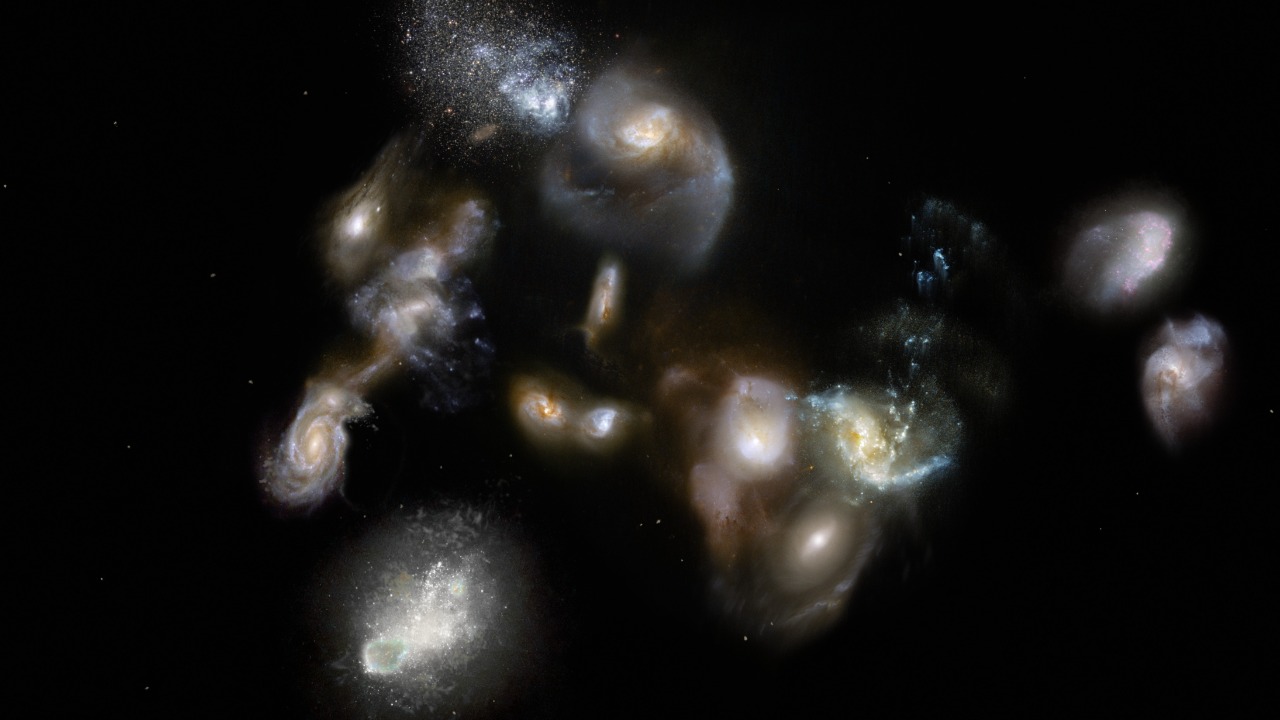

Deep space has just delivered a cosmic curveball: an object that behaves so strangely it appears to break the rules astronomers use to describe how the universe grew up. The discovery centers on an extremely hot, tightly packed galaxy cluster that seems far too mature for its age, an “impossible” structure that forces scientists to revisit what they thought they knew about the early cosmos. I see it as part of a broader pattern, where each new exotic signal or ghostly cloud reveals that the universe is more inventive than our current theories allow.
The galaxy cluster that should not exist
The heart of the mystery is a blisteringly hot galaxy cluster that formed when the universe was still very young, yet already looks as massive and organized as structures that took billions of years to assemble in standard models. Astronomers analyzing its properties found that the gas in this cluster is heated to extreme temperatures and moving at extraordinary speeds, more than 5,000 times faster than typical sound waves, which is wildly out of step with expectations for such an early epoch. One researcher put it bluntly, arguing that “something in the early universe” must have been pumping in energy, likely three recently discovered supermassive black holes in the core that are driving violent activity inside the cluster, according to reporting on this Jan result.
What makes this object feel “impossible” is not just its temperature or speed, but its timing. In the standard picture of cosmic evolution, galaxy clusters grow gradually as gravity pulls smaller groups together, so the most massive and turbulent clusters should appear relatively late in the universe’s history. Instead, this cluster looks like a fully fledged heavyweight in an era when such giants were not supposed to exist, echoing earlier images of forming clusters such as SPT2349-56, where an artist’s impression showed radio jets from active galaxies embedded in a hot intracluster medium inside the nascent structure labeled with the number 56. The new cluster goes further, suggesting that the recipe for building large scale structure, and the role of early black holes in stirring and heating that gas, may need to be rewritten.
A ghostly dark cloud with no stars at all
At roughly the same time that astronomers were grappling with this overachieving cluster, another team using Hubble uncovered a very different kind of oddity: a vast, invisible structure that seems to be made almost entirely of dark matter. The object, nicknamed Cloud-9, shows up not through its own light but through its gravitational pull on surrounding galaxies, which betray the presence of a massive cloud that contains no stars. Hubble has revealed that this strange cosmic object, described as a dark matter dominated cloud with no stars at all, is warping the motions and distribution of nearby material in a way that signals a huge hidden mass, according to a detailed report on Hubble and the detection of Cloud-9.
Cloud-9 is not just a curiosity, it is the first confirmed detection of this specific kind of dark structure, identified by a NASA team using the Hubble Space Telescope to track how gravity sculpts the surrounding field. Researchers describe it as a dark matter dominated cloud with no stars, a configuration that challenges assumptions that dark matter halos inevitably seed visible galaxies. NASA has framed the find as a crucial new clue to early galaxy formation, arguing that this object, labeled RARE among known structures, could reveal why some dark matter clumps light up with stars while others remain forever dark.
The “ghostly object” that links the two extremes
Cloud-9 is not alone in this new category of barely visible structures. Astronomers have also reported an unexpected ghostly object in the depths of space, a vast reservoir of gas that contains no stars and yet exerts a clear gravitational influence. Scientists describe this ghostly object as a new type of astronomical structure, a cloud of gas that contains no stars but still shapes its environment, suggesting that there may be an entire population of such dark or dim entities that standard surveys have missed. The team behind the discovery emphasizes that this kind of object forces a rethink of how gas, dark matter, and star formation interact in the early universe, as detailed in coverage of how Astronomers and Scientists are mapping these ghostly clouds.
When I put the hot cluster and these starless clouds side by side, a pattern emerges. On one end, there is a galaxy cluster that is too energetic and too mature for its age, hinting at overactive black holes and rapid assembly. On the other, there are dark matter dominated clouds like Cloud-9 and the ghostly gas object that seem to have stalled before forming any stars at all, despite sitting in massive halos. One analysis of deep space objects notes that while Cloud-9 and the ghostly cloud are puzzling in their own right, the extremely hot galaxy cluster is not behaving as expected either, underscoring how these disparate discoveries collectively strain current models of structure growth, as highlighted in a report on how Astronomers are confronting multiple anomalies at once.
Strange signals from compact objects closer to home
The universe’s taste for the uncanny is not limited to distant clusters and dark clouds. Within our own galaxy, radio telescopes have uncovered compact objects that defy expectations about how dead stars behave. One striking example is the ultra long period magnetar GPM J1839–10, a highly magnetized neutron star that pulses in radio waves every 22 minutes, a rhythm so slow it should be impossible for a standard magnetar to maintain. NRL scientists using the VLITE instrument confirmed that magnetar GPM J1839–10 has been pulsing regularly every 22 minutes, and after scouring historical data they found that this bizarre pattern has persisted for decades, a result that has now been published in Nature and documented in detail by NRL and the VLITE team.
Other radio surveys have picked up strange space objects that emit powerful radio waves in bursts, then fall silent for long stretches, behavior that does not fit neatly into known categories like pulsars or standard magnetars. One such object, described as having roughly the mass of our sun, produces radio signals that switch on and off in a way that suggests an exotic magnetic configuration or an entirely new class of stellar remnant. Coverage of these detections notes that the signals were strong enough to trigger a Media Error in some playback systems, a reminder of how raw and unexpected the data can be when telescopes stumble onto something that standard software is not prepared to handle.
Interstellar visitors and the bigger cosmic puzzle
While these deep space anomalies challenge our understanding of cosmic structure, smaller wanderers passing through our own neighborhood are raising their own questions about how typical our solar system really is. The interstellar comet 3I/ATLAS, for example, has given astronomers a rare chance to study material that formed around another star and then drifted into our planetary backyard. Observations show that Comet 3I/ATLAS made its closest approach to Earth on December 19, a flyby that highlighted how its activity is driven by outgassing of volatile ices as it approaches the Sun, a behavior that confirms its status as an Interstellar object and underscores how different its composition is from many local comets.
Earlier observations of 3I/ATLAS showed that after the comet made its closest approach to the Sun, it was expected to remain out of view of Earth until around the middle of the decade, as its trajectory carried it back into deep space. NASA scientists have described 3I/ATLAS as an interstellar comet that is moving on a hyperbolic path that will never return, a one time visitor that offers a fleeting look at chemistry shaped in another planetary system, as summarized in reporting on how ATLAS approached the Sun and then faded from view. Spectroscopic work using large telescopes and space based instruments has gone further, using data from two observatories to build a detailed spectral portrait of 3I/ATLAS, including an image captured with Hubble’s Wide Field Camera 3 that reveals how its surface has been altered by long exposure to the interstellar medium, as described in a technical analysis of ATLAS and Hubble’s Wide Field Camera.
When I step back from the details, the throughline is clear. From the “impossible” hot cluster and the dark matter dominated Cloud-9 to ghostly gas clouds, ultra long period magnetars, and interstellar visitors like Comet 3I/ATLAS, the universe keeps presenting objects that do not fit neatly into existing categories. Each one forces theorists to adjust models of how matter clumps, how black holes feed, how magnetic fields evolve, and how material from other stars drifts through our skies. The impossible object lurking in deep space is not a single anomaly, it is a sign that the cosmos is still full of surprises, and that our current picture of its past is, at best, a first draft.
More from Morning Overview