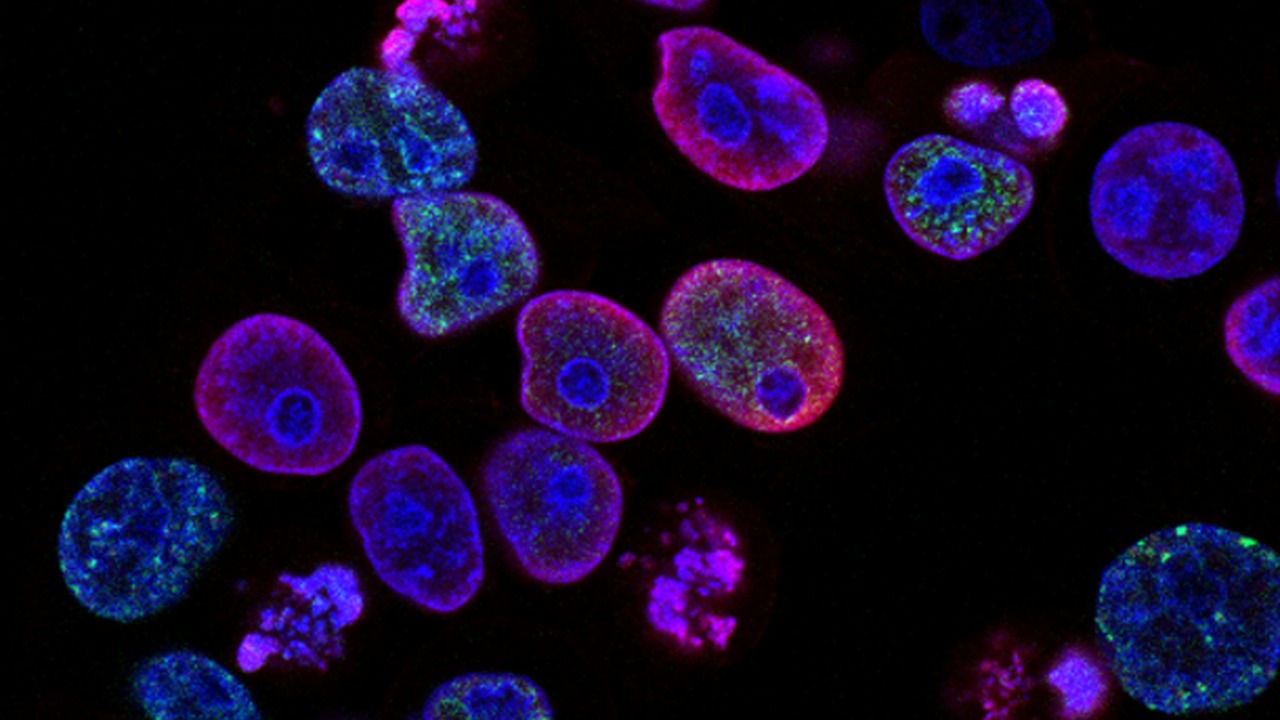

Scientists mapping the human body at the cellular level keep running into the same surprise: beneath the apparent chaos of tissues and organs, there is a hidden order that looks a lot like pure mathematics. From the way cells are sized and arranged to the branching of neurons and blood vessels, researchers are finding repeating numerical patterns that echo structures in nature, language and even quantum computing. I see a picture emerging in which the body is not just built from biology, it is also constrained and guided by deep mathematical rules.
Those rules are now being traced from the scale of individual RNA strands up to the architecture of whole organs. The work is still in its early stages, but it is already reshaping how scientists think about development, disease and the possibility of predicting what tissues will do next. The more closely researchers look, the more the human body starts to resemble a living equation.
The strange pattern hiding in a census of human cells
When researchers set out to count every major type of cell in the human body, they expected a messy catalog, not a clean curve. Instead, after more than a decade of work estimating how many cells of each kind we carry, they found that cell types, when ranked by size and abundance, fall into a regular mathematical relationship that repeats across the body. The project showed that human cells, although they vary widely and are far from the same size, collectively follow a predictable distribution that links their mass to how common they are.That discovery, described as a familiar mathematical pattern that also appears in nature and language, suggests that the body’s cellular makeup is not arbitrary but organized along a statistical rule that keeps different categories in balance. The analysis, which drew on data for all of the major cell types, revealed that the number and size of cells line up along a curve that mirrors patterns seen in word frequencies and city sizes, a result highlighted in a detailed report on how a catalog of all human cells reveals a mathematical pattern. A companion account of the same work notes that this effort, which began more than ten years ago, showed that the roughly 200 or more cell categories in the body, although far from the same size, still conform to a shared numerical rule, as summarized in coverage of how Sep researchers estimated how many cells make up the human body.
From red blood cells to neurons, a repeating size–number rule
Once scientists had that census, a second surprise emerged: the same size–number relationship seemed to hold across wildly different cell types, from oxygen-carrying corpuscles to the branching neurons that govern thought. When they plotted how many cells of each type exist against their typical mass, they saw that small cells are vastly more numerous, while large cells are rarer, in a way that follows a consistent mathematical curve. This is not just a vague trend, it is a specific pattern that keeps the categories of cells “even” in terms of their total contribution to body mass.In practical terms, that means the body appears to be tuned so that tiny red blood cells, mid-sized immune cells and bulky muscle fibers all share the load in a balanced way, rather than one category dominating the others. Reporting on this work describes how the pattern links the abundance of each cell type to its size, suggesting that evolution has settled on a rule that optimizes how tissues are packed and resourced, as explained in an analysis of how From the oxygen-carrying corpuscles in our blood to the branching neurons that govern our thoughts, our body is built. A related account emphasizes that these cells follow a mathematical pattern based on size and mass that appears elsewhere in nature, reinforcing the idea that the same statistical law is at work in ecosystems, languages and the human organism, as described in coverage of What these cells reveal about a pattern that repeats in nature and language.
A “tissue code” of simple rules behind complex organization
Finding a statistical pattern in cell sizes is one thing, but it still leaves open how tissues maintain their intricate structure over a lifetime of wear, tear and repair. To tackle that, scientists from ChristianaCare and the University of Delaware turned to mathematics again and reported that a surprisingly small set of rules can explain how tissues stay organized. Their work suggests that instead of needing a unique instruction for every cell, the body relies on a handful of principles that govern when cells divide, where they move and how they are replaced.
In their model, five rules act like a “tissue code” that choreographs the behavior of stem cells and their descendants, turning static cell maps into dynamic predictions of how tissues renew themselves. The researchers argue that this code can help explain why some tissues are resilient while others are prone to cancer or degeneration, and they frame it as a kind of hidden blueprint that math can help decode, as detailed in a report on how New research from ChristianaCare and the University of Delaware shows how math can help unlock the body’s hidden blueprint. A complementary summary describes how these five rules can be used to turn static snapshots of tissue into forecasts of future behavior, underscoring that the same simple code can generate a wide variety of healthy and diseased patterns, as outlined in coverage of how Scientists have uncovered a surprisingly simple “tissue code”.
Fractals: the rhythm of life from cells to organs
Alongside these statistical laws, another kind of pattern keeps surfacing in the body: fractals, shapes that repeat their structure at different scales. Decades ago, Boston University researchers studying cellular activity reported that the timing of certain biological signals follows a fractal rhythm, a mathematically predictable form that repeats over and over across scales. They described this as a “rhythm of life,” in which fluctuations in cell behavior are not random noise but part of a self-similar pattern that can be captured with equations.
That early work showed that processes like heartbeat variability and neural firing can exhibit fractal dynamics, hinting that the body uses scale-free patterns to stay adaptable yet stable. The idea was that the same statistical structure appears whether you look at short or long timescales, a finding that has since influenced how scientists think about everything from heart disease to brain disorders, as highlighted in a report on how Boston University Scientists Find Pattern in Cellular Activity. Later accounts of fractals in biology have expanded that view, describing how the nervous system, blood vessels and organ surfaces all show repeating motifs that let a finite body manage flows of information and nutrients efficiently.
Fractals in the brain, lungs and blood vessels
Nowhere is that fractal architecture more striking than in the nervous system. Neuroscience research summarized in recent work on fractals notes that the brain exhibits a fractal pattern in both structure and activity, with neurons branching like trees and firing in bursts that follow scale-free statistics. The same reporting explains that neurons are arranged so that a small number connect to a large number of other neurons, a pattern that supports efficient communication and resilience, and that this organization can be described with fractal mathematics.Those branching rules are not limited to the brain. Analyses of the body’s geometry point out that the nervous system, blood vessels and the structure of the brain and lungs are all examples of fractal design, echoing the definition by Franco-Polish mathematician Benoît Mandelbrot, who called a fractal “a way of seeing infinity.” In that view, the fine airways of the lungs and the smallest capillaries in the circulatory system are scaled-down versions of the larger branches that feed them, a layout that maximizes surface area and flow within a limited volume, as described in a feature explaining how Franco Polish Beno Mandelbrot, Simply put, defined fractals that appear in our nervous system, blood vessels and lungs. A separate account on the links between quantum computers and biology reinforces this picture, noting that fractals are in our heads and that our brains and nervous systems display these repeating patterns in both their wiring and their dynamics, as summarized in an analysis of how Fractals are in our heads and in our brains and nervous systems.
Universal shapes and the geometry of organs
Beyond branching trees and statistical curves, mathematicians are now arguing that there is a universal class of shapes that can explain how complex biological forms arise. A team from the University of Oxford and Budapest University of Technology and Economics has described a family of geometries that can generate smooth, organic structures with few, if any, sharp corners, mirroring the contours seen in organs and tissues. Their work suggests that many seemingly intricate biological shapes can be produced by varying a small set of parameters within this class.In practice, that means the same underlying mathematics could describe the outline of a leaf, the curve of a heart valve or the folds of a gut, tying together biology and geometry in a single framework. The researchers argue that these shapes are “universal” in the sense that they recur across species and scales, and that understanding them could help explain how growth processes are constrained, as detailed in a report on how A team of mathematicians from the University of Oxford and Budapest University of Technology and Economics have uncovered a new universal class of shapes. A related account emphasizes that these mathematicians see their framework as a way to explain complex biological forms that have smooth boundaries and very few sharp corners, reinforcing the idea that organs sit inside a narrow mathematical design space, as described in coverage of how Mathematicians discover new universal class of shapes to explain complex biological forms.
A mysterious developmental pattern across the whole body
While some of these patterns emerge from large datasets or abstract geometry, others are being spotted directly in how tissues are laid out. Researchers examining cell arrangements across multiple organs have reported a strange mathematical pattern that seems to run throughout the human body, hinting at an undiscovered developmental mechanism. They describe a structured rule that appears to govern how cells are positioned and connected, suggesting that embryonic growth follows a template that is more orderly than previously assumed.
This pattern, which shows up across the entire human organism, is not yet fully explained, but the scientists behind the work argue that it could help clarify how the body maintains coherence as it grows and repairs itself. They also suggest that understanding this rule might improve how medicine locates and destroys cancer cells, by revealing the normal layout that tumors disrupt, as outlined in a report that notes how Mar researchers find a strange mathematical pattern across the entire human organism. A follow up description of the same work stresses that this discovery hints at an undiscovered developmental mechanism that appears to follow a structured pattern, and that decoding it could sharpen tools that locate and destroy cancer cells, as described in coverage that explains how Mar scientists see a pattern that may help medicine locates and destroys cancer cells.
Pure math written into RNA and evolutionary genetics
The body’s mathematical order does not stop at tissues and organs, it reaches down into the code that builds proteins. Work on evolutionary genetics has shown that RNA secondary structures, the folded shapes formed by strands of genetic code that are smaller than proteins, follow strict mathematical rules in how they can arrange themselves. Researchers studying these free floating strands of genetic codes have argued that their possible configurations can be described using tools from pure mathematics, and that evolution appears to exploit this structure.
By mapping which RNA folds are more likely and how they change over time, scientists have found that the space of genetic possibilities is not random but organized along predictable lines, which in turn shapes how proteins and, ultimately, cells evolve. The findings suggest that “pure math” is effectively written into evolutionary genetics, constraining which mutations are viable and which are not, as detailed in an analysis explaining how Smaller than proteins are RNA secondary structures, free floating strands of genetic codes. That perspective links the microscopic world of RNA to the larger scale patterns seen in cells and tissues, reinforcing the idea that mathematics is woven through the body at every level.
Why these patterns matter for medicine and technology
For now, many of these discoveries are descriptive, they tell us that the body follows certain rules, but not yet how to rewrite them. Even so, the implications for medicine are significant. If cell sizes and numbers follow a known curve, deviations from that curve could become early warning signs of disease, long before symptoms appear. If tissues obey a five rule “tissue code,” therapies might be designed to nudge those rules back into balance rather than targeting individual cells in isolation.
Fractal patterns in the brain and blood vessels could similarly guide diagnostics, with disruptions in self-similarity serving as markers for conditions like dementia or cardiovascular disease. At the same time, the recognition that fractals are in our heads and that neurons are wired so that a small number connect to a large number of other neurons has inspired comparisons between the brain and emerging technologies such as quantum computers, as discussed in an exploration of how The researchers showed that neurons are arranged so that a small number connect to a large number of other neurons. As mathematicians refine universal shape classes and geneticists map the mathematical space of RNA, I see a future in which doctors and engineers treat the body less as a black box and more as a solvable, if staggeringly complex, equation.
More from Morning Overview