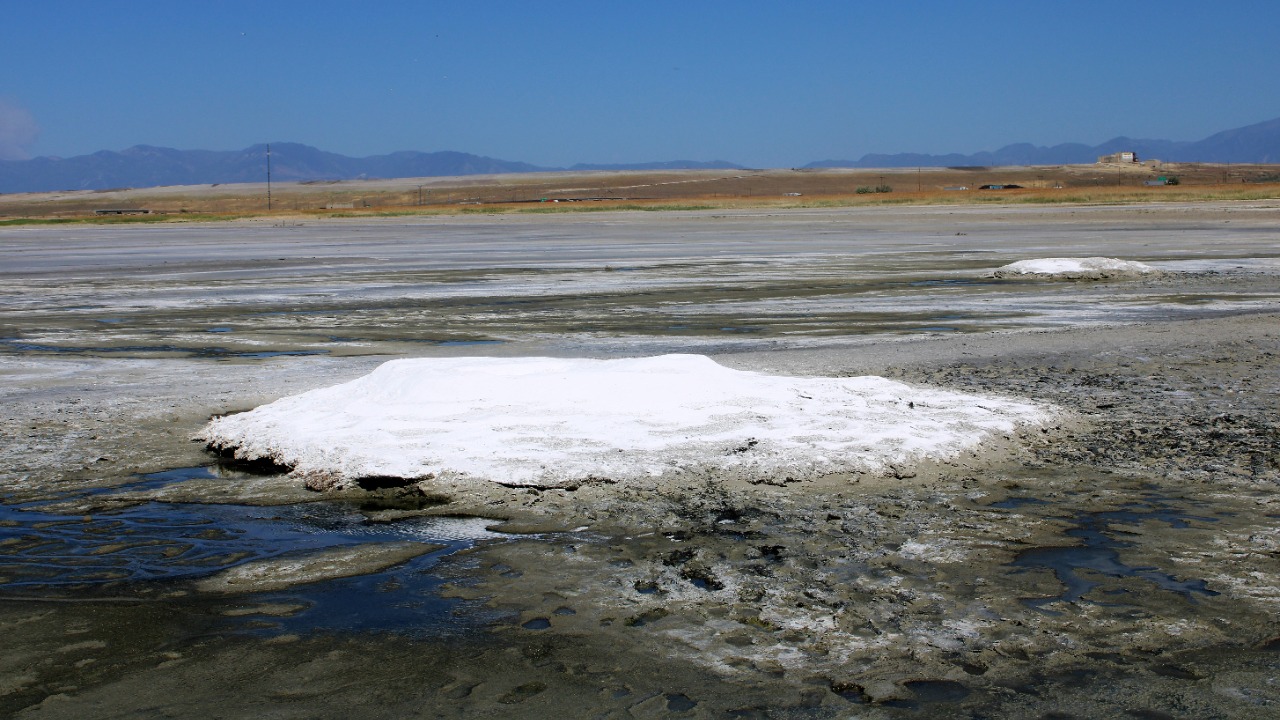

Utah’s Great Salt Lake has just yielded a new resident, a microscopic animal that no one had ever documented there before. The discovery of a tiny roundworm, formally described as a new species, is reshaping how researchers understand one of North America’s saltiest and most stressed water bodies. It is a reminder that even in a lake famous for its stark, inhospitable waters, life is still finding ways to adapt and surprise scientists.
A hidden animal in plain sight
For decades, the Great Salt Lake was thought to host only a short list of animals, dominated by brine shrimp and brine flies that could tolerate its extreme salinity. The new work by Utah biologists shows that this picture was incomplete, because they have now characterized a tiny roundworm that had been overlooked in the sediments and microbial mats that line the lakebed. According to reporting on the project, the team identified the nematode as part of a genus that had never before been recorded in this inland sea, a finding that undercuts the old assumption that only a couple of hardy animal groups could survive here and that most other creatures were excluded by the salt.
The animal itself is so small that it is measured in millimeters, which helps explain why it escaped notice for so long despite the lake’s long history of scientific attention. Researchers describe it as a microscopic roundworm that lives among grains of sand and crystals, a habitat that is easy to miss when surveys focus on larger organisms like brine shrimp. One account notes that Utah biologists have now formally described this nematode as Diplolaimelloides woaabi, a species so small that, despite its abundance, it often goes unnoticed.
Meet Diplolaimelloides woaabi
The newly described animal carries a name that reflects both its scientific lineage and its local roots. The genus, Diplolaimelloides, is typically associated with coastal and estuarine environments, which makes its presence in a landlocked hypersaline lake particularly striking. The species name, woaabi, was chosen to honor the Indigenous history and cultural connections tied to the lake, signaling that this is not just a biological discovery but also a moment to recognize the human communities that have lived with these waters for generations. By placing the worm within Diplolaimelloides, taxonomists are also signaling that it is part of a broader group of nematodes that are adapted to salty, dynamic environments, even if this particular lineage had never before been seen in Utah’s inland basin.
Descriptions of the animal emphasize that it is a new species of worm that is absolutely not a snake, despite some early social media confusion about the word “worm” and the lake’s eerie reputation. Instead, it is a classic nematode, with a slender, cylindrical body and a lifestyle that involves feeding on microbes and organic particles in the sediment. Reporting on the formal description notes that this new species, Diplolaimelloides woaabi, was identified in the Great Salt Lake and may exist nowhere else on Earth, which immediately raises questions about how such a specialized creature evolved in such an unlikely place.
How scientists finally spotted the lake’s newest resident
The story of how this worm was found starts with a hunch that the Great Salt Lake’s food web was more complex than the textbook version suggested. A group of researchers from the University of Utah began to suspect that nematodes might be present after noticing hints of microscopic life in sediment samples that did not match the known brine shrimp and brine fly communities. What began as a promising idea turned into a multi‑year effort, with scientists collecting cores of mud, carefully washing and sieving them, and then examining the results under high‑powered microscopes. Over time, they built up enough evidence to confirm that they were looking at a previously undocumented animal that had quietly been part of the lake’s ecosystem all along.
Accounts of the project describe how the team’s work stretched over several years, from early sampling campaigns to the painstaking process of sorting and identifying tiny worms one by one. One report notes that researchers have identified a tiny roundworm that is only a fraction of a millimeter long, yet robust enough to survive in the lake’s briny conditions, and that this microscopic discovery took roughly three years of focused effort to confirm. The same reporting explains that the scientists ultimately concluded that this roundworm is a new species, adding that researchers have identified a tiny nematode that had never before been recorded in the Great Salt Lake.
A microscopic discovery three years in the making
From the outside, the discovery might sound like a quick announcement, but the underlying science was anything but fast. The team’s work unfolded over roughly three years, starting with exploratory sampling in 2022 and continuing through repeated field seasons and lab analyses. Each round of sampling brought back new sediment, and each batch of sediment had to be processed, stained, and examined for signs of life. The researchers were not just looking for any worm, they were trying to determine whether the nematodes they saw represented known species or something entirely new. That required detailed morphological measurements, comparisons with existing taxonomic keys, and, in some cases, genetic analyses to confirm that the Great Salt Lake worms did not match any previously described species.
One account of the project describes it as a “Microscopic Discovery Three Years in the making,” emphasizing how much patience and repetition were required to move from a vague suspicion to a formal species description. The same reporting notes that researchers have uncovered a previously unknown animal that belongs to one of only two known animal taxa that dominate the Great Salt Lake, a reference to the fact that brine shrimp and brine flies had long been considered the lake’s primary animal residents. By documenting this new nematode, the scientists have effectively expanded that list, showing that the lake’s animal life includes at least one more distinct group. The work is summarized in coverage that highlights how researchers have uncovered a previously unknown creature that challenges the old two‑taxa view of the lake’s ecosystem.
Why a coastal genus in a landlocked lake is such a puzzle
One of the most intriguing aspects of Diplolaimelloides woaabi is its family tree. The genus Diplolaimelloides is usually associated with coastal environments, where tides, waves, and estuarine currents shape the habitat. Finding a member of this genus in the Great Salt Lake, which sits in the interior of the continent and has no direct connection to the ocean, raises immediate questions about how it got there. The lake’s extreme salinity and isolation make it an unlikely destination for a coastal nematode, yet the genetic and morphological evidence place this worm squarely within that group. For scientists, that mismatch between expected range and actual location is a clue that some unusual dispersal or evolutionary history is at work.
Researchers who have studied the worm’s origins have put forward two leading theories to explain how a coastal nematode genus ended up in the Great Salt Lake. One idea is that migratory birds, which move between coastal wetlands and the lake, may have carried nematode eggs or cysts on their feathers or feet, effectively transporting the worms across long distances. Another possibility is that human activity, perhaps through shipping or the movement of equipment and materials, inadvertently introduced the genus to the lake. Reporting on the discovery notes that the same questions apply to how a coastal nematode genus ended up in the lake, and that researchers currently have two leading theories about its arrival, centered on bird‑mediated transport and human‑linked dispersal.
Inside the lab that hunts worms in Great Salt Lake mud
The discovery of Diplolaimelloides woaabi did not happen by accident, it grew out of a focused effort by scientists who specialize in nematodes and extreme environments. At the University of Utah, biology professor Michael Werner and his colleagues have spent years collecting and analyzing worms from a variety of habitats, including the Great Salt Lake. Their work involves wading into the lake’s shallows, scooping up sediment, and then bringing it back to the lab for careful processing. Once in the lab, the mud is washed through fine sieves, and the remaining material is examined under microscopes to reveal the tiny, wriggling forms of nematodes that would otherwise be invisible to the naked eye.
One account describes how a post‑doctoral researcher in the Werner lab, part of the School of Biological Sciences, examines nematodes recovered from the Great Salt Lake, highlighting the hands‑on nature of the work and the level of detail required to distinguish one species from another. That same reporting explains that the Great Salt Lake ecosystem has become more interesting as scientists have confirmed that nematodes are part of its food web, interacting with brine shrimp and brine flies rather than existing in isolation. Coverage of the lab’s efforts notes that a post‑doctoral researcher in the Werner group has been central to documenting how these worms fit into the lake’s broader biological community.
From suspicion to proof: nematodes join the Great Salt Lake food web
Before Diplolaimelloides woaabi was formally named, there was already growing evidence that nematodes were quietly shaping the Great Salt Lake ecosystem. Earlier work had shown that these worms were present in the sediments and that they were likely feeding on bacteria and algae, which in turn influenced the resources available to brine shrimp and brine flies. By cycling nutrients and breaking down organic matter, nematodes can act as a bridge between microscopic producers and larger animals, even if they are rarely seen by casual observers. The confirmation that a distinct, locally adapted species is present strengthens the case that worms are not just incidental visitors but integral players in the lake’s food web.
Reporting on the lake’s biology notes that nematodes were proven to be part of the Great Salt Lake’s ecosystem through a study that documented their presence and interactions with other organisms. That work set the stage for the later identification of Diplolaimelloides woaabi by showing that worms were already established in the system. A separate account explains that University of Utah biology professor Michael Werner and his team found several species of roundworms, known as nematodes, in the Great Salt Lake, adding that these discoveries expand the list of animals known to inhabit the lake’s waters alongside brine shrimp and brine flies.
A name fit for the lake’s native history
When scientists name a new species, they often use the opportunity to recognize the place where it was found or the people connected to that landscape. In the case of Diplolaimelloides woaabi, the naming process was explicitly tied to the Great Salt Lake’s Indigenous and local history. The species epithet, woaabi, reflects that intent, signaling that the worm is not just a scientific curiosity but also part of a living landscape with deep cultural roots. By embedding that history in the Latinized name, the researchers have created a permanent reminder that the lake’s story includes both ecological and human dimensions.
Coverage of the naming process notes that the discovery of Diplolaimelloides woaabi was outlined in a new study that emphasized both its scientific novelty and its connection to the lake’s heritage. That reporting explains that the species name was chosen to be “fit for the lake’s native history,” underscoring the deliberate effort to honor local narratives alongside taxonomic conventions. One account summarizes this by stating that the discovery of Diplolaimelloides woaabi adds a previously unknown nematode species to the world’s catalog and that its name was selected to reflect the Great Salt Lake’s native history.
What this discovery means for a stressed, iconic lake
The Great Salt Lake has become a symbol of environmental stress, with shrinking water levels, rising salinity, and growing concern about dust and ecosystem collapse. Against that backdrop, the discovery of a new animal species might seem like a small bright spot, but it carries larger implications. It suggests that the lake still harbors hidden biodiversity and that its ecological networks are more intricate than previously recognized. That complexity can be a source of resilience, because a richer web of interactions often helps ecosystems absorb shocks, but it also means that the consequences of continued decline may be more far‑reaching than managers once assumed.
Reports on the lake’s biology emphasize that nematodes are now recognized as part of the Great Salt Lake’s ecosystem, which means that any changes in salinity, water level, or pollution will affect not just brine shrimp and brine flies but also the worms that help process nutrients and support microbial communities. One account notes that nematodes were proven to be part of the Great Salt Lake’s ecosystem through earlier research, and that the formal description of Diplolaimelloides woaabi adds a new, locally adapted species to that picture. For conservationists and policymakers, this is a reminder that decisions about water use and lake management are not just about preserving a scenic landscape, they are about safeguarding an entire, still‑unfolding world of microscopic life that underpins the health of the broader system.
A lake that keeps rewriting its own story
Diplolaimelloides woaabi is only one species, but its discovery hints that the Great Salt Lake may still hold many biological surprises. The fact that a new animal could be found in such a well‑known and heavily studied body of water suggests that other microscopic residents may be waiting in the wings, especially in underexplored habitats like deep sediments, microbial mats, and marginal wetlands. Each new find forces scientists to revisit long‑held assumptions about what kinds of life can survive in hypersaline conditions and how those organisms interact. In that sense, the lake is not a static backdrop but an active laboratory where evolution and adaptation are playing out in real time.
At the same time, the worm’s story underscores how much effort and patience are required to uncover these hidden threads. It took years of sampling, careful lab work, and taxonomic expertise to move from a vague suspicion of nematodes to the formal description of a new species. That investment has paid off by revealing a creature that links the Great Salt Lake to distant coastal ecosystems through its genus and that deepens our understanding of how life copes with extremes. As one account of the broader project notes, what began as a promising hunch has now been confirmed after years of meticulous work by scientists from the Uni of Utah, who showed that the Great Salt Lake is capable of supporting millions of migratory birds and a richer array of microscopic life than anyone had documented before, a story captured in coverage that explains what began as a simple question about worms has grown into a new chapter in the lake’s evolving narrative.
Why this tiny worm matters far beyond Utah
It might be tempting to view a millimeter‑scale worm in a single lake as a local curiosity, but the implications reach much further. Diplolaimelloides woaabi adds to the global inventory of life, expanding the known diversity of nematodes and providing a new data point for scientists who study how animals adapt to extreme environments. Its presence in a hypersaline, landlocked lake that is under intense environmental pressure offers a natural experiment in resilience and vulnerability. By tracking how this species responds to changing salinity, water levels, and nutrient loads, researchers can gain insight into how other microscopic organisms might fare as climate change and human water use reshape inland seas around the world.
The discovery also reinforces a broader lesson about the value of basic fieldwork and taxonomy at a time when funding and attention often tilt toward high‑tech solutions. Without scientists willing to collect mud, peer through microscopes, and work through the painstaking process of species description, creatures like Diplolaimelloides woaabi would remain invisible, and the ecosystems they inhabit would appear simpler and more fragile than they really are. Reporting on the Great Salt Lake’s latest species discovery notes that it took years to confirm researchers’ suspicions and that the lake’s newest nematode has been given a name fit for its native history, a story captured in coverage that describes how Great Salt Lake’s latest species discovery reflects both scientific persistence and cultural awareness. In that sense, this tiny worm is a reminder that even the most familiar landscapes can still surprise us, and that those surprises can reshape how we think about life on a changing planet.
More from MorningOverview