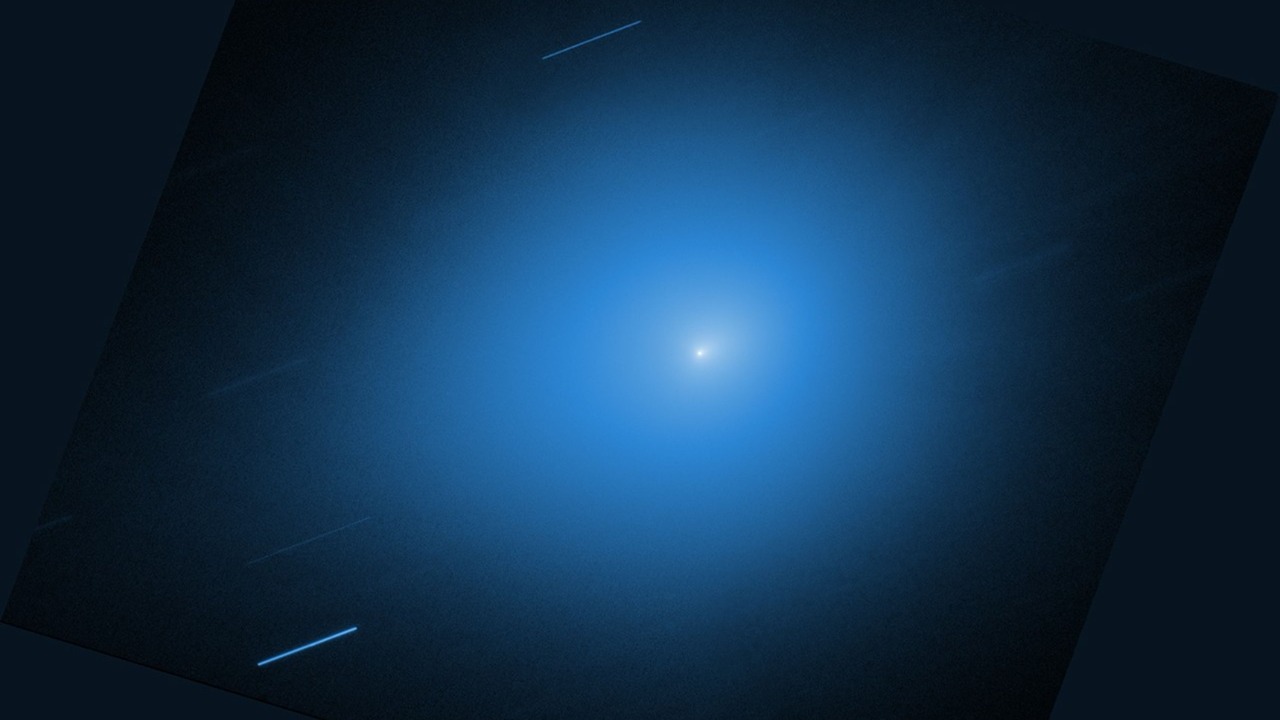

The interstellar object 3I/ATLAS has turned a routine comet flyby into a genuine scientific puzzle, thanks to a remarkably symmetric jet structure that refuses to behave like anything seen in the solar system. Instead of a messy spray of gas and dust, astronomers are watching a disciplined pattern of plumes that wobble, align and re align in ways that standard comet physics struggles to explain. I see that symmetry forcing researchers to ask whether 3I/ATLAS is simply an unusually tidy exocomet or a sign that our assumptions about interstellar visitors are still far too narrow.
As the third confirmed interstellar object after 1I/Oumuamua and 2I/Borisov, 3I/ATLAS was always going to attract attention, but its jets have elevated that curiosity into something closer to unease. Harvard astrophysicist Avi Loeb has already argued that the object’s behavior deserves to be treated as a potential technological signature, not just an exotic natural phenomenon, and other scientists are openly describing themselves as baffled by the symmetric pattern. The debate now unfolding around 3I/ATLAS is less about one comet and more about how far researchers are willing to stretch existing models before they consider more radical possibilities.
3I/ATLAS joins a short, strange list of interstellar visitors
When 3I/ATLAS was confirmed as an interstellar object, it immediately joined a very small club that already included 1I/Oumuamua and 2I/Borisov. I see that context as crucial, because it means every odd feature of this newcomer carries disproportionate weight in how astronomers think about material from beyond the solar system. Oumuamua’s elongated shape and non gravitational acceleration, followed by Borisov’s more conventional cometary appearance, had already set up a contrast between “weird” and “ordinary” interstellar visitors, and 3I/ATLAS now lands squarely on the weird side of that ledger.
Reports describing 3I/ATLAS as the third ever interstellar object to cruise through the solar system after 1I/Oumuamua in 2017 and 2I/Borisov underline how little comparative data scientists actually have when they try to classify its behavior. In that framing, the object is not just another comet, it is a rare sample of exoplanetary debris whose jets, tail and rotation encode information about a distant planetary system. The fact that this sample is presenting a symmetric jet structure that does not line up neatly with expectations is precisely why the scientific community is treating it as more than a curiosity from deep space.
A symmetric jet that refuses to act like a normal comet
What has truly unsettled observers is the way 3I/ATLAS appears to produce a pair or set of jets that are strikingly symmetric around its nucleus. Typical solar system comets vent gas and dust from irregular patches on their surfaces, creating lopsided fans and spirals that change as they spin and heat up. In contrast, images and analyses of 3I/ATLAS point to a jet configuration that looks almost engineered, with plumes emerging in a balanced pattern that stays coherent over time instead of dissolving into chaos.
Harvard astrophysicist Avi Loeb has highlighted this unusual behavior, listing the complex jet structure among the most puzzling aspects of the interstellar object and emphasizing how the symmetry stands out against the messy norms of cometary activity. In his view, the interstellar object 3I/ATLAS displays a configuration of jets and tail features that cannot be waved away as a trivial quirk of outgassing, which is why he has urged colleagues to take the pattern seriously as they refine models of its rotation and composition, as well as any more speculative interpretations anchored in the observed complex jet structure.
Hubble’s snapshot and the “technological signature” debate
The symmetry of the jets did not emerge from casual backyard observations but from high precision imaging, including a Hubble Space Telescope snapshot that captured a remarkably ordered plume pattern. When I look at that level of detail, it is clear why some astronomers are reluctant to treat the structure as a statistical fluke. The jets appear to bracket the nucleus in a way that suggests a stable geometry, not just random vents lighting up as the object tumbles through sunlight.
Avi Loeb has gone further than most by explicitly flagging the symmetric jet seen by Hubble as a possible technological signature, arguing that an artificial object could, in principle, use controlled outgassing to maneuver or communicate. In his discussion of 3I/ATLAS as an exocomet, he sets the symmetric jet alongside the broader tail of the object and compares it with earlier debates over Oumuamua, which he also treated as a candidate for non natural explanations. That framing, presented in the context of Science focused analysis, does not claim proof of technology, but it does insist that the symmetry is anomalous enough to keep that possibility on the table.
Wobbling jets and a comet that will not sit still
Symmetry alone would already be intriguing, yet 3I/ATLAS complicates the picture with jets that wobble and shift in a way that suggests a complex spin state. Instead of a simple rotation that sweeps a fixed jet around like a lighthouse beam, observers describe narrow plumes of gas and dust that appear to change orientation, sometimes within the broader anti tail structure that trails away from the Sun. To me, that behavior hints at either a tumbling nucleus or a pattern of activity that switches on and off across different surface regions.
Video analyses of the object’s behavior describe how, within the anti tail, scientists saw jets as narrow plumes that were shifting and wobbling, a pattern that left them openly baffled about the underlying mechanics. The wobbling jets, captured in detailed breakdowns of the comet’s motion, reinforce the sense that 3I/ATLAS is not following the script written by solar system comets, which typically show more predictable correlations between rotation, sunlight and outgassing. That is why the footage of weird wobbling jets has become a touchstone in discussions about how to model the object’s internal structure and spin.
“Set of jets” and the navigation thought experiment
One of the more striking interpretations of the symmetric pattern is the idea that a coordinated set of jets could, in principle, be used to steer a spacecraft. When I consider that scenario, I see why some commentators have latched onto the navigation analogy, because a balanced arrangement of plumes could generate controlled thrust vectors, much like the reaction control system on a satellite or the cold gas thrusters on a crewed capsule. The key point is not that 3I/ATLAS is a confirmed vehicle, but that its geometry invites comparisons with engineered propulsion layouts.
Coverage of the object has explicitly described a “Set of jets” surrounding 3I/ATLAS that could be used for navigation of a spacecraft, framing the symmetric plumes as something that, if replicated intentionally, would allow precise course corrections in interstellar space. That line of reasoning builds on the observation that the jets are not only symmetric but also appear to be arranged in a way that could, in theory, produce net thrust if modulated over time. By treating the Set of jets as a thought experiment in propulsion, scientists and commentators are testing how far they can stretch natural explanations before they start to resemble deliberate engineering.
Why standard comet physics is struggling to keep up
Under ordinary circumstances, cometary jets are explained by solar heating that causes volatile ices to sublimate, venting gas and dragging dust into space from localized patches on the surface. The resulting plumes are shaped by the comet’s rotation, its internal structure and the distribution of active regions, which usually leads to asymmetric, time variable jets that match the object’s irregular shape. In that framework, a perfectly symmetric and persistent jet pattern would require an almost implausibly tidy arrangement of vents and a finely tuned spin axis.
Analyses of 3I/ATLAS emphasize how its wobbling jets, combined with the symmetric layout, complicate any attempt to fit it into the usual models of mass, momentum and outgassing patterns. Reports describing Interstellar Comet 3IATLAS as baffling scientists with wobbling jets stress that the observed behavior does not line up neatly with expectations based on known comets, particularly when researchers try to reconcile the jet geometry with the object’s trajectory and brightness. That is why the object has been framed as a case where standard comet physics is being stress tested, with the Interstellar Comet forcing modelers to revisit assumptions about how jets interact with an interstellar nucleus.
Avi Loeb’s broader campaign to widen the search
Avi Loeb’s interest in 3I/ATLAS does not exist in isolation, it is part of a broader campaign he has waged to expand the range of phenomena that astronomers are willing to consider as potential technological signatures. From his earlier arguments about Oumuamua to his current focus on symmetric jets, Loeb has consistently pushed the idea that some interstellar objects might be artificial or at least influenced by advanced civilizations. I see his intervention on 3I/ATLAS as an attempt to normalize the practice of treating anomalies as data points in the search for extraterrestrial technology, rather than dismissing them as noise.
In his comments on 3I/ATLAS, Loeb lists unusual behaviors such as the complex jet structure and the symmetric plume pattern as reasons to keep an open mind about non natural explanations, while still grounding his arguments in the observational record. By explicitly naming the interstellar object 3I/ATLAS and comparing its behavior with that of Oumuamua, he is drawing a line between different anomalies that, in his view, collectively justify a more systematic search for technological signatures in astronomical data. Whether or not the community ultimately agrees with his conclusions, his role as a Harvard astrophysicist gives his insistence on taking the complex behavior of ATLAS seriously a particular weight in the ongoing debate.
Natural oddity or engineered object? The stakes of the puzzle
For most planetary scientists, the default assumption remains that 3I/ATLAS is a natural exocomet whose symmetric jets reflect an unusual but ultimately physical configuration of ices, fractures and spin states. In that view, the object is valuable precisely because it expands the known diversity of cometary behavior, offering a chance to refine models of how interstellar debris forms and evolves in other planetary systems. If the symmetry can be explained through detailed simulations of outgassing and rotation, it will still have forced a productive rethinking of how flexible those models need to be.
At the same time, the willingness of figures like Avi Loeb to entertain technological interpretations, and the navigation analogies drawn from the “Set of jets” description, show how quickly anomalies at interstellar scales can bleed into discussions about extraterrestrial engineering. I find that tension revealing, because it highlights a scientific culture that is trying to balance skepticism with curiosity in an era when high resolution instruments like Hubble can expose patterns that look almost too neat to be natural. Whether 3I/ATLAS ultimately lands in the category of natural oddity or remains a lingering candidate for something more exotic, its symmetric jet structure has already done its work by forcing scientists to confront how they interpret the rare, baffling visitors that drift in from between the stars.
More from MorningOverview