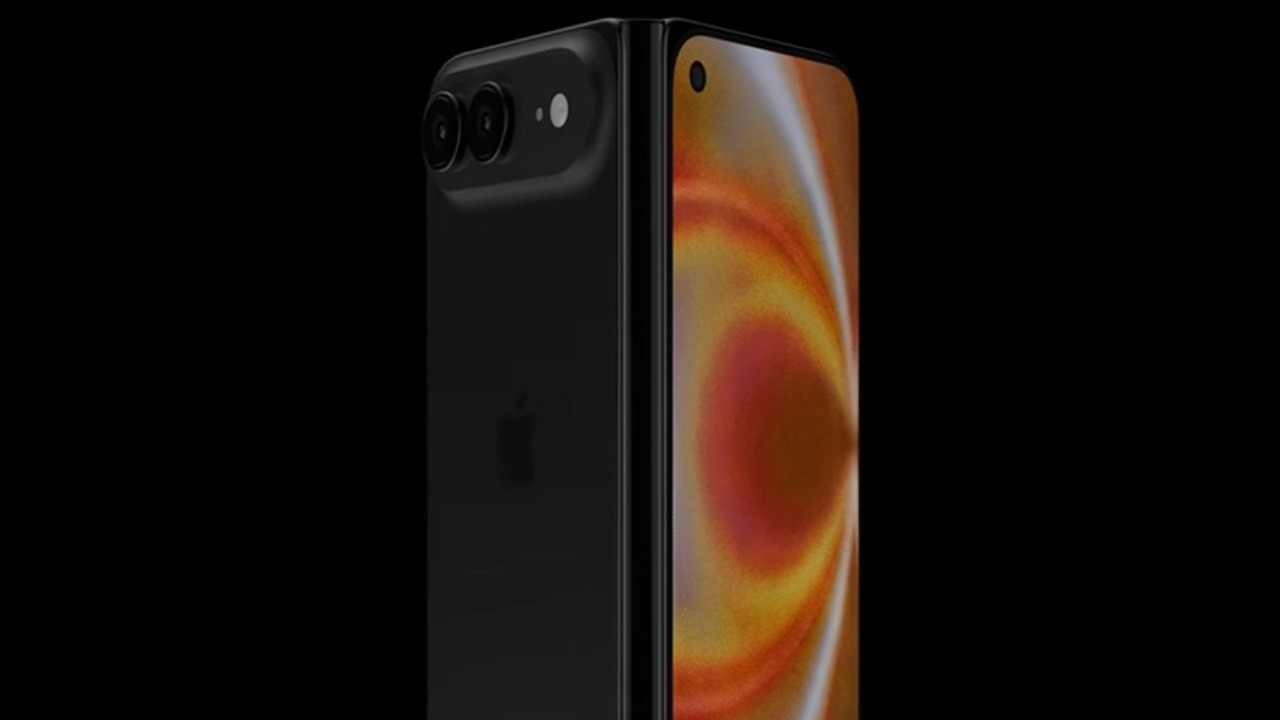

Samsung has finally shown a foldable OLED panel that looks, at least in demos, like it has no visible crease at all, and that single detail could reset expectations for every folding phone that follows. The timing and the whispers around it have immediately pulled Apple into the frame, with industry chatter suggesting this breakthrough screen is destined to debut not in a Galaxy, but in a long-rumored iPhone Fold. For a category that has spent years asking users to tolerate a wrinkle down the middle of their very expensive displays, the stakes could not be clearer.
Samsung’s creaseless moment at CES
At CES, Samsung Display used its booth to make a very specific point: the crease that has defined foldables so far does not have to be part of the deal. The company set an entirely flat-looking foldable OLED panel side by side with a current-generation screen that still shows the familiar valley, inviting close-up comparisons that highlighted how aggressively it has attacked the problem of visible deformation along the hinge line. In the demo, the new panel folded and unfolded while the surface remained smooth to the eye, a marked contrast with the rippled texture that has dogged earlier Galaxy Z Fold models and their rivals, as detailed in reports on the latest Samsung Display showcase.
The company framed the panel as a generational leap for its foldable roadmap, hinting that the same technology could give the next Galaxy Z Fold a clear advantage in both look and feel. The crease has long been the most visible reminder that foldables are still a compromise, especially when bright light catches the center of the screen, and Samsung’s decision to spotlight a panel that appears to erase that compromise signals how central this fix has become to its strategy. Coverage of the booth emphasized that the demo was not just a concept but a working screen that could be folded repeatedly without the telltale groove returning, a claim that aligns with the more detailed breakdown of the crease-less panel and its potential to redefine what a premium foldable should look like.
Why this panel screams “iPhone Fold”
Even as Samsung Display talked up the benefits for its own ecosystem, the design and proportions of the panel immediately sparked speculation that it was built with Apple in mind. The screen’s aspect ratio, bezels, and overall footprint look far closer to a tall, phone-first device than to the tablet-leaning Galaxy Z Fold silhouette, which has fueled the idea that this is effectively a reference panel for an iPhone Fold-style product. Reports have pointed out that the way the panel folds, and the way the crease disappears when it is fully open, match long-running rumors about how Apple wants its first folding iPhone to behave, with a focus on making the unfolded experience feel indistinguishable from a standard, flat OLED display, a connection that underpins the argument that this is probably the iPhone Fold’s crease-proof screen.
Neither Apple nor Samsung is commenting on whether this exact panel is earmarked for Cupertino, but the alignment between the demo hardware and the rumored specifications of Apple’s first foldable is striking. Analysts have noted that the timing of the reveal, coming just as supply chain chatter around a folding iPhone has intensified, suggests Samsung Display is signaling to investors and partners that its technology is ready for a marquee customer. One detailed report framed it bluntly, arguing that, given how rumors about Samsung’s panel roadmap and Apple’s foldable plans have dovetailed, this is probably the same display that will be used in Apple’s device, a conclusion that rests on the observation that, as Given the shared timelines and technical requirements, the overlap is hard to ignore.
How Samsung finally flattened the crease
From a technical standpoint, the disappearance of the crease is not magic, it is the result of incremental improvements in hinge geometry, panel layering, and ultra-thin glass that have finally converged. Samsung Display appears to be using a tighter, more complex hinge that allows the OLED stack to fold into a gentler curve rather than a sharp V, which reduces the mechanical stress that typically etches a permanent line into the screen. At the same time, refinements to the protective cover layer and the adhesive that bonds it to the OLED seem to let the surface flex more evenly, so the panel can bend thousands of times without developing a visible trough, a behavior that early hands-on descriptions of the Free Foldable OLED Panel have highlighted.
What stands out in the CES demos is not just the absence of a crease when the panel is open, but the way the surface behaves under motion and light. Viewers described running fingers across the center of the display and feeling no dip, and shining bright overhead lighting on the screen without seeing the usual distortion that gives away the fold line. That suggests Samsung Display has also tuned the polarization and anti-reflective coatings so that any microscopic unevenness is less visible, an optical trick layered on top of the mechanical improvements. The result is a panel that, at least in controlled conditions, looks and feels like a single, continuous sheet of glass, a claim that is central to the way Samsung is pitching its Creaseless Foldable Display Tech Revealed as the moment foldables stop feeling like a compromise.
The Apple connection and shared supply chain
The most intriguing part of this story is how deeply intertwined Samsung’s display breakthrough appears to be with Apple’s hardware plans and the broader component ecosystem that serves both companies. Reports have highlighted that a South Korean supplier, Fine M-Tec, is providing key materials for the new hinge and panel stack, and that the same supplier is already embedded in Apple’s supply chain for other devices. That overlap has fueled the argument that the creaseless panel shown at CES is not just a generic technology demo, but a preview of a shared platform that will underpin both future Galaxy Z Fold models and an iPhone Fold, a scenario laid out in detail in analyses of the Apple Connection and Shared Technology between the two giants.
For Apple, leaning on Samsung Display for a first-generation foldable panel would be consistent with its approach to OLED iPhones, where it has relied heavily on Samsung’s manufacturing scale while pushing for custom specifications. For Samsung, supplying a flagship component to a direct rival in the premium phone market is a familiar trade-off, one that brings in substantial revenue even as it risks letting Apple define the user experience around a technology Samsung has championed for years. The reports that tie Fine M-Tec and other South Korean partners to both companies underscore how global and interdependent the foldable supply chain has become, and how a single breakthrough like this creaseless panel can ripple across multiple brands once it is production-ready, a dynamic that the discussion of the Samsung Creaseless Foldable Display makes explicit.
What this means for Galaxy Z Fold 8
Even if an iPhone Fold ends up being the first mass-market device to ship with this panel, Samsung’s own Galaxy Z Fold line stands to benefit directly from the underlying technology. The crease has been the single most persistent criticism of the Galaxy Z Fold series, from the original model through the Galaxy Z Fold 5, and it has been a visible reminder that users are paying a premium for a screen that still looks slightly unfinished. By transplanting the creaseless panel and its refined hinge into the Galaxy Z Fold 8, Samsung could finally deliver a device that feels as polished as its price tag, with an inner display that no longer distracts from videos, games, or productivity apps every time the content crosses the center line, a transformation that recent coverage of how the new screen Could Transform Galaxy Z Fold 8 has emphasized.
There is also a strategic angle: if Apple does launch an iPhone Fold with a Samsung-made creaseless display, Samsung’s own foldable line will be judged directly against a rival using similar core technology. That raises the pressure on Samsung Mobile to pair the new panel with meaningful improvements in software, durability, and camera performance so that the Galaxy Z Fold 8 can compete on more than just the absence of a crease. Analysts have suggested that Samsung may lean into multitasking features, S Pen integration, and tighter ecosystem hooks with Galaxy tablets and watches to differentiate its devices, while using the creaseless screen as the baseline expectation rather than the headline feature, a shift in emphasis that aligns with the way the company has framed the panel at CES as part of a broader evolution rather than a one-off stunt.
Why Apple might get it first
The idea that the best foldable screen Samsung has ever made could debut in an Apple product has understandably riled parts of the Android community, but it also fits a familiar pattern in the display industry. Samsung Display often develops cutting-edge panels that then ship first in devices from whichever customer is ready to lock in volume orders and pay a premium for early access, and Apple has a long history of doing exactly that for iPhone components. In online discussions around CES, some Samsung fans have voiced frustration that the company might let Apple showcase the creaseless experience before it appears in a Galaxy, with one widely shared thread describing the new panel as the best foldable screen Samsung has ever made and questioning why it might not be used in its own foldable lineup first, a sentiment captured in the debate over whether CES should have been the moment Samsung committed publicly to doing so.
From Apple’s perspective, securing a crease-free panel for its first foldable is almost a prerequisite, because the company has little appetite for launching a new form factor that looks compromised next to its own flat iPhones. Reports have argued that Apple is likely to insist on a display that feels indistinguishable from a standard OLED when open, with no visible or tactile ridge, and that Samsung’s new panel is the first to convincingly meet that bar. One analysis framed the situation as a potential coup for Apple, suggesting that Samsung has shown off a crease-free foldable display that might end up being used by the rumored iPhone Fold before it appears in a Galaxy, and that this could give Apple a powerful marketing hook around design purity, a scenario that has been widely discussed since Samsung showed off the new Fold-ready panel.
The user experience shift: from compromise to confidence
For people who actually live with foldable phones, the promise of a creaseless screen is less about aesthetics and more about trust. The visible crease has always been a reminder that the display is a moving part, something that might fail or degrade faster than a traditional slab phone, and that perception has kept some buyers on the sidelines even as prices have slowly come down. By presenting a panel that looks and feels like a normal OLED when open, Samsung Display is trying to remove that psychological barrier, to make folding screens feel like a natural evolution rather than a science experiment, a shift that early reactions to the What makes this creaseless display technology so revolutionary have zeroed in on.
If Apple does ship an iPhone Fold with this panel, the user experience stakes rise even higher, because Apple will almost certainly frame the device as a no-compromise iPhone that just happens to fold. That would put pressure on every other foldable maker, from Samsung to Google and Motorola, to match not only the absence of a crease but also the overall polish of the software and hardware integration. In that scenario, the creaseless screen becomes table stakes rather than a differentiator, and the real competition shifts to how each company uses the extra screen real estate, whether through multitasking features, stylus support, or new camera modes that take advantage of the folding form factor. The CES demos hint at that future by showing the panel running familiar apps and content without any visual distraction at the fold, a subtle but powerful signal that the technology is ready for everyday use, a point reinforced by the way Samsung is already positioning the panel as a near-term advantage rather than a distant concept.
The broader foldable market and what comes next
The arrival of a convincing creaseless panel also raises questions for other players in the foldable space, many of whom have been racing to soften or hide the crease with varying degrees of success. Devices like the Google Pixel Fold and Motorola Razr have experimented with different hinge designs and display stacks, but none have fully eliminated the visual and tactile dip in the center of the screen. If Samsung Display’s new panel becomes the benchmark, those companies will either need to license similar technology, develop their own alternatives, or risk being left with visibly older-looking hardware in a market that is still trying to win over mainstream buyers. The fact that Samsung is already showcasing the panel as a shipping-ready Samsung Displays Crease Free Foldable OLED Panel at CES underscores how quickly the bar is moving.
There is also a question of how this technology might filter into other categories, from foldable laptops to rollable displays and even automotive dashboards that can change shape. Samsung Display has a history of using CES to tease panels that later appear in everything from gaming monitors to in-car screens, and a creaseless folding OLED could be particularly attractive for devices that need to switch between compact and expansive modes without visible wear. For now, the spotlight is firmly on phones, but the same engineering that lets a 7 or 8 inch panel fold flat without a crease could eventually scale up to larger form factors, especially as component suppliers like Fine M-Tec refine the materials involved. The presence of the panel in product-style showcases, complete with model numbers and configuration details that resemble a shipping product, reinforces the sense that this is not a one-off prototype but the foundation for a new generation of foldable hardware.
The unanswered questions
For all the excitement around a crease-free foldable screen, several critical questions remain unanswered, starting with durability. The CES demos show a panel that looks flawless under show-floor conditions, but they do not yet reveal how it will hold up after tens of thousands of folds in pockets, bags, and real-world environments filled with dust and temperature swings. Previous generations of foldables have sometimes looked pristine out of the box only to develop more pronounced creases or other artifacts over time, and until Samsung or Apple publishes concrete cycle counts and warranty terms for devices using this panel, some skepticism is warranted. Reports that focus on how the crease has been the defining weakness of foldable phones, and how often users fold and unfold the screen in daily life, underline why long-term testing will matter as much as the initial wow factor, a concern that is front and center in analyses of how the new panel Fold story plays out.
There is also the matter of cost and availability. A cutting-edge panel like this is unlikely to be cheap, and if Apple does secure early access for an iPhone Fold, that could constrain supply for Samsung’s own devices or push prices higher for the first generation of creaseless foldables. Until either company announces concrete products, pricing, and launch windows, the technology sits in a kind of limbo between impressive demo and everyday reality. What is clear, though, is that the visual of a foldable screen with no crease has already reset expectations, and that both Samsung and Apple will be judged against that image when they finally show their next wave of folding phones to the public.
More from Morning Overview