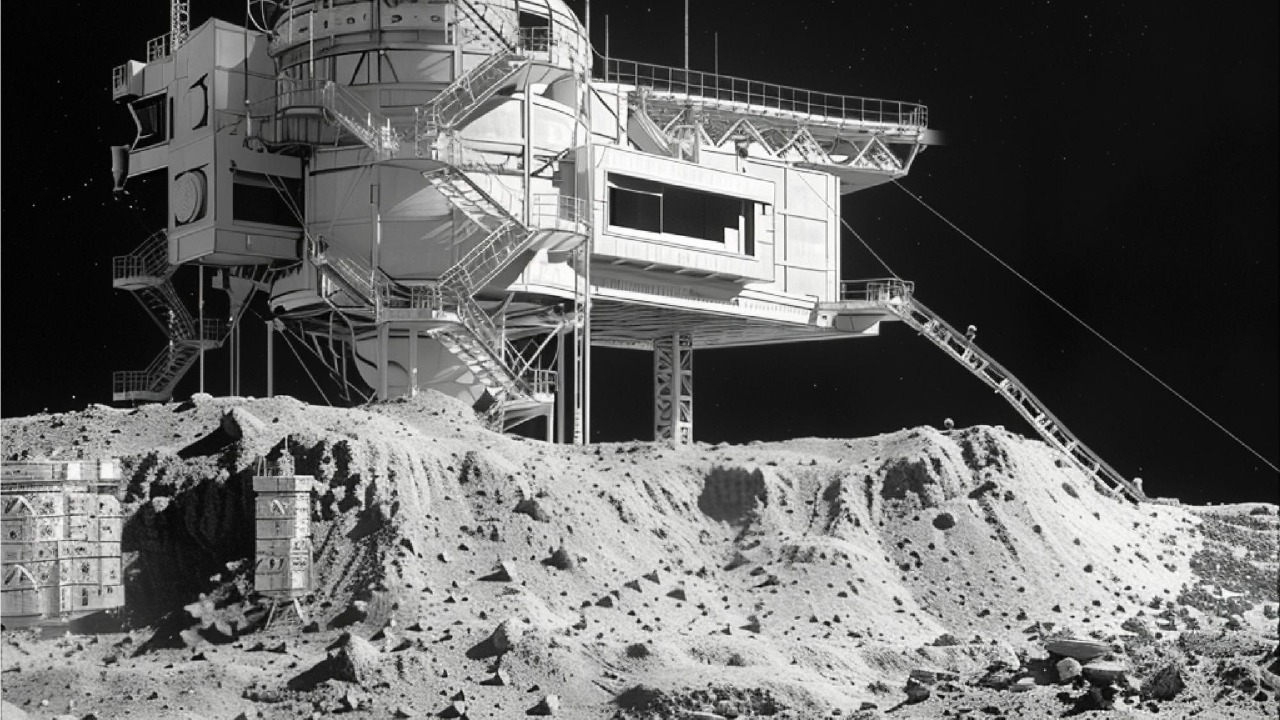

Russia’s space leadership has set a striking new benchmark for the next phase of lunar exploration, declaring that it wants a functioning nuclear power plant on the Moon by 2036. The project is framed as the backbone for a permanent presence on the lunar surface, with nuclear energy pitched as the only realistic way to keep equipment and habitats running through the brutal cold and long nights. It is an audacious goal that blends engineering ambition with geopolitical signaling, and it instantly raises questions about feasibility, safety and the emerging rules of a nuclear age in space.
Russia’s 2036 nuclear moonshot
Russian officials have outlined a plan to install a nuclear power facility on the Moon by 2036, presenting it as a cornerstone for long term human and robotic activity on the surface. In public statements, they have described a compact station designed to operate autonomously in the Moon’s harsh environment, providing steady electricity where solar panels would struggle. The pitch is not just about planting another flag, it is about building infrastructure that can support rovers, laboratories and eventually habitats without relying on fragile solar arrays and massive battery banks.
The project has been described as a national priority, with Russia has unveiled plans that explicitly call for a nuclear installation capable of surviving extreme temperature swings and radiation on the Moon. Officials have framed the 2036 target as aggressive but achievable if funding and political backing hold, and they have linked the plant directly to ambitions for a sustained lunar base. In that narrative, nuclear power is not a side project, it is the enabling technology that turns short visits into a permanent foothold.
Roscosmos and Moscow’s strategic calculus
The Russian Space Agency, Roscosmos, has been cast as the central architect of this lunar power push, with Moscow treating the project as both a technological challenge and a strategic asset. Roscosmos has said it plans to build a lunar power plant by 2036, tying the schedule to a broader roadmap of robotic landers, cargo flights and eventual crewed missions. For the Kremlin, a working nuclear station on the Moon would signal that Russia remains a first tier space power, even as it faces economic pressure and competition from private companies and rival states.
In official communications from Moscow, the plan is described as a coordinated effort in which The Russian Space Agency, Roscosmos leads development of the reactor and surface systems while other state entities handle launch and logistics. Reporting on the initiative notes that Russia plans to build a lunar power plant by 2036 and that the announcement came from Moscow, underscoring that this is not a speculative idea from industry but a declared government objective. That framing matters, because it ties the project to national prestige and makes it harder to quietly shelve if technical or budget problems emerge.
Why nuclear, and why the Moon’s 336-hour night matters
The choice of nuclear power is rooted in the physics of the Moon itself. A lunar day lasts roughly two Earth weeks, followed by a night of similar length, which means solar panels sit in darkness for about a 336-hour stretch with no sunlight. Storing enough energy to bridge that gap with batteries alone would require enormous mass and cost, and fuel cells would need regular resupply. A compact nuclear plant, by contrast, can provide continuous power regardless of the Sun’s position, which is critical for keeping life support, communications and scientific instruments running through the long freeze.
Russian planners have explicitly cited the need to survive the 336-hour lunar night as a key justification for putting a reactor on the Moon. Reports describe a design intended to power rovers and labs when temperatures plunge and solar arrays are useless, highlighting that a nuclear power plant could stabilize operations during those extended dark periods. In that context, nuclear energy is less about raw wattage and more about reliability, giving mission planners a predictable baseline of electricity that does not depend on weather, dust or the angle of the Sun.
A joint Russian-Chinese lunar base in the making
Russia’s nuclear plan is not envisioned as a solo outpost but as the power core for a shared Russian and Chinese base on the Moon. Moscow has signaled that the plant is meant to support a joint station, with the two countries pooling technology and launch capacity to build what they describe as a long term research and resource hub. The idea is that a stable power grid would allow them to run scientific equipment, communications systems and industrial infrastructure at a scale that would be impossible with small, isolated landers.
Reporting on the project notes that Moscow’s betting big on lunar nuclear power to fuel a joint Russian-Chinese moon base, with the plant expected to supply energy for habitats, scientific equipment and infrastructure. That partnership is not just about sharing costs, it is also about aligning two major space programs around a common architecture that could, if it works, give them a durable presence on the lunar surface. In geopolitical terms, a functioning Russian and Chinese base powered by a nuclear station would be a powerful symbol of their cooperation and a direct challenge to Western led initiatives.
China and Russia’s broader power station deal
The nuclear plant fits into a wider agreement in which China and Russia have committed to build a power station on the Moon by 2036 as part of a much larger lunar complex. The two sides have described a vision that includes not only a reactor but also modules, landing pads and support systems spread across an area likened to the size of a major theme park. That scale hints at ambitions that go beyond pure science, with talk of industrial activity and even tourism in the longer term, although those elements remain speculative.
One account describes how China and Russia make a deal to build a power station on the MOON by 2036 as part of a vast Disneyland sized lunar space base, emphasizing that Russia has inked a deal signed by the two nations. Another analysis notes that China and Russia Plan Lunar Nuclear Power Station by 2036 and describes the arrangement as a Pioneering Space Collaboration, highlighting Joint efforts that could influence global space exploration dynamics. Together, these reports depict a structured partnership rather than a loose alignment, with the power station at the center of a shared lunar strategy.
Chang’e-8 and the groundwork for a nuclear-powered base
On the Chinese side, the roadmap for a joint lunar station runs through a series of robotic missions that will test technologies needed for a permanent base. A key step is the Chang’e-8 mission, which is planned to land on the Moon and demonstrate systems such as in situ resource utilization, advanced robotics and construction techniques. Those capabilities are essential if China and Russia hope to assemble and maintain a nuclear power station and associated infrastructure without constant resupply from Earth.
According to one account, Its groundwork will be laid by China’s 2028 Chang‘e-8 mission, which is described as a crucial step in China’s race to build a lunar base and in mapping out the lunar surface. The same reporting notes that the memorandum between the two countries comes at a time when China is focused on building the station’s modules, suggesting that Chang’e-8 will help define where and how those modules, including power systems, might be deployed. That sequence underlines how robotic exploration and nuclear infrastructure are being woven together into a single long term plan.
Global context: a crowded race for lunar nuclear power
Russia’s nuclear ambitions are unfolding in a broader context where multiple space powers are eyeing the Moon as the next strategic frontier. The announcement of a planned nuclear power station comes as global powers increasingly focus their efforts on exploring Earth’s only natural satellite, with national agencies and private companies all sketching out their own visions of lunar industry and science. In that environment, a working reactor on the surface would be more than an engineering feat, it would be a marker of influence in cislunar space.
Coverage of the Russian plan notes that the decision to pursue a nuclear station arrived just as other countries were ramping up their own lunar programs, emphasizing that the announcement comes as global powers increasingly focus their efforts on exploring Earth‘s only natural satellite. At the same time, Russia’s move sits alongside Western initiatives that also see nuclear power as the key to long duration missions, reinforcing the sense that the next phase of the space race will be powered not just by rockets but by reactors.
NASA, The Trump administration and parallel nuclear plans
The United States has its own nuclear lunar ambitions, with NASA working on a small fission reactor intended to support future Artemis missions. The concept involves a compact system that could be delivered by a single launch and then deployed on the surface to provide steady power for habitats, rovers and scientific instruments. American officials have argued that such a reactor would reduce reliance on solar arrays and batteries, particularly at sites near the poles where lighting conditions are complex.
One detailed explainer notes that NASA plans to put a nuclear reactor on the moon and that the reactor would launch to the surface on a single lander, while also pointing out that the schedule may be a potentially unrealistic schedule. The same reporting highlights how The Trump administration is accelerating policy support for nuclear systems in space, reflecting a political push to keep pace with rivals. In that light, Russia’s 2036 target is not an isolated ambition but part of a wider trend in which major powers see nuclear power as the linchpin of their lunar strategies.
Technical and political risks on the road to 2036
Even if the strategic logic is clear, the path to a nuclear plant on the Moon by 2036 is riddled with technical and political risks. Designing a reactor that can survive launch, landing and decades of operation in vacuum is a nontrivial challenge, and Russia’s recent track record in space hardware has been mixed. There are also questions about how to shield astronauts and sensitive instruments from radiation, how to manage heat rejection in an airless environment and how to safely decommission or relocate a reactor at the end of its life.
On the political side, the project will unfold against a backdrop of sanctions, budget constraints and evolving space law. International agreements already limit the use of nuclear power sources in space, and a full scale station on the Moon will test how those rules are interpreted. Russian officials have tried to project confidence, with one report noting that Russia Nuclear Power Plant Moon plans call for a Power Plant by 2036, but outside analysts point to the gap between ambitious roadmaps and the realities of funding and technology. As the 2030s approach, the world will see whether the promise of a nuclear powered lunar base becomes a defining achievement of this era or another unrealized vision in the long history of spaceflight.
More from MorningOverview