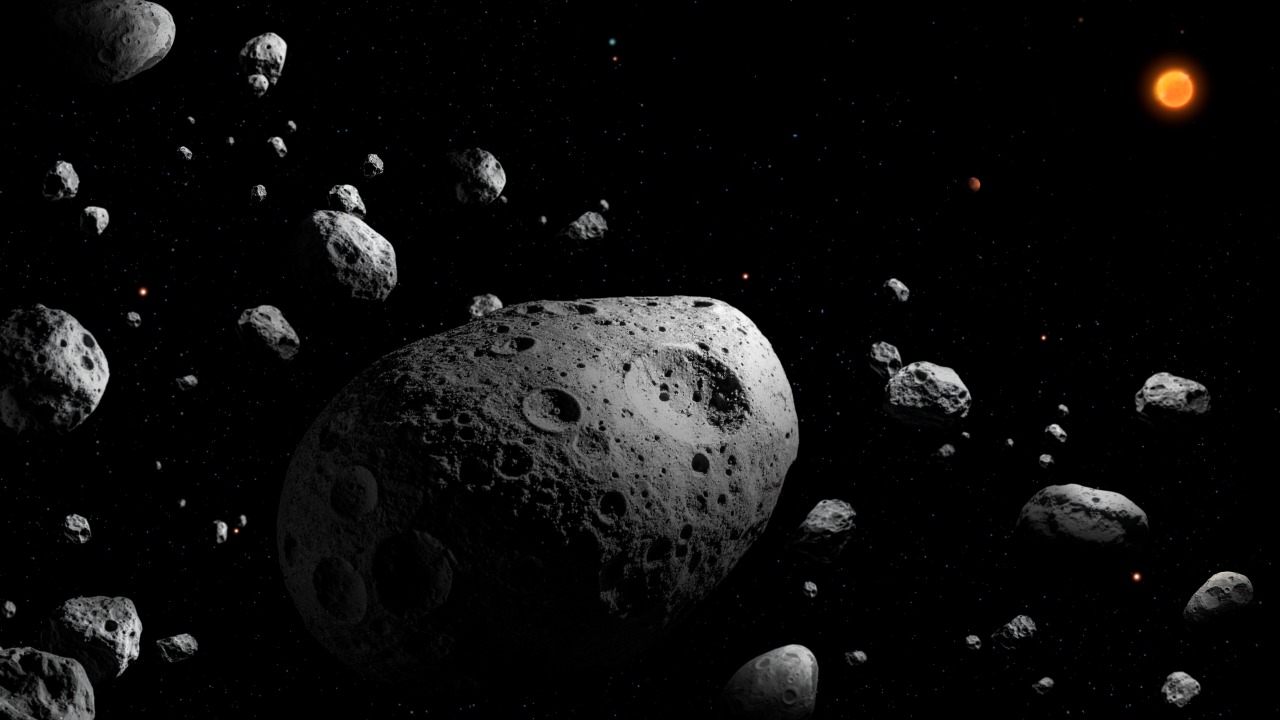

A newly spotted space rock has just shattered the speed record for large asteroids, spinning so quickly that by all expectations it should have torn itself apart. The object, named 2025 MN45, is roughly the size of several football fields yet whirls around in less than a minute, forcing astronomers to rethink how such massive rubble piles can hold together. Its discovery, in the very first images from a powerful new survey telescope, hints that the solar system may be hiding more extreme objects than anyone anticipated.
Instead of a fragile heap of debris, 2025 MN45 appears to be a surprisingly tough monolith, with internal strength closer to solid rock than loose gravel. That unexpected resilience, combined with the asteroid’s breakneck rotation, is turning a routine cataloging effort into a natural experiment in planetary physics and a showcase for a next-generation observatory.
The asteroid that outran the spin limit
Asteroids larger than a few hundred meters are not supposed to spin this fast. For decades, researchers have seen a clear “spin barrier” where objects bigger than about 0.3 miles in diameter tend to rotate no faster than once every couple of hours, otherwise centrifugal forces would fling material into space. 2025 MN45, which is sized over 0.3 miles across and comparable to seven or eight football fields, completes a full turn in well under sixty seconds, making it the fastest-spinning asteroid of its size ever recorded.
That blistering pace puts 2025 MN45 in a rare class of “superfast rotators,” objects that defy the usual rubble-pile model for mid-size asteroids. Earlier work had identified a handful of smaller bodies that spin in under a minute, but nothing this large had crossed that threshold. Astronomers now calculate that to survive such a rotation rate, the asteroid must have a cohesive strength similar to solid rock, a conclusion echoed in analyses that find it would need to be more like a single boulder than a loose aggregate to avoid flying apart in less than a minute, as highlighted in detailed modeling of its cohesive strength.
Rubin Observatory’s first big catch
The discovery of 2025 MN45 is also a coming-out moment for the NSF–DOE Vera C. Rubin Observatory, which is still in its pre-survey phase but already delivering headline-grabbing science. The asteroid was found in the first images from the Vera Rubin Observatory’s wide-field camera, a system designed to scan the sky repeatedly and catch fleeting changes. In those early test exposures, astronomers spotted the telltale streak of a fast-moving object and quickly realized they were looking at a record-breaking asteroid, later confirmed as the fastest-rotating rock known that is larger than six football fields, a milestone that marked the Rubin Observatory’s first major discovery.
The observatory’s power comes from pairing a huge mirror with what is described as the world’s largest digital camera, the Legacy Survey of Space and Time Camera. This instrument is built to support a decade-long survey, repeatedly imaging the entire visible sky and enabling researchers to track subtle motions and brightness changes. The same setup that flagged 2025 MN45 is also being used to identify dozens of other unusually fast rotators, with researchers reporting that these asteroids were detected using the Legacy Survey of and uncovering dozens of high-speed objects between April and May of the previous year.
How a giant rock stays in one piece
To understand why 2025 MN45 is so surprising, it helps to look at how most asteroids are built. Many mid-size bodies in the main belt are thought to be rubble piles, loose collections of rocks and dust held together primarily by gravity. In that scenario, spin them too fast and they start to shed material, a process that can create binary asteroids or even small families of fragments. The existence of a large object spinning faster than this gravitational limit suggests that at least some asteroids are more like monolithic chunks, with internal forces that can resist the outward pull of rapid rotation, a conclusion that aligns with assessments that 2025 MN45 resides in the main belt and behaves like other superfast rotators.
Researchers estimate that 2025 MN45 must have a cohesive strength on par with solid rock to withstand its spin, which is far higher than the minimal strength needed for a rubble pile. That finding dovetails with broader Rubin Observatory results, which include other notable asteroid discoveries such as 2025 MJ71, an object with a 1.9-minute rotation period that also pushes the limits of what loose material can endure. Together, these extreme rotators are forcing scientists to refine models of asteroid interiors, fracture strength, and how collisions and thermal forces sculpt these bodies over billions of years.
A survey built for speed freaks
What makes 2025 MN45 especially intriguing is that it did not appear as a one-off oddity but as part of a broader pattern emerging from Rubin’s early data. During a “First Look” event, the observatory’s team identified roughly 1,900 new asteroids, with 2025 MN45 standing out as one of the most extreme. That haul included a range of sizes and orbits, and follow-up work showed that within this population, dozens of objects spin at unusually high speeds. In that context, 2025 MN45 is the most dramatic example of a trend that suggests the solar system may harbor many more fast rotators than earlier surveys could detect, a point underscored when astronomers described how 2025 MN45 was one of the standout finds in a batch of new objects flagged during the observatory’s First Look campaign.
The survey’s design is central to that success. By repeatedly imaging the same patches of sky with short exposures, the Legacy Survey of Space and Time can capture the subtle flickers that reveal an asteroid’s rotation period. Researchers analyzing early data reported finding 76 asteroids spinning at such high speed that they challenge conventional models, a result that only becomes possible when a camera can monitor brightness changes over hours and nights. Those methods, described as part of the broader survey, turn Rubin into a kind of cosmic strobe light, freezing the spin of distant rocks in exquisite detail.
What 2025 MN45 tells us about the solar system
Beyond the technical feat, 2025 MN45 offers a new window into how asteroids form, evolve, and sometimes survive against the odds. Way out in the asteroid belt, collisions, sunlight, and gravitational nudges constantly reshape these bodies, spinning some up and breaking others apart. The fact that an object nearly the size of eight football fields can rotate so quickly without disintegrating suggests that at least part of the belt’s population is tougher and more coherent than the classic rubble-pile picture, a perspective echoed in reports that describe an unusual asteroid spinning faster than anything its size and emphasize how far out in the belt this object resides.
For planetary defense, the discovery is a reminder that not all potential impactors will behave the same way. While 2025 MN45 itself is not expected to pose a threat to Earth over the next century, understanding whether a fast-spinning body is a solid monolith or a fragile aggregate matters for any future mission that might need to deflect one. Scientists who first highlighted the record-breaking nature of 2025 MN45 have also stressed that it is nearly the size of eight football fields and yet remains safely distant from Earth, a reassuring detail that allows researchers to treat it as a laboratory rather than an emergency.
A new era of extreme asteroids
As Rubin’s pre-survey work continues, 2025 MN45 is already being joined by a growing cast of fast rotators that collectively redraw the map of what asteroids can be. Scientists involved in the early analyses have emphasized that this space rock somehow broke the speed limit, with coverage By Elisha Sauers noting how the object stunned researchers at a major astronomy meeting. Other reports have framed it as a cosmic giant that defies expectations, with Scientists highlighting its size and speed in public briefings and educational videos.
The story has also reached younger audiences, with explainers describing how the Spinning space rock whirls faster than anything else its size and using an eye-catching Image to show its motion. Other coverage has emphasized that the world’s largest camera was key to spotting the fastest-spinning asteroid with diameter over 0.3 miles, underscoring how technology and curiosity are combining to reveal a solar system that is more dynamic, and more extreme, than the textbooks once suggested. As Jan reports from multiple teams converge on 2025 MN45, the fastest-spinning large asteroid yet seen is poised to become a benchmark for understanding how far nature can push a spinning rock before it finally comes apart.
More from Morning Overview