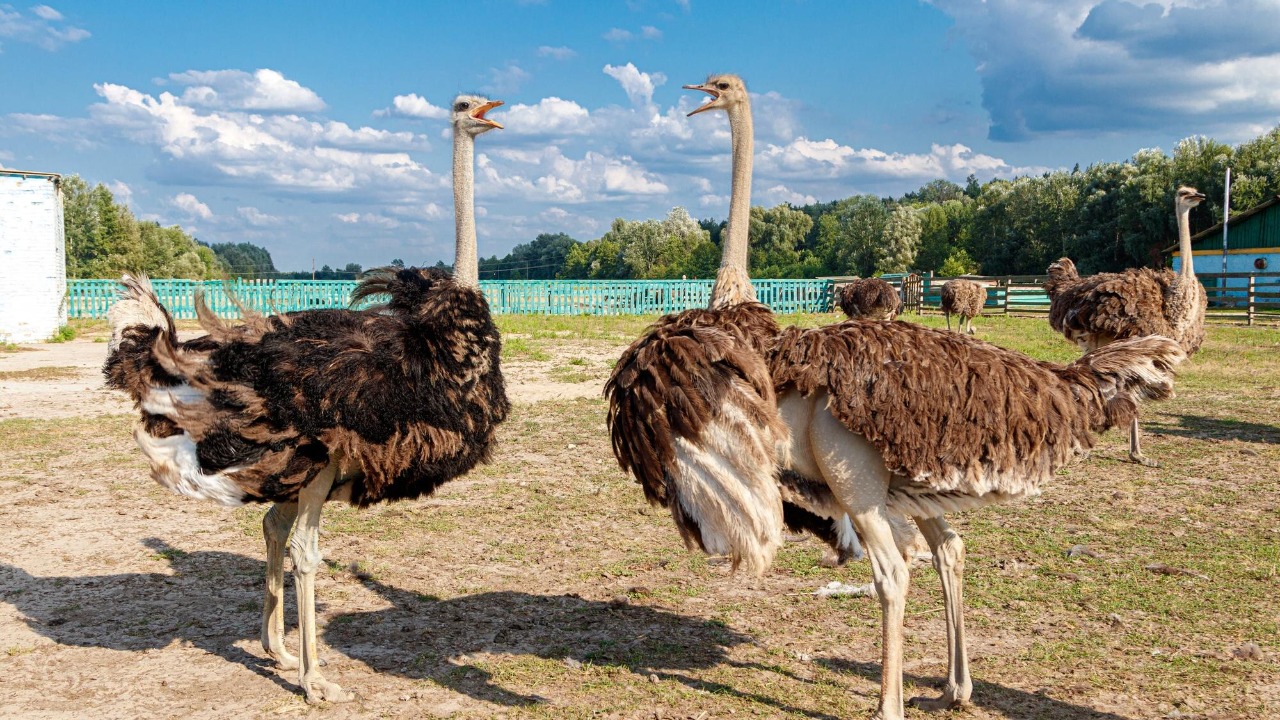

Rare, 9‑foot-tall red‑necked ostriches, sometimes nicknamed “camel birds” for their towering height and desert stride, have been released into a Saudi Arabian reserve in a striking attempt to bring back a vanished giant of the dunes. The move turns a once‑abstract conservation goal into a living, running reality on the sand, and it signals how seriously the kingdom is now taking the idea of restoring lost wildlife to its arid heartlands.
The birds, which can look almost prehistoric as they loom over shrubs and low dunes, are part of a carefully managed reintroduction that blends science, symbolism and national ambition. By returning these long‑absent runners to the landscape, Saudi conservation planners are testing whether a modern desert economy can coexist with the full scale of its native fauna.
The return of the red‑necked “camel bird”
The animals at the center of this story are red‑necked ostriches, a striking form of the world’s largest living bird that once roamed across North Africa and into the Arabian Peninsula. Standing close to 9 feet tall, with bare crimson necks and powerful legs, they have earned the local nickname “camel birds” because they share the same open, sandy habitats and tower above most other creatures in the desert. Their reappearance in Saudi Arabia is not a curiosity for tourists, it is a deliberate attempt to restore a keystone presence that shaped how these ecosystems once worked.
Conservation teams in Saudi Arabia have now released a group of these red‑necked ostriches into a protected desert reserve, treating the event as a milestone in a broader rewilding push that aims to bring back native species that disappeared under hunting pressure and habitat change. The project focuses on the same tall, red‑necked form described in detailed natural history accounts of the species, and it is framed as a test of whether these birds can once again navigate the harsh, open landscapes that historically supported them, as described in specialist profiles of the red‑necked ostrich.
A species built for Earth’s harshest open spaces
To understand why these birds are central to desert restoration, it helps to remember what they are built to do. Ostriches are not just big birds, they are the largest birds on Earth, with long, muscular legs, reduced wings and a body plan that has traded flight for speed and endurance on the ground. Their anatomy is a study in specialization, from the two‑toed feet that grip the sand to the long neck that lets them scan for predators while feeding on low vegetation, a suite of traits that has been documented in scientific overviews of Ostriches and their place among the flightless birds of Earth.
There is only one species in the genus Struthio, but within it, regional forms like the red‑necked ostrich have evolved to match specific climates and landscapes. The birds now running across Saudi sand are adapted to semi‑deserts and plains, where their height helps them spot threats and their long stride lets them cover large distances between scattered food and water sources. In that sense, returning them to a Saudi reserve is not an experiment in forcing wildlife into an alien setting, it is an attempt to reunite a desert specialist with the kind of open terrain that shaped its evolution.
From North African strongholds to Saudi sands
The particular lineage being reintroduced is closely tied to North African landscapes, which is why conservationists are explicit about working with the North African form of the bird. In breeding records and field notes, these animals are identified as North African ostrich, with the scientific name Struthio camelus camelus, a reminder that they are part of a broader species that once ranged widely across the continent and into adjacent regions. Their story is not just about Saudi Arabia, it is about reconnecting fragmented pieces of a once‑continuous distribution.
In practical terms, the Saudi project has drawn on carefully managed breeding groups that track the exact composition of each release, including sex ratios and subspecies identity. One such record describes a group labeled as “1.2 North African ostrich (Struthio camelus camelus),” using the standard shorthand that signals one male and two females, a small but genetically meaningful nucleus for a future population. That same note emphasizes that these birds are adapted to deserts, semi‑deserts and plains, the very environments that define the Saudi reserve where they have now been set free, as outlined in a field update on North African Struthio reintroduction work.
Inside Saudi Arabia’s rewilding experiment
Saudi Arabia’s decision to bring back these towering birds is part of a broader shift in how the kingdom thinks about its deserts. For decades, conservation in the region focused on preventing further loss, often through strict protection of remaining wildlife and limits on hunting. The release of red‑necked ostriches marks a pivot toward active restoration, where managers are not only guarding what is left but also trying to rebuild what has been lost, using rewilding as a guiding concept rather than a distant aspiration.
In this context, the ostrich release is framed as a milestone in an ambitious program that aims to repopulate reserves with native herbivores and large birds that once shaped vegetation patterns and predator dynamics. The birds are being monitored as they explore their new home, with teams tracking how they move, what they eat and how they cope with temperature extremes. That monitoring is not just about animal welfare, it is about learning whether a modern Saudi landscape, with its roads, fences and human activity, can still function as a viable home for a species that evolved in open, lightly populated plains, a point underscored in detailed coverage of the Saudi Arabian release.
Why a 9‑foot bird matters to desert ecosystems
Releasing a handful of giant birds might sound symbolic, but ecologists see very practical reasons to put ostriches back on the sand. As large, mobile herbivores and omnivores, they can influence which plants thrive, how seeds are dispersed and how nutrients move across the landscape. Their foraging can open up dense patches of vegetation, their droppings can fertilize poor soils and their movements can create subtle paths that other animals follow, all of which can nudge a degraded desert toward a more dynamic, resilient state.
There is also a cultural and psychological dimension to their return. For communities that have known these birds only from stories or old photographs, seeing a red‑necked ostrich stride across a dune reconnects people with a wilder version of their homeland. That sense of continuity matters when governments ask citizens to support protected areas, hunting restrictions or habitat restoration budgets. A reserve that holds visible, charismatic species like camel birds is easier to champion than one that protects only invisible processes, and the Saudi project is clearly leaning on that visibility to build support for a wider rewilding agenda anchored in the presence of these 9‑foot desert specialists.
Challenges of keeping camel birds on the landscape
For all the optimism, keeping such conspicuous animals on the landscape is not simple. Red‑necked ostriches are highly visible, relatively slow to reproduce and vulnerable to both direct threats like poaching and indirect ones like habitat fragmentation. In a region where off‑road driving, fencing and expanding infrastructure can slice up open terrain, managers must think carefully about how these birds will move, where they will find safe nesting sites and how they will avoid collisions or entanglements that did not exist in their historical past.
There is also the question of climate and water, even for a species that is famously tolerant of heat and aridity. While ostriches can survive long periods without drinking by drawing moisture from food and conserving water efficiently, they still need access to patches of vegetation that hold enough nutrition to sustain their large bodies. If overgrazing by livestock or shrub removal for fuel continues around reserves, the birds could find themselves in islands of suitable habitat surrounded by increasingly barren ground. The Saudi experiment will therefore test not only the resilience of the birds but also the willingness of surrounding land users to adjust practices so that a 9‑foot runner can share the desert with herds, vehicles and human settlements.
What success would look like over the next decade
In the short term, success for the Saudi ostrich release will be measured in survival rates, health indicators and the ability of the birds to adapt to their new surroundings. Managers will watch for signs that they are feeding well, avoiding conflict with people and predators, and using the reserve in ways that match expectations from their North African counterparts. If the birds begin to form stable groups, establish regular ranging patterns and show normal breeding behavior, it will be a strong signal that the habitat is functioning as intended.
Over a longer horizon, the real test will be whether a self‑sustaining population can emerge without constant human intervention. That would mean chicks surviving to adulthood, genetic diversity being maintained through careful planning and, eventually, the possibility of birds dispersing to adjacent suitable areas. At that point, the camel bird would no longer be a guest in the Saudi desert but a resident once again, shaping the ecosystem alongside other restored species. For a country investing heavily in protected areas and ecological tourism, that outcome would turn a single release into a cornerstone of a new relationship between people, wildlife and the vast open spaces that still define much of the Arabian landscape.
More from Morning Overview