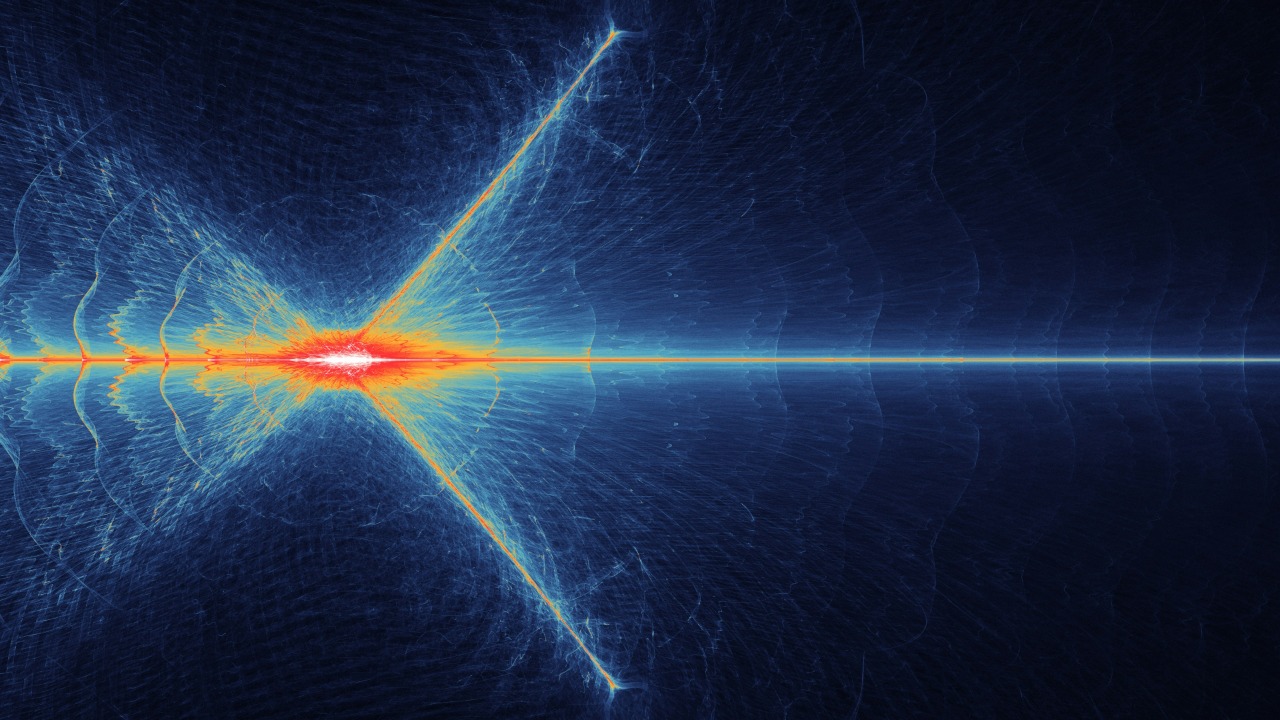

Quantum chaos used to be the kind of phrase that made experimental physicists wince, a shorthand for fragile devices going off the rails when too many particles started talking to each other. Now a new generation of experiments is flipping that script, showing that the same unruly effects that once threatened to wreck quantum hardware can instead be harnessed as a resource. By deliberately steering into this turbulence, researchers are finding ways to boost signals, stabilize delicate states, and even sharpen the line between classical and quantum computing power.
What looks like randomness at first glance is turning into a design principle, with theorists and experimentalists learning to choreograph disorder rather than fight it. The result is a field that no longer treats chaos as a bug in quantum technology, but as a feature that might help unlock quantum advantage in real devices.
From nuisance to tool: superradiance gets a rethink
For years, one of the most notorious troublemakers in quantum optics was a collective effect called superradiance, in which a crowd of atoms or qubits suddenly dumps its energy in a blindingly fast burst. In the lab, that kind of synchronized flash can scramble information and shorten the lifetime of the very states engineers are trying to preserve, so it was long filed under “things to suppress at all costs.” Recent work has started to turn that intuition around, showing that if I treat superradiance as something to be shaped instead of eliminated, it can amplify useful signals and even help coordinate the operation of complex quantum devices.
In new experiments that inspired the phrase “physicists turn quantum chaos into something surprisingly useful,” teams have shown that carefully tuned interactions can make superradiant bursts more predictable and more informative, rather than purely destructive. Instead of a random flare, the collective emission becomes a controllable probe of how energy and information move through a device, and in some setups it can enhance the readout of qubits by making their joint response louder than any single element. That shift in mindset, from fearing to exploiting collective behavior, is at the heart of the work described in physicists turn quantum chaos into something surprisingly useful.
Why “quantum chaos” is not just classical chaos in disguise
To understand why this is more than a branding exercise, it helps to be precise about what quantum chaos actually means. In classical physics, chaos is about trajectories that diverge exponentially, so that tiny differences in initial conditions balloon into wildly different outcomes. Quantum systems do not have sharp trajectories in the same way, so researchers instead look at how energy levels, wave functions, and measurement statistics behave when a system is strongly interacting and sensitive to perturbations. In that regime, the solutions to the governing equations can be so intricate that they are described as algorithmically complex, even though the underlying evolution still preserves information.
That distinction matters because it means quantum chaos is not pure randomness, it is structured complexity that can, in principle, be reversed or decoded. The same mathematical fingerprints that signal chaotic behavior, such as specific patterns in energy level spacings, also tell me that a system is exploring its full configuration space efficiently. For quantum technologies, that efficiency is a double edged sword: it can accelerate unwanted decoherence, but it can also be harnessed to spread information quickly across many degrees of freedom, which is exactly what some quantum algorithms and sensing protocols need. The new experiments on superradiance and related effects are essentially attempts to ride that edge.
Long considered a bug, now a feature in quantum hardware
In the early generations of quantum devices, engineers treated any sign of collective behavior as a red flag. If one qubit’s error could cascade into a whole register, or if a shared cavity mode could trigger a superradiant avalanche, the safest strategy was to isolate components as much as possible. That mindset is reflected in how often superradiance was described as a “serious technical challenge” for the stable operation of key quantum technologies, something to be engineered away rather than embraced. The recent shift is that researchers are now deliberately designing architectures where that same effect is not just tolerated but used as a functional element.
By carefully tuning coupling strengths and geometries, experimental teams have shown that the collective emission that once looked like a chaotic failure mode can be made to act like a controllable knob on device performance. In some setups, the onset of superradiance serves as a sensitive indicator of when a system crosses a threshold in density or coherence, effectively turning a former nuisance into a diagnostic tool. That is why new work, highlighted in a focused discussion that notes how it was long considered a serious technical challenge, is being framed as a conceptual pivot for quantum hardware design.
Quantum systems that refuse to heat up
One of the most striking examples of chaos being tamed comes from experiments on many body systems that, counterintuitively, do not thermalize even when they are driven and disordered. In a recent study, physicists reported a quantum setup that effectively refuses to heat up, maintaining its structure instead of relaxing to a featureless equilibrium. The key ingredient is strong Quantum coherence, which keeps the system’s many components locked into a correlated pattern even as randomness is introduced.
The phenomenon, described as MBDL, short for MBDL, challenges long held assumptions about how complex quantum matter should behave under continuous driving. Instead of chaos washing out memory, the system retains a detailed imprint of its initial state, which could be a powerful asset for quantum information storage and error protection. For device designers, that suggests a new strategy: rather than fighting every source of disorder, it might be possible to engineer specific patterns of randomness that, paradoxically, help preserve coherence by trapping energy and information in non thermal states.
Algorithms, advantage, and the role of structured chaos
On the theoretical side, the same ideas are reshaping how I think about quantum algorithms and the elusive goal of quantum advantage. The pursuit of that advantage is often framed as a race to find problems where quantum machines can deliver a provable and practical speedup over classical ones. In condensed matter physics, for example, researchers are building quantum algorithm software that targets super quadratic improvements by exploiting the natural dynamics of strongly interacting systems, which are often chaotic in the technical sense.
Those efforts lean heavily on the fact that quantum evolution can explore many configurations in parallel, a kind of built in parallelism that classical machines cannot match. One concrete example is a quantum algorithm for finding collision inducing disturbance vectors in SHA 1, which explicitly notes that, with the advent of quantum computer hardware, quantum supremacy over classical algorithms becomes achievable when that parallelism is fully exploited. In both cases, the algorithms are not trying to avoid complex, chaotic looking dynamics; they are designed to ride them, using interference and entanglement to sift out the rare configurations that solve a problem while the rest of the vast search space cancels itself away.
Unconditional quantum advantage and why chaos matters
The stakes of mastering this complexity are underscored by recent claims of “unconditional” quantum advantage, where a quantum device outperforms any conceivable classical competitor on a well defined task. In one high profile example, researchers demonstrated such an advantage on a problem that, by design, has little direct practical value, precisely so that it could be analyzed cleanly. The point was not to build a better spreadsheet, but to show that quantum hardware can already do something that classical machines, in principle, cannot match, a milestone described as the first reported demonstration of unconditional quantum advantage.
What ties that result to the story of quantum chaos is the nature of the task itself, which typically involves sampling from the output of a highly entangled, strongly interacting circuit that is effectively impossible to simulate classically. The same features that make the dynamics look chaotic, such as rapid scrambling of information and extreme sensitivity to small changes, are what make the output distribution so hard to reproduce with any classical algorithm. In that sense, quantum chaos is not just a side effect of quantum advantage, it is one of its engines, and learning to control it is essential if I want to move from contrived demonstrations to useful applications.
Philosophy, Physics & Chemistry, and the broader context
These developments are not happening in a vacuum, they sit at the intersection of deep philosophical questions about determinism and information, and very practical questions about how to build better sensors and computers. Theoretical work cataloged in resources like the Stanford Encyclopedia of Philosophy has emphasized that quantum chaotic systems, while unpredictable in detail, still evolve unitarily and preserve information, which is why their solutions can be described as algorithmically complex rather than truly random. That perspective helps reconcile the apparent disorder seen in experiments with the underlying mathematical structure, and it guides how I think about reversibility, measurement, and the limits of prediction.
On the experimental side, the story of quantum chaos turning useful is part of a broader wave of results in Physics & Chemistry, where researchers are discovering new materials and effects that blur the line between control and complexity. The same section that highlights “Physicists Turn Quantum Chaos Into Something Surprisingly Useful” also points to work where “Scientists Make Material That Can Mo…” perform exotic tasks, underscoring how quickly the frontier is moving. In that landscape, the names that appear in the reporting, such as Jan, Long, By Ga, Oct, Physics, Chemistry, Quantum, MBDL, and the phrase With the, are more than stray details; they are markers of a community that is learning, piece by piece, to turn the unruliest corners of quantum mechanics into working technology.
More from MorningOverview