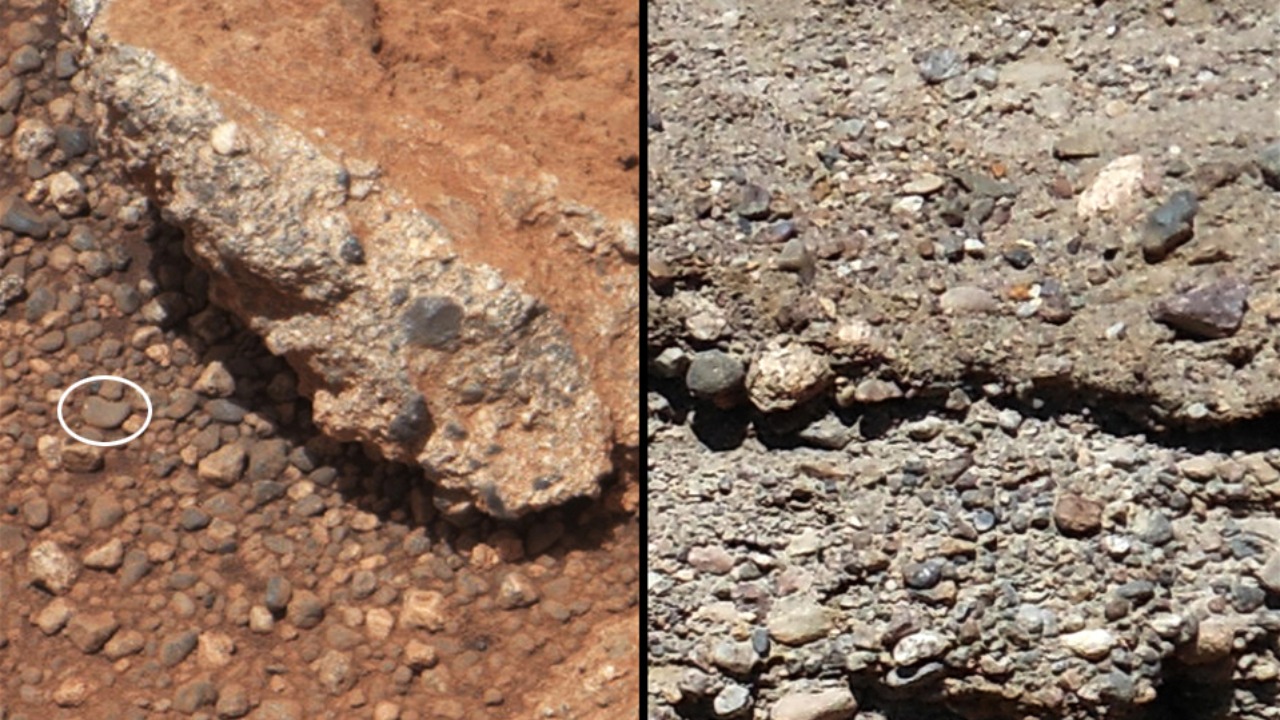

A single metallic boulder sitting in an ancient Martian riverbed is forcing scientists to rethink what they thought they knew about the Red Planet. The rock, an apparent interplanetary visitor, is not just a curiosity, it is a test case for whether Mars was a closed world or part of a restless, material‑trading solar system that may have ferried the ingredients for life across space. If the early analysis holds, this one object could permanently shift the Mars story from a planet studied in isolation to a crossroads in a much larger cosmic network.
At the same time, other strange stones cracked open by rovers are revealing sulfur rich veins, opal like minerals and complex layering that point to long lasting water and habitable environments. Taken together, the mysterious newcomer and the native rocks are converging on a single, high stakes question: did Mars once host life, and did material from elsewhere help seed it?
The rock that should not be there
When NASA’s Perseverance rover rolled across the floor of Jezero Crater, mission scientists expected to see familiar volcanic and sedimentary layers. Instead, they found a sculpted, metallic looking boulder that stood proud of the surrounding flat slabs, a rock that looked like it had been dropped in from somewhere else. During the rover’s investigation of the bedrock at a site called “Vernodden,” the team flagged the object, roughly 80 centimeters across, for closer study because its shape and texture were so unlike the low lying, fragmented rocks around it.
Perseverance targeted the boulder, later named “Phippsaksla,” with its SuperCam instrument and discovered that it is unusually rich in iron and nickel, a chemical fingerprint that strongly suggests an iron nickel meteorite rather than a native Martian stone. That composition is typically associated with material that formed in the cores of large asteroids, which means Phippsaksla almost certainly originated elsewhere in the solar system before ending up on Mars. Its presence in Jezero Crater, an ancient lake basin, immediately raised the stakes: this was not just a stray rock, it was a physical record of how impacts move material between worlds.
Why Phippsaksla is different from other Martian meteorites
Meteorites are not new to Mars. The Curiosity rover has cataloged several iron nickel specimens in Gale crater, including a roughly 1 meter wide object dubbed “Lebanon” and another called “Cacao,” and the earlier Opportunity and Spirit missions also encountered metallic visitors. What makes Phippsaksla stand out is not only its size and composition but the context in which it was found, perched in a river carved landscape that Perseverance is exploring specifically for signs of ancient habitability and possible biosignatures.
On November 19, in a mission update, NASA reported that this unusual rock on Mars, the Red Planet, had been formally named Phippsaksla and described it as a likely meteorite from elsewhere in the solar system, based on its iron nickel signature and sculpted appearance. The agency emphasized that Phippsaksla sits within Neretva Vallis, an ancient river valley that feeds into Jezero Crater, where geologist Michael Tice has been studying a nearby formation called Bright Angel for evidence that microbes may once have thrived in mud under water some 3.5 billion years ago. In that setting, a foreign body like Phippsaksla is more than a curiosity, it is a potential clue to how organic rich material could have been delivered into an environment already primed for life.
A messenger from the asteroid belt
The chemistry of Phippsaksla points to a violent origin story. Iron nickel meteorites are thought to be fragments of the metallic cores of differentiated asteroids, bodies that once melted internally so that heavy elements sank to the center. When those parent asteroids were shattered by collisions, chunks of their cores were launched into new orbits, some eventually intersecting planets. SuperCam’s detection of high iron and nickel content in Phippsaksla fits this picture, suggesting that the rock formed deep inside a large asteroid before being blasted free and wandering the solar system.
Mission scientists have explained that such meteorites are invaluable because they preserve conditions from the earliest era of planetary formation, when metal rich cores were taking shape and heavy elements were being redistributed. They also help researchers understand how impacts deliver material across planetary bodies, a process that could have moved water bearing minerals and organic compounds between worlds. In a mission briefing, the team noted that They, meaning meteorites like Phippsaksla, are key to reconstructing how impacts have shaped Mars and how these collisions may have altered its surface and interior over time, a story that is now being refined as Perseverance continues to study meteorites in Jezero.
Perseverance’s broader hunt for signs of life
Phippsaksla is arriving in a landscape already rich with tantalizing clues. NASA’s Perseverance rover was sent to Jezero Crater because orbital data showed it once hosted a lake and river delta, making it one of the most promising places on Mars to search for past life. Earlier in the mission, Perseverance collected rock samples that may contain possible signs of ancient microbial activity, including fine grained sediments that formed in water and minerals that can trap organic molecules. In a mission update shared in Sep under the prompt “Could Mars have once hosted life?,” NASA highlighted that Perseverance had collected a rock sample that may contain a possible signal of past biology, underscoring how central the life question is to every target the rover chooses.
That same campaign has turned up an “odd looking rock” that appears totally alien to the Red Planet, another object whose composition does not match the surrounding terrain and that may also be a meteorite. NASA’s Perseverance Mars rover recently captured images of this out of place stone, which, like Phippsaksla, stands out against the local bedrock and hints at material imported from elsewhere. The mission team has described how these finds, combined with sedimentary cores from the crater floor and delta, are building a layered record of Jezero’s history, from its watery past to the later era when impacts delivered exotic rocks that Perseverance is now cataloging as part of its search for Odd clues to habitability.
A strange visitor in Jezero Crater
The mission team’s growing list of exotic rocks in Jezero Crater includes another standout: a strange, out of place boulder that NASA has described as a rock on Mars that came from somewhere else. While exploring the crater, Perseverance identified this object, later also associated with the name Phippsaksla in mission updates, as a target because its texture and color contrasted sharply with the surrounding terrain. Initial analysis suggested that it did not match the local igneous or sedimentary units, reinforcing the idea that it was delivered by an impact rather than formed in place.
NASA has explained that this rock, discovered by Perseverance on Mars in Jezero Crater, is being studied not only for its own composition but for what it can reveal about long term habitability and past life. By comparing its chemistry with that of nearby native rocks, scientists hope to determine how much foreign material has been mixed into Jezero’s sediments and whether those imports carried water rich minerals or organic compounds. The mission team has emphasized that understanding how such a rock formed in the cores of large asteroids and then arrived in Jezero will help refine models of impact driven delivery of material, a process that could have influenced the conditions for life on Mars.
Daily bombardment and the Martian surface
Phippsaksla is not an isolated event in Martian history. Seismology data from other missions show that Mars, The Red Planet, is under near daily fire from space rocks, with small impacts generating a new class of quakes that ripple through the crust. These findings indicate that the planet’s surface is constantly being reshaped by incoming material, from dust sized grains to larger meteoroids that can excavate craters and deposit foreign rocks like Phippsaksla across the landscape.
Researchers such as Natalia Wojcicka, a research associate who has studied these impact driven quakes, have argued that this steady bombardment is a key part of Mars’s story, not just a background hazard. The pattern of impacts helps scientists learn about Mars’s history, including how thick its crust is, how its interior responds to shocks and how impacts change its surface over time. In that context, a large iron nickel meteorite in a river valley is both a geological marker and a data point in a broader effort to understand how incoming material has modified the planet’s environment, a theme that is now central to studies of Mars.
Curiosity’s cracked rocks and hidden chemistry
While Perseverance dissects Jezero’s meteorites and mudstones, the Curiosity rover is performing its own kind of forensic geology in Gale crater. In late May 2024, Curiosity drove over a rock and accidentally cracked it open, revealing bright yellow crystals inside that turned out to be rich in sulfur. That surprise, described in detail by mission scientists, showed that the interior of seemingly ordinary stones can hide complex chemistry, including sulfur that likely combined with other elements to form salts like sulfate, which often precipitate from water.
Subsequent analysis of that fractured rock and others like it has deepened the picture of Gale’s watery past. Reports on Curiosity Cracked Open a Rock on Mars And Revealed a Big Surprise describe how the rover’s instruments detected unexpected mineral assemblages that point to episodes of groundwater flow and chemical alteration long after the original sediments were laid down. Another mission update from Home, under the Science section, recounted how Curiosity drove over a rock on Mars, accidentally breaking it, and how what appeared inside left scientists with more questions than answers, especially when they compared the broken stone to the one it crushed. Together, these events underscore how much of Mars’s history is locked inside rocks that only reveal their secrets when rovers physically disturb them, a lesson that now informs how teams approach targets like Curiosity’s latest finds.
Opal, river channels and the case for long lasting water
Curiosity’s discoveries are not limited to accidental fractures. In a separate line of investigation, the rover has identified opal like deposits in Martian rocks, a finding that has major implications for the search for past life. Talia Sepersky, a planetarium educator, has explained how the detection of opal by the NASA Mars Curiosity Rover suggests that water once persisted in the subsurface, since opal typically forms when silica rich fluids move through rock and then solidify. She has argued that such minerals could be a game changer in the field of space exploration because they can trap and preserve microscopic evidence of past environments, and potentially even biosignatures, within their structure.
Curiosity has also been mapping ancient river channels in Gale crater, where images captured by the rover’s MastCam in June revealed a field of stones that appear to have been piled into mounds within a channel. Mission scientists described how Finding a field of stones arranged in this way points to sustained water flow that was strong enough to move and sort pebbles, then leave them behind as the river waned. In a detailed mission report, the team used these observations to argue that Gale once hosted long lived streams and lakes, conditions that would have been favorable for microbial life and that now provide a crucial comparison point for the watery history being reconstructed in Jezero.
A gangbusters summer of Martian rocks
The past few field seasons on Mars have been unusually productive for rock hunters. NASA’s Martian rovers, Perseverance and Curiosity, had what mission scientists described as a gangbusters summer, detecting rocks with potential signs of ancient water, complex geology and even remnants of the planet’s original crust. In a mission overview, the team highlighted how Perseverance and Curiosity together have sampled everything from fine grained mudstones to coarse conglomerates, as well as exotic boulders that may be pieces of deep crust or mantle, painting a far more varied picture of Mars than the old stereotype of a uniformly dusty desert.
Among the standout finds were rocks rich in pure sulfur, a likely anorthosite boulder that could be a piece of the planet’s primordial crust and a striped “zebra rock” that caught scientists’ attention because of its unusual banding. In a report on these discoveries, mission scientists noted that in a span of seven weeks, Perseverance and Curiosity found pure sulfur deposits and that the anorthosite boulder might eventually be shipped back to Earth for confirmation as part of a future sample return campaign. These finds, described in detail in a mission summary on NASA’s recent work, show that Mars’s crust is more complex than once thought, with layers and compositions that record a long and dynamic geological history.
Weird rocks, sulfur veins and what they imply
Beyond the headline grabbing meteorites and opals, Mars is littered with smaller oddities that quietly reshape scientific thinking. A survey of weird rocks that have turned up on Mars describes how Curiosity’s late May 2024 encounter with the sulfur rich stone opened a new window into the planet’s geochemistry. The sulfur in the stone, exposed when the rover cracked it open, likely combined with other elements to make salts like sulfate, which often form in evaporating lakes or groundwater systems. That chemistry suggests that water was not only present but actively cycling through the subsurface, altering rocks long after the original sediments were deposited.
Other strange finds include rocks with unusual textures, colors and layering that hint at processes like hydrothermal alteration, freeze thaw cycles and wind driven erosion that can mimic or obscure biological signatures. Mission scientists have emphasized that each of these weird rocks forces them to refine their criteria for what counts as a promising biosignature versus a purely abiotic pattern. The growing catalog of such objects, documented in mission updates and analyses of Curiosity’s traverse, is now a crucial reference set for interpreting Phippsaksla and other meteorites, since any claim about imported organics must be weighed against the complex, non biological chemistry already at work on Mars.
How Phippsaksla could rewrite the Mars narrative
All of this context is what makes Phippsaksla so consequential. If follow up studies confirm that it is an iron nickel meteorite that formed in the core of a large asteroid and later landed in an ancient river valley, then Mars can no longer be treated as a mostly closed system whose rocks tell only a local story. Instead, the planet becomes a node in a solar system wide exchange of material, where meteorites like Phippsaksla deliver exotic metals, minerals and possibly organic compounds into environments that were already wet and potentially habitable. That scenario would strengthen the case that life’s ingredients were shared between worlds, rather than assembled in isolation on each planet.
NASA has already framed Perseverance’s work in Jezero as a search for possible ancient life, noting in a Sep update titled Could Mars have once hosted life? that the rover has collected a rock sample that may contain a possible sign of past biology. The discovery of Phippsaksla within the same broader region, combined with the identification of a rock on Mars that came from somewhere else while exploring Jezero Crater, suggests that the story of life on Mars, if it existed, may be inseparable from the story of impacts and interplanetary exchange. As I weigh the accumulating evidence, from Curiosity Cracked Open a Rock on Mars And Revealed a Big Surprise to the gangbusters summer of Perseverance and Curiosity, I see Phippsaksla not as an isolated curiosity but as the clearest physical link yet between Mars’s internal history and the wider, impact driven evolution of the inner solar system, a link that could permanently change how we talk about Phippsaksla and the Red Planet.
Rovers, drills and the surprises still to come
The story of Phippsaksla also fits a broader pattern that mission engineers have come to expect: Mars rarely behaves as predicted. In a conversation about InSight’s Mole, a heat probe that struggled to burrow into the Martian subsurface, engineer Troy Hudson reflected that We have learned again, or it has been reinforced in us, that Mars is always a source of surprise and that doing remote geology on another planet means constantly revising expectations about what the subsurface is going to be like. That lesson applies just as much to surface rocks as to buried layers, as each new rover image seems to reveal something that does not quite match the models.
Perseverance’s own journey reflects that evolving mindset. A year after landing on Mars, the red planet, the rover was already setting its sights on intriguing new targets, with mission planners explaining how each new outcrop or boulder could change the way we explore the red planet. Since then, the team has added tools like high resolution video, including public facing clips on platforms such as YouTube, to share discoveries in near real time, and has used targeted observations, like those of Phippsaksla, to refine where to drill and sample. As I watch this process unfold, including detailed mission explainers that break down how NASA’s Martian rovers Perseverance and Curiosity coordinate their campaigns and how Curiosity Cracked Open a Rock on Mars And Revealed a Big Surprise, I am struck by how each unexpected rock, from sulfur veins to iron nickel meteorites, is less an anomaly than a reminder that Mars still has many ways left to surprise us, a reality captured in mission briefings and public updates on Mars.
The public window into Mars’s rock revolution
One underappreciated aspect of this rock revolution is how visible it has become to people on Earth. NASA and its partners now routinely share rover imagery and analysis through social media and video platforms, turning each new rock into a kind of public event. Short explainers on channels like YouTube walk viewers through how instruments like SuperCam and MastCam work, while Instagram posts highlight key questions such as Could Mars have once hosted life? and showcase how NASA’s Perseverance rover has spotted rock samples that may contain possible signals of past biology on Mars. This transparency has turned objects like Phippsaksla into shared reference points in a global conversation about life beyond Earth.
At the same time, more traditional mission updates continue to detail the technical side of the work. Reports on how NASA’s Perseverance rover on Mars captured a dust devil and discovered a shiny metallic rock that may be a meteorite, described as a mysterious visitor from outer space on Mars’s surface after four years of operations, give readers a sense of the day to day challenges of rover driving and target selection. Other updates, such as those that note how Perseverance and Curiosity found pure sulfur and anorthosite boulders and how some samples may eventually be shipped back to Earth for confirmation, underscore that the ultimate goal is to bring these rocks into terrestrial laboratories. As I follow these streams of information, from detailed mission logs to quick social clips, I see a consistent throughline: each new rock, whether cracked open by Curiosity or dropped in from an asteroid belt, is another piece of a puzzle that is steadily transforming our understanding of Perseverance and Curiosity and the Red Planet’s past.
From isolated world to cosmic crossroads
In the older Mars story, the planet was a largely self contained world whose fate was decided early: it lost its magnetic field, its atmosphere thinned, its surface dried out and it became a cold desert that preserved a fossil record of its own internal evolution. The emerging picture, sharpened by Phippsaksla and its kin, is more dynamic and interconnected. Mars now looks like a place where river valleys like Neretva Vallis once hosted mud rich environments that may have supported microbes, where opal and sulfur salts record long lasting groundwater and where iron nickel meteorites from the cores of large asteroids landed in those same basins, potentially delivering new chemical ingredients.
As I weigh the evidence from mission reports, scientific analyses and public briefings, I find it increasingly difficult to see Mars as an isolated case study. Instead, it appears as a crossroads in a solar system wide network of material exchange, a place where rocks from distant asteroids, native sediments and perhaps even biological traces intersect. The discovery of Phippsaksla, framed by NASA as a meteorite from elsewhere in the solar system and studied alongside native rocks that may contain possible signs of ancient life, crystallizes that shift. One mysterious rock will not answer the life question on its own, but it has already changed the terms of the debate, forcing scientists to consider not just whether Mars once hosted life, but how the wider cosmos may have helped shape whatever story unfolded on the Red Planet.
Supporting sources: NASA Found Opal on Mars. What’s It Mean for the Search for Past Life?.
More from MorningOverview