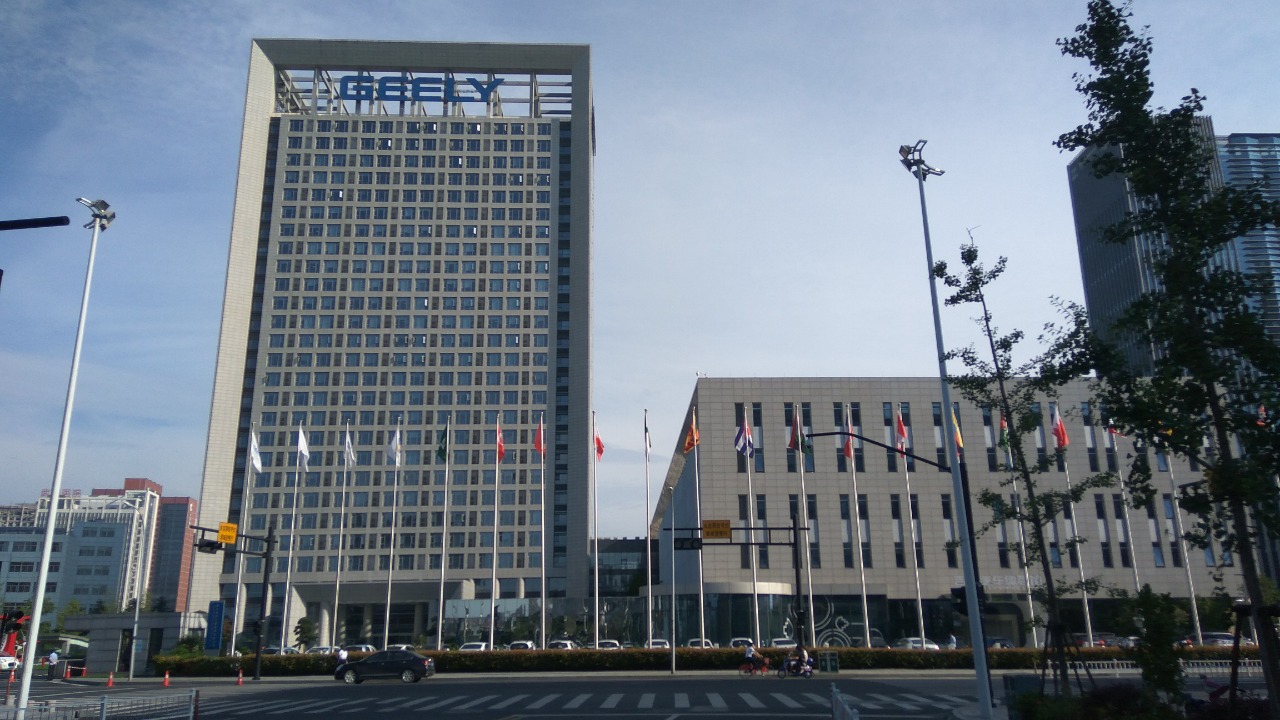

One of China’s most ambitious carmakers is edging closer to a move that could reshape the American electric vehicle market. Geely Holding Group has used the global spotlight of CES in Las Vegas to hint that its Zeekr and Lynk & Co brands may be the first Chinese-made EVs to arrive in meaningful volume on U.S. roads. The signals are still cautious, but they are clear enough that I see a serious strategic play taking shape rather than a passing flirtation.
For U.S. buyers, that would mean a new wave of lower cost, high tech models from a company that already owns Polestar and Volvo and has spent years preparing for a global push. For rivals, it would test how far tariffs, political scrutiny and brand loyalty can really slow a well funded Chinese challenger that believes it can build cars in America within a few years.
Geely’s CES hints: from curiosity to concrete timeline
Geely Holding Group chose CES in Las Vegas to move its U.S. ambitions out of the realm of rumor and into the language of planning. On the show floor, the company framed Zeekr and Lynk & Co as the spearhead for a potential American launch, positioning them as Chinese made EVs designed from the outset with global buyers in mind, including those in the United States. The way Geely showcased these brands, and the confidence with which executives discussed them, suggested that the company now sees the U.S. as a market it can eventually crack rather than a fortress to avoid, a shift that aligns with its broader push to sell Zeekr and Lynk & Co to American buyers as highlighted in its CES presence.
At CES, Geely’s communications leadership went further than marketing language and started talking in years, not decades. In a detailed conversation about the company’s future, the communications chief for one of China’s largest automakers, which is also the owner of Polestar and Volvo, said the question for Zeekr and Lynk & Co in America is no longer “if” but “when.” That executive described a planning window measured in the next 24 to 36 months, a timeframe that, if met, would put Geely’s brands on sale in the U.S. while today’s crop of EV tax incentives and charging build outs are still reshaping the market, a point underscored in a CES interview about Geely On Zeekr, Lynk, Co Brands In America.
“The Question Is When”: inside Geely’s U.S. calculus
When an executive describes a U.S. launch as inevitable, it signals that internal debates have shifted from whether to take the risk to how to execute it. In Las Vegas, Geely’s communications chief framed the company’s thinking in exactly those terms, saying the question is when Zeekr and Lynk & Co arrive in America, not whether they will come at all. That phrasing matters, because it suggests Geely believes its technology, cost base and brand portfolio, which includes Polestar and Volvo, give it enough leverage to navigate tariffs, regulatory scrutiny and political headwinds that have kept other Chinese automakers on the sidelines, a stance captured in the remark that “The Question Is When” China’s Geely On Zeekr, Lynk & Co Brands In America.
From my perspective, that confidence rests on two pillars. First, Geely has already built a track record of selling premium EVs and hybrids in Western markets through Polestar and Volvo, which gives it experience with U.S. safety rules, dealer expectations and consumer tastes. Second, the company appears to be betting that by the time Zeekr and Lynk & Co are ready, the U.S. EV market will have matured enough that buyers will be more focused on price, range and software than on the country of origin. That is a calculated gamble, but it is consistent with how Geely has repositioned itself over the past two decades from a budget brand to a technology focused group with global ambitions.
Long-term interest, short-term obstacles
Geely Holding Group has been careful to stress that its interest in the U.S. is long term, not a quick grab for market share. In a video interview around CES, the company discussed its desire to enter the U.S. passenger car market while acknowledging that tariffs on Chinese made vehicles and scrutiny of automotive software and data flows are real constraints. Executives described a phased approach in which different brands and production strategies are being evaluated for future expansion, a sign that Geely is mapping multiple paths into the market rather than betting everything on a single import led strategy, as reflected in its comments about long-term US market interest.
Those obstacles are not theoretical. The U.S. has already used tariffs and security reviews to slow or block Chinese technology in sectors from telecoms to solar panels, and connected cars sit at the intersection of both hardware and data. I read Geely’s careful language about “being evaluated for future expansion” as an acknowledgment that any U.S. move will likely require some combination of local manufacturing, joint ventures or brand structures that can ease political concerns. That is a slower route than simply shipping cars from China, but it may be the only realistic way for a Chinese automaker to build a durable presence in the U.S. under current conditions.
Ash Sutcliffe’s 2–3 year clock and the case for U.S. factories
The most concrete signal yet came from Ash Sutcliffe, Head of Global Communications for Geely Holding Group, who has started talking openly about building cars in America. In a recent discussion, Ash Sutcliffe, Head of Global Communications for Geely Holding Group, said the Chinese conglomerate is planning to build vehicles in the U.S. in the next 2 to 3 years, framing local production as a way to address both tariffs and consumer trust. He also noted that the group has already secured the rights to the trademark it would need, a small but telling sign that legal and branding groundwork is underway, details that emerged in a report on how Ash Sutcliffe, Head of Global Communications for Geely Holding Group, is framing the plan.
That timeline aligns closely with other comments from Geely executives about when a formal U.S. announcement might come. In a separate interview about a Chinese EV strategy, a senior figure said they expect to have an announcement on a U.S. entry in the next 24 to 36 months, describing that window as an exciting period for the company. The reference to 36 m as a planning horizon underscores that Geely is not thinking in vague long term aspirations but in specific corporate cycles, a point that was made explicit when a spokesperson for a Chinese EV brand said they expect a decision within that 36 m window.
Geely’s global playbook: from “price to technology” to Zeekr and Lynk & Co
To understand why Geely appears confident enough to contemplate a U.S. push, it helps to look back at how the company has reinvented itself. In 2007, Geely announced its entry into its 2.0 era, describing a major strategic transformation from price to technology and from low end positioning to a focus on improving its capabilities in terms of technology and product branding. That shift laid the groundwork for later acquisitions and partnerships, including its ownership of Volvo and Polestar, and it explains why Geely now sees itself not as a discount exporter but as a global technology group that can compete on software, safety and design, a trajectory documented in an analysis of how Geely shifted its strategy.
Zeekr and Lynk & Co are the clearest expressions of that 2.0 mindset. Zeekr is positioned as a premium electric brand with advanced driver assistance and over the air software updates, while Lynk & Co blends hybrid and plug in models with subscription style ownership. Both are designed to appeal to younger, tech savvy buyers who might otherwise gravitate toward Tesla or established European marques. By pairing those brands with the credibility of Polestar and Volvo in Western markets, Geely is effectively building a portfolio that can address multiple price points and regulatory regimes, which is exactly the kind of flexibility a Chinese automaker would need to navigate a complex U.S. entry.
How Geely’s approach differs from Chery, BYD and VinFast
Geely is not the only Chinese or Asia based automaker eyeing the U.S., but its strategy looks distinct when set against its peers. Chinese state-owned automaker Chery, for example, has also talked about entering the U.S. market, with Brian Wu, executive vice president of Chery, describing the American market as very important for the company and outlining plans to bring Chinese models to U.S. buyers. That ambition, detailed in a report on how Chinese state-owned automaker Chery views the U.S., shows that multiple Chinese brands see an opening, but Chery lacks Geely’s existing U.S. footprint through Volvo and Polestar.
BYD, by contrast, has taken a more cautious stance despite being one of the world’s largest EV makers. A senior executive recently said that Tesla rival BYD is not planning to come to the US, explaining that the company does not currently see a path that justifies the political and economic risk. That position was echoed by Stella Li, CEO of BYD Americas, who said Chinese electric vehicle manufacturer BYD is not planning to enter the U.S. market and is instead focusing on building a plant in the vicinity of Mexico City to serve other regions, a strategy outlined in a piece on how Tesla rival BYD is staying away from the U.S. and in a separate analysis of how Chinese BYD is investing near Mexico City.
Lessons from VinFast and the new “market access” reality
Any Chinese automaker contemplating a U.S. launch today has to reckon with the sobering example of VinFast, the Vietnamese EV startup that arrived with splashy marketing and is now retrenching. Electric vehicle (EV) startup VinFast has begun contracting its U.S. footprint, with industry publication Automotive News reporting that some dealers are the latest to exit the brand after early sales and service challenges. For Geely, the VinFast experience is a reminder that even with aggressive pricing and incentives, building a dealer network, service infrastructure and brand recognition in America is a multi year grind, a reality captured in coverage of how Electric startup VinFast is shrinking its presence.
On top of those commercial hurdles, Chinese automakers face what one analysis calls a new gatekeeper: market access itself. Policymakers are increasingly using tariffs, safety rules and data regulations as tools to control which foreign EVs can compete in their domestic markets, a trend that has been especially sharp for Chinese brands. A recent examination of this dynamic described market access as the new gatekeeper and argued that Chinese automakers will need to be patient and opportunistic, going on the offensive only when market conditions permit, a framework that helps explain why Geely is moving carefully and why others are holding back, as outlined in a discussion of Market Access and The New Gatekeeper.
Local manufacturing and the Xpeng precedent
One way to navigate that gatekeeper is to build cars closer to the customer, and other Chinese EV makers are already testing that approach in Europe. Xpeng, for instance, has begun European production in Austria, a move that signals a strategic shift from export based sales to localized manufacturing for the Guangzhou based company. By assembling vehicles inside the European Union, Xpeng can reduce shipping costs, adapt more quickly to local regulations and blunt some of the political backlash against Chinese imports, a strategy described in a report on how production in Austria marks a shift for the Guangzhou based company.
Geely appears to be drawing similar conclusions for the U.S. market. The talk from Ash Sutcliffe about building cars in America within 2 to 3 years suggests that local manufacturing is not just a theoretical option but a central plank of the company’s strategy. If Geely can site a plant in a politically receptive state, line up suppliers and leverage its experience running factories for Volvo and Polestar, it could present its U.S. operations as a source of jobs and investment rather than as a pure import play. That would not eliminate concerns about Chinese ownership or data flows, but it would give Geely a stronger argument in Washington and in state capitals that are eager for EV related manufacturing.
What a Geely entry would mean for U.S. buyers and rivals
If Geely follows through on its hints and launches Zeekr and Lynk & Co in the U.S. within the next few years, the impact on the market could be significant. For consumers, the arrival of another well funded EV player with a full lineup of crossovers, sedans and possibly minivans would likely mean more choice and sharper pricing, especially in segments where Tesla and legacy automakers have been able to maintain relatively high margins. Zeekr’s focus on long range batteries and high end interiors, combined with Lynk & Co’s flexible ownership models, could appeal to buyers who want something different from the traditional dealership experience without sacrificing quality or safety.
For rivals, a Geely entry would test how resilient their U.S. positions really are. Tesla would face a new competitor that, unlike many startups, already has scale and a deep bench of engineers, while established brands like Ford, General Motors and Toyota would have to contend with a Chinese group that can spread R&D costs across multiple global brands. The political debate would also intensify, with lawmakers weighing the benefits of new factories and jobs against concerns about Chinese ownership and technology. In that sense, Geely’s potential move is not just a business story but a test case for how open the U.S. remains to foreign competition in a sector that is central to both climate policy and industrial strategy.
The stakes of timing in a fast-shifting EV landscape
Timing will be critical. If Geely can hit its own 24 to 36 month window for a U.S. announcement and begin local production within 2 to 3 years, it will arrive while the EV market is still in a growth phase but before it is fully saturated. That would give Zeekr and Lynk & Co room to carve out niches, especially if they can undercut rivals on price while matching them on technology. Waiting longer could mean facing a more crowded field and potentially tougher trade barriers, particularly if U.S. policymakers decide that Chinese EVs pose an existential threat to domestic automakers and respond with even higher tariffs or outright restrictions.
From what I see in Geely’s recent moves, the company understands that window and is trying to position itself accordingly. Its executives are talking in specific timeframes, its communications chief is floating the idea of U.S. factories, and its broader corporate history shows a willingness to invest heavily when it believes a market is strategically important. Whether that will be enough to overcome the political and regulatory headwinds is still uncertain, and some elements of the plan remain unverified based on available sources. But the direction of travel is clear: among Chinese automakers, Geely looks like the one most determined to test how far a Chinese EV champion can go in the United States.
More from Morning Overview