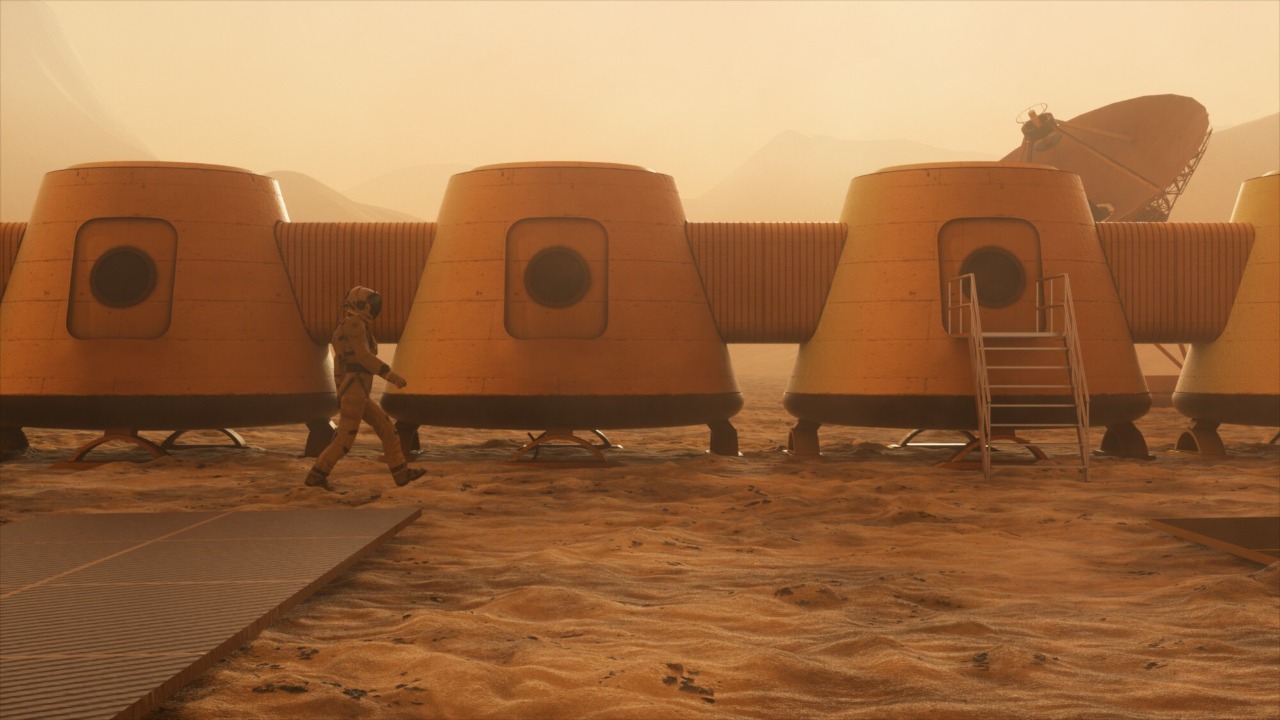

Turning Martian dust into shelter has long sounded like science fiction, but researchers are now treating it as an engineering problem with a biological answer. Instead of shipping steel and concrete across space, they are designing microbes that can survive the cold, thin air and intense radiation of Mars and then literally grow the walls around future settlers. The emerging vision is starkly practical: use living materials to turn a hostile planet into a place where humans can pour foundations without ever opening a bag of cement.
Why Mars needs biology, not just rockets
For all its familiar red vistas, Mars is a brutal construction site. The planet’s low gravity, dust storms and deep cold make traditional building materials heavy liabilities, and every kilogram of steel or cement launched from Earth adds punishing cost to any mission plan. Researchers who study how Life first emerged From Earth argue that the only sustainable way to build long term Martian habitats is to copy that early playbook and work with simple organisms that can use what is already on the ground.
That logic is now shaping serious engineering proposals. Studies on Settling Mars stress that spaceflight is so expensive that hauling bulk construction materials is simply not viable at the scale of a town or city. Instead, mission planners are increasingly focused on in situ resource utilization, a dry phrase that in practice means teaching microbes to turn Martian dust, ice and atmospheric carbon dioxide into bricks, binders and even self-healing concrete.
The microbial concrete revolution
The most immediate breakthrough comes from extremophile bacteria that can turn loose regolith into something that behaves like concrete. British researchers working with Extremophile strains have shown that some microbes can survive conditions similar to Martian volcanic soils and deep caves, then precipitate minerals that cement grains of dust together. In parallel, laboratory tests on a synergistic pair of bacteria indicate that two tough species can transform simulated Martian dust into a durable building material that behaves like a concrete block.
Engineers describe this as a “microbial powerhouse” because the organisms do double duty, both surviving harsh conditions and producing a solid, concrete-like binder. Reporting on Microbial experiments notes that these Two bacteria species could cement humanity’s first home on Mars by binding local dust into a solid, concrete-like material without the need for high-temperature kilns or large amounts of water. The same concept underpins broader work on Scientists who strongly believe that bacteria can be used to grow very durable construction materials that could support colonies on Mars in the near future.
Living bricks and synthetic lichens
Beyond loose-fill concrete, researchers are now fabricating literal “living bricks” that can be stacked like Lego. Teams from Texas A&M and the University of Nebraska at Linco have demonstrated blocks grown from microbial communities embedded in a mineral matrix, which harden into structural units while keeping a fraction of the microbes alive. Reports on these Scientists explain that the advancement has the potential to let crews assemble walls from modules that can later repair microcracks as the organisms continue to deposit minerals.
Another line of work focuses on hybrid systems that pair photosynthetic bacteria with fungi to mimic lichens. Texas researchers have developed a process to build Martian homes using fungi and cyanobacteria that act as Synthetic Lichens, forming a living skin that can grow on Martian regolith without constant human intervention. Earlier coverage of these Texas efforts notes that such Martian systems could reduce the need for sending extra materials from Earth by letting structures thicken and strengthen over time. That same principle underlies broader research into New ‘Living’ materials that could let crews start construction on Mars with only a small starter culture of microbes instead of shiploads of bricks.
From synthetic biology labs to Martian streets
What ties these projects together is synthetic biology, the deliberate redesign of organisms to perform useful tasks. Advocates who ask How Earth Will We Colonize Mars, Use Synthetic Biology argue that the same tools used to program yeast to make medicines can be used to program microbes to make building materials. In that vision, Mars becomes a test bed where engineered bacteria, cyanobacteria and fungi are shipped as tiny vials, then scaled up in bioreactors to churn out binders, polymers and even insulation, all tuned to Martian gravity and temperature swings.
Researchers exploring whether future astronauts Could build houses on Mars with bacteria frame it as an extension of using microbes to grow crops or recycle waste. The same bacterial strains that stabilize soil for agriculture could help form the foundations of greenhouses and pressure vessels. Social media posts that ask whether we Could future astronauts build houses on Mars with bacteria highlight that researchers have discovered special microbes capable of surviving Martian-like conditions and producing mineral binders, turning a speculative idea into a concrete engineering pathway.
Self-healing habitats and the risks of living walls
One of the most intriguing promises of microbial construction is self-repair. Work on self-healing materials shows that bacteria embedded in concrete can remain dormant until cracks let in water or air, at which point they wake up and precipitate minerals that seal the gap. Researchers note that this process could technically go on almost forever, a tantalizing prospect for a hostile environment like the one of concrete structures exposed to Martian dust, radiation and temperature swings. If similar systems are tuned for Martian chemistry, a habitat wall might quietly patch micrometeorite damage without a maintenance crew ever noticing.
That vision is already influencing how scientists talk about Martian Colonies Could Be Built by Living Microbes That, with future astronauts potentially relying on walls that are partly alive. At the same time, there are real risks. Any system that depends on biology must be kept within strict environmental limits, and some researchers warn that keeping microbes alive without human intervention is harder than it sounds. Reports on Other researchers exploring various options for living bricks emphasize the need for designs that minimize external nutrient supply, so that a failure in one life-support system does not cascade into structural weakness.
From lab prototypes to Martian neighborhoods
For now, most of these ideas live in petri dishes and small test blocks, but the trajectory is clear. Studies on living materials describe proof-of-concept systems where cyanobacteria and fungi form self-sustaining composites that grow on Martian simulant soil. Coverage of Martian Colonies Could with such living materials notes that future astronauts may not just inhabit prefabricated modules but instead cultivate their own building stock on site. Parallel reporting on new process work from Texas underscores that scientists are already testing how these systems behave without constant human tending, a key requirement for any long-duration mission.
As these prototypes scale up, they intersect with broader conversations about how to design entire Martian neighborhoods. Analyses of Two bacteria species that could cement humanity’s first home on Mars, and reports asking whether Martian Colonies Could by such systems, frame microbial construction as a cornerstone of any realistic settlement plan. Social media discussions that highlight how Could future astronauts build houses on Mars with bacteria capture a shift in mindset: instead of treating microbes as contaminants to be scrubbed away, mission designers are starting to see them as the planet’s first construction workers.
More from Morning Overview