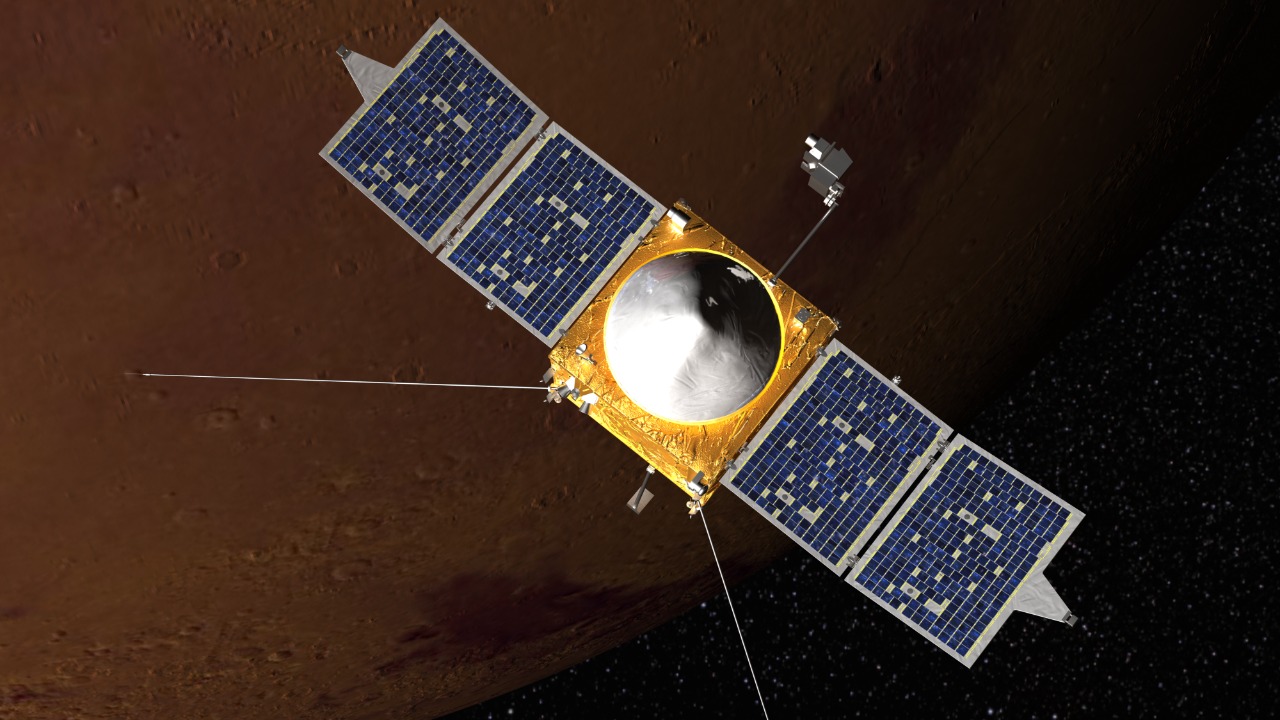

NASA’s veteran Mars orbiter MAVEN has fallen ominously silent, cutting off a decade-long stream of atmospheric data that reshaped how scientists think about the red planet’s past. After weeks without a response, engineers are confronting the possibility that one of their most productive Martian sentinels may never phone home again.
The loss would not only mark the end of a workhorse mission, it would also expose how fragile our robotic presence around Mars really is, from the spacecraft themselves to the communications lifeline that keeps them connected to Earth.
From atmospheric scout to Martian mainstay
When NASA sent the Mars Atmosphere and Volatile EvolutioN mission, better known as MAVEN, to Mars, the goal was straightforward and ambitious: figure out how a once thicker atmosphere thinned into the cold, dry shell we see today. Since the MAVEN spacecraft entered orbit around Mars in 2014, it has been studying the red planet’s upper atmosphere, ionosphere, and the way charged particles from the Sun strip gas away into space, turning a textbook question into a living laboratory in orbit. That work helped explain why the atmosphere of Mars is often described as tenuous and why its sky can appear pink-orange in images, a topic that even introductory physics problems send students to the official NASA Web pages for MAVEN to explore.
Over time, MAVEN evolved from a narrowly focused science probe into a central node in the Martian network. Its orbit and radio system made it a natural relay for surface missions, passing data between Earth and rovers on the ground while still running its own atmospheric campaigns. That dual role, as both a research platform and a communications hub, is why NASA officials have repeatedly described MAVEN as one of the agency’s workhorse missions and why its sudden silence now feels less like the quiet end of a long career and more like a critical system failure in Mars orbit.
The moment the signal vanished
The current crisis began when NASA lost communication with its MAVEN probe nearly a month ago, a gap that has now stretched long enough to trigger talk of a permanent loss. One of NASA’s workhorse spacecraft in orbit around Mars has fallen silent, leaving engineers to sift through the last bits of telemetry and tracking data from Dec. 6 to reconstruct what might have gone wrong in those final, fleeting contacts. In deep space operations, a missed check-in can be routine, but a prolonged blackout from a previously stable orbiter is a red flag that something fundamental has changed.
Inside mission control, the first hours after a missed contact are usually spent ruling out simple explanations: a mispointed antenna, a software glitch, a temporary power issue. In this case, those standard recovery scripts have so far failed to coax even a whisper from the spacecraft, which is why NASA officials are now openly acknowledging that the Mars Atmosphere and Volatile EvolutioN mission may be dead. That stark possibility hangs over every subsequent troubleshooting step, because the longer the silence stretches, the more likely it is that MAVEN has suffered damage that no command sequence can undo.
A spinning spacecraft and a shrinking set of options
Clues from the last available data suggest that MAVEN is not simply quiet but in distress. Tracking information indicates that the spacecraft is apparently spinning, a sign that it may have lost the stable orientation it needs to keep its solar panels pointed at the Sun and its antennas aimed at Earth. For a probe that relies on precise pointing to maintain power and communications, an uncontrolled spin can quickly cascade into deeper trouble, from drained batteries to overheated or frozen components, especially in the harsh thermal environment around Mars.
Engineers are trained for this kind of anomaly, and they have been working through contingency plans to stop the rotation and reestablish contact. Those efforts include sending blind commands through the Deep Space Network in the hope that MAVEN’s onboard systems are still listening and capable of executing a safe-mode routine that would slow the spin and reorient the spacecraft. Reports that the orbiter is still silent at Mars, and apparently is spinning too, underscore how narrow the path to recovery has become, even as teams continue to probe every possible avenue to bring the mission back from the brink using the limited insight they can glean from the last tracking data.
Inside NASA’s scramble to revive MAVEN
Once it became clear that MAVEN was not responding to routine calls, NASA shifted into a more aggressive recovery posture. A communication blackout temporarily silenced NASA’s MAVEN orbiter, a crucial source of data on Mars’ atmosphere, and engineers have been working through a carefully staged series of tests and commands to diagnose the spacecraft’s state so far from Earth. Each attempt must account for the long light travel time between the planets, which turns every exchange into a slow-motion conversation where feedback arrives minutes later, if it arrives at all.
Those constraints make the process painstaking. Teams have to balance the need to send bold corrective commands against the risk of pushing a damaged spacecraft into an even worse configuration. According to accounts of the internal effort, Engineers have been modeling different failure modes, from attitude control problems to power system faults, and then crafting command sequences tailored to each scenario. The fact that MAVEN suddenly goes silent around Mars, and has stayed that way despite these attempts, highlights both the ingenuity and the limits of remote spacecraft surgery, especially when the patient may already be critically compromised, as described in detailed coverage of NASA MAVEN Mars Engi recovery work.
Why MAVEN mattered so much to Mars science
If MAVEN is truly gone, the scientific loss will be immediate and long lasting. Since the MAVEN spacecraft entered orbit around Mars in 2014, it has been studying the red planet’s upper atmosphere in unprecedented detail, tracking how solar storms, seasonal changes, and long term solar cycles affect the rate at which gas escapes into space. Those measurements turned abstract models of atmospheric escape into concrete numbers, helping scientists quantify how much air Mars has lost over billions of years and how that loss transformed a once more habitable world into the frigid desert we see today, as highlighted in early mission summaries that emphasized how Since the MAVEN mission began, it has reshaped our understanding of Martian climate history.
Beyond its core atmospheric work, MAVEN’s instruments captured the dynamic behavior of the Martian ionosphere, the charged layer that plays a key role in how radio waves propagate and how the planet interacts with the solar wind. That data fed into models that are now used to plan future missions, from orbiters to potential crewed flights, by predicting how space weather might affect communications and radiation exposure. Losing that continuous stream of observations would leave a gap in the long term record that scientists rely on to track how Mars responds to the changing Sun, a record that cannot simply be reconstructed later because the planet and its star will never again be in exactly the same state.
The relay role: a quiet backbone for rovers
MAVEN’s importance was never limited to pure science. One of NASA’s workhorse spacecraft in orbit around Mars has also been a critical relay for surface missions, passing commands to and from the Curiosity and Perseverance rovers that explore the ground. Orbiters like MAVEN can see rovers for only a few minutes each pass, but during those windows they can downlink large volumes of data that would take far longer to send directly to Earth, turning short line-of-sight contacts into a high bandwidth bridge back home.
That relay role is why the loss of signal from this critical Mars orbiter has implications that ripple far beyond its own instrument suite. While other spacecraft can pick up some of the slack, each has its own orbit, antenna configuration, and workload, and none can perfectly replicate the coverage pattern MAVEN provided. The sudden silence of a mission that had become one of NASA’s workhorse missions forces planners to rethink how they schedule rover downlinks and uplinks, and it underscores how dependent surface exploration has become on a small fleet of aging orbiters, as detailed in reports that describe how One of NASA relied on MAVEN to keep Curiosity and Perseverance connected.
Houston, we have a problem: what might have gone wrong
When a spacecraft that has been stable for years suddenly goes dark, the list of suspects is both familiar and frustratingly broad. NASA’s MAVEN spacecraft, short for Mars Atmosphere and Volatile EvolutioN, went mysteriously silent after a decade in space, and the precise cause of the signal loss is currently unknown. Engineers are considering possibilities that range from a failure in the attitude control system, which could explain the apparent spin, to a fault in the radio hardware or power system that might have cut off the transmitter even if other subsystems are still functioning.
Complicating the diagnosis is the fact that MAVEN operates in a harsh environment where small issues can snowball. A micrometeoroid strike, a degraded component finally reaching the end of its life, or an unexpected interaction with the Martian atmosphere at low altitude could all, in theory, trigger a chain reaction that leaves the spacecraft unable to point its antenna or generate enough power. The iconic phrase “Houston, We Have a Problem” has been invoked in coverage of this incident for good reason: after a decade in space, MAVEN went mysteriously silent, and without fresh telemetry, the team can only infer what happened from the last healthy packets and the absence of any response to their increasingly urgent calls, as captured in detailed accounts titled along the lines of Houston We Have Problem NASA Has Lost Contact With the MAVEN Mars Orbiter.
The Deep Space Network’s fragile lifeline
Every attempt to reach MAVEN depends on a separate, often overlooked system: the global array of giant radio antennas that make up NASA’s Deep Space Network. Unfortunately, the Deep Space Network hasn’t heard from the science orbiter since the first signs of trouble, a silence that highlights how even a perfectly functioning ground system can only listen and wait when a spacecraft stops talking. The DSN’s role is to send commands and receive data, but it cannot fix a broken transmitter or reorient a spinning spacecraft on its own; it is the phone line, not the phone.
At the same time, the network itself is under strain. A key antenna in NASA’s Deep Space Network was recently damaged, prompting a push to explore the updates, project details, and repair milestones needed to restore full capacity and prevent similar disruptions in the coming decades. That effort, described in technical updates that urge readers to Explore the NASA Their plans, underscores how aging infrastructure on Earth can compound the challenges of managing aging spacecraft at Mars. While there is no indication that DSN issues caused MAVEN’s silence, the episode is a reminder that deep space exploration depends on a chain of hardware and software that stretches from Martian orbit to desert valleys in California, Spain, and Australia, and any weak link can limit how quickly and effectively teams respond when a mission is in trouble.
What MAVEN’s possible loss means for Mars exploration
If MAVEN never responds again, NASA will have to adjust both its scientific ambitions and its operational playbook at Mars. On the science side, the end of continuous upper atmosphere monitoring would leave researchers without a key tool for tracking how Mars responds to solar storms and long term solar cycles, especially during periods when other missions are focused on different targets. The data already collected will keep scientists busy for years, but the absence of new measurements will limit their ability to test models against fresh events, particularly as the Sun moves through its activity cycle and sends changing streams of charged particles toward the red planet.
Operationally, the loss would accelerate a shift that was already underway: the need to design future Mars missions with more redundancy in both science capabilities and communications. NASA has long relied on a small cadre of orbiters to serve as relays, and MAVEN’s silence shows how risky that dependence can be when each spacecraft is well past its original design life. In the near term, other orbiters will shoulder more of the load for Curiosity and Perseverance, but in the longer term, planners will have to decide whether to launch dedicated relay satellites, equip rovers with more powerful direct-to-Earth antennas, or both. Unfortunately for MAVEN, the Deep Space Network hasn’t heard from the science orbiter since the anomaly began, as one technical analysis put it, and that reality is forcing a broader reckoning with how fragile our Martian infrastructure really is, a point underscored in commentary that opens with the stark line, Unfortunately Deep Space Network has been met with only silence.
A decade in orbit, and a reminder of spaceflight’s limits
Whatever the final verdict on MAVEN, its decade in orbit around Mars has already secured its place in the history of planetary exploration. The mission answered fundamental questions about how Mars lost its air, provided a real time laboratory for studying atmospheric escape, and quietly kept surface missions connected to Earth. It also demonstrated how a spacecraft designed for one purpose can be repurposed and extended, evolving from a focused atmospheric probe into a multi role asset that supported both science and operations far beyond its original mandate, as reflected in educational materials that ask students to check whether MAVEN has been launched and has arrived at Mars by visiting the official Has it been launched pages.
For all that success, MAVEN’s apparent silence is a sobering reminder that no spacecraft lasts forever, especially in the unforgiving environment of deep space. Components age, radiation accumulates, and small anomalies can eventually add up to a failure that no amount of ingenuity on the ground can reverse. As NASA weighs whether to keep trying to raise the orbiter or to formally declare the mission over, the story of MAVEN is already shaping how engineers think about the next generation of Mars explorers, from more resilient hardware to more robust communication networks. The end of one mission, however it comes, is also the starting point for the next, and the lessons written in MAVEN’s final, missing chapter will travel with every spacecraft that follows it to the red planet.
Supporting sources: A NASA spacecraft orbiting Mars may be dead.
More from MorningOverview