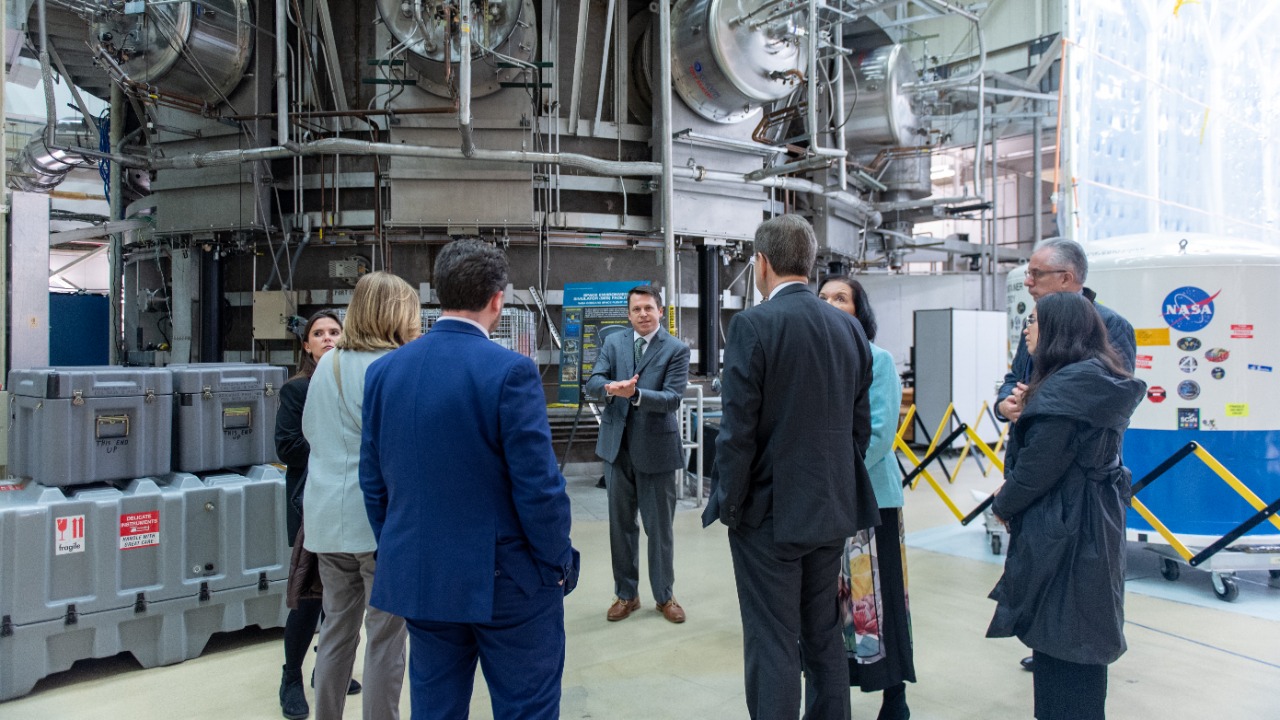

NASA has quietly shut down its largest research library at the Goddard Space Flight Center, a decision that will see unique books, reports and technical records tossed into dumpsters or warehoused out of reach. What sounds like a bureaucratic reshuffle is, in practice, the dismantling of a core piece of the agency’s institutional memory, with scientists warning that priceless material is being lost faster than it can be digitized or saved.
The closure, carried out under the Trump administration as part of a broader reorganization of labs and staff, has stunned researchers who relied on the Goddard collection to reconstruct past missions and design new ones. Instead of a carefully planned preservation effort, they are watching shelves cleared in a rush, with irreplaceable documents treated as surplus property rather than as the raw material of future discovery.
How NASA’s biggest library ended up on the chopping block
The research library at NASA’s Goddard Space Flight Center in Greenbelt, Md., was not a side room of dusty shelves, it was the agency’s largest repository of technical literature, mission reports and internal documentation. Reporting describes how the library, after 66 years of operation, has been ordered to close permanently, with the decision framed as part of a cost cutting and consolidation push that also affects laboratories and staff across the center. The shutdown is being carried out under the Trump administration, which has authorized NASA to dispose of federally owned property that is no longer deemed essential to current programs.
Accounts of the process make clear that the closure is both immediate and irreversible, with staff instructed to remove collections and prepare them either for storage or disposal rather than for systematic preservation. Coverage of the decision notes that NASA’s largest research library at the Goddard Space Flight Center will close on Jan 2, that books will literally be tossed away, and that the move is explicitly tied to directives from Trump officials to streamline operations. In that context, the Goddard library is not an isolated casualty but a symbol of how short term budget and space pressures can override the long term value of scientific archives that took decades to build.
What is actually being lost on the shelves
Scientists who worked with the Goddard collection stress that the real loss is not simply the number of volumes but the uniqueness of what they contain. Many of the documents on those shelves are internal mission reports, engineering notebooks, obscure conference proceedings and data compilations that were never widely published and cannot simply be downloaded from a modern database. One former director of NASA’s Space Science Data Coordinated Archive, identified as Williams, put it bluntly, saying “You can’t just get these things online,” a reminder that the analog past still holds information that has never been digitized or indexed.
Reports on the closure describe thousands of unique documents that will either be warehoused with uncertain access or discarded outright, including materials that capture how early missions were designed, tested and flown. Some scientists worry most about what is on the shelves that no one has thought to scan yet, the obscure but crucial charts, calibration records and technical memos that become vital when a new anomaly appears or a future mission needs to replicate an old configuration. Once those are thrown out, there is no backup copy in a cloud server, only a gap in the historical record that no amount of funding can later repair.
Inside Goddard, the center that grew up with American spaceflight
To understand the stakes, it helps to remember what Goddard Space Flight Center represents inside NASA. Named for physicist Robert H. Goddard, a pioneer of modern rocketry described as a scientist of great insight and a unique genius for invention, the center has long been one of the agency’s premier hubs for space and Earth science. Official descriptions of Goddard emphasize its role in building and operating satellites, managing major observatories and coordinating data systems that underpin everything from Hubble images to climate records.
Goddard is frequently described as the nation’s premiere space research complex, a place where laboratories, integration facilities and mission control rooms sit alongside the library that has now been shuttered. The same reorganization that is closing the library is also tied to laboratory cuts and consolidations, raising fears that the center’s broader research capacity is being hollowed out. When a facility that has anchored American spaceflight for generations starts dismantling its own memory bank, it signals a shift in priorities that reaches far beyond one building or one set of shelves.
How the closure fits into a wider pattern of cuts and consolidation
The decision to shut the Goddard library is explicitly linked to a larger restructuring of NASA’s facilities and workforce. Reports describe how the closure is part of staff and laboratory cuts at Goddard, with some labs being consolidated or closed outright and positions eliminated or reassigned. One account notes that Goddard is undergoing accelerated closures and consolidations that have sparked widespread concern among scientists and policymakers, with uncertainty looming over the future of federal research facilities that depend on stable infrastructure to plan long term projects.
In that context, the library’s fate looks less like an isolated misjudgment and more like a symptom of a broader shift in how federal science is managed. A detailed analysis of Goddar lab closures highlights how rapid decisions, driven by budget and political pressure, can undermine the careful planning that complex research campuses require. When libraries, labs and support staff are all being trimmed at once, the risk is not just that individual projects suffer, but that the entire ecosystem that makes ambitious missions possible starts to fray.
Lawmakers and scientists push back on the Trump administration
The political reaction to the Goddard shutdown has been unusually sharp for what might otherwise have been an internal NASA decision. Coverage of the closure notes that the Trump administration is being directly blamed for the move, with critics arguing that its directives to cut and consolidate have targeted the very infrastructure that keeps American science competitive. One report describes how NASA’s biggest research library is about to go dark and explicitly ties the decision to The Trump administration, underscoring how the White House’s priorities are being felt deep inside technical agencies.
Members of Congress have also weighed in, framing the closure as a threat to national capabilities rather than as a parochial issue for one center. In particular, Sen Chris Van Hollen has said he will fight moves that undermine Goddard’s mission, while Rep Zoe Lofgren has issued a statement criticizing the impact on research and development. Their comments appear in detailed coverage of Sen Chris Van Hollen and Rep Zoe Lofgren’s response, which also quotes scientists who fear that once the material is gone, no future administration will be able to bring it back.
“Books will be tossed away”: what happens to the collection now
For all the talk of reorganization and modernization, the practical reality of the closure is brutally simple. Reports on the Goddard library stress that NASA’s largest library at the Goddard Space Flight Center will close permanently on Jan 2 and that books will be tossed away, language that leaves little room for a comforting narrative about careful curation. The decision is described as immediate and irreversible, with NASA authorized to dispose of federally owned property that no longer fits within its streamlined footprint, even when that property consists of one of a kind scientific records.
Some portion of the collection is expected to be warehoused, but coverage of the plan makes clear that storage is not the same as access or preservation. One detailed account notes that NASA’s largest research library at Goddard Space will see its materials either warehoused or discarded, with no guarantee that warehoused items will be cataloged, digitized or made available to researchers. That description appears in reporting on how the NASA’s largest research library is being broken up, and it underscores why so many scientists describe the process as a form of cultural vandalism carried out under the cover of administrative housekeeping.
Why digital archives are not enough to replace a working library
Supporters of the closure often point to the growth of online databases and digital repositories as evidence that a physical library is no longer essential. Scientists who have used the Goddard collection push back hard on that assumption, arguing that the digital record of NASA’s work is partial, inconsistent and often missing the very materials that matter most when something goes wrong. Williams, the former director of NASA’s Space Science Data Coordinated Archive, is quoted warning that “You can’t just get these things online,” a reminder that even the agency’s own data systems were never designed to capture every memo, drawing or lab notebook that might later prove important.
In practice, a working research library is more than a storage room, it is a staffed, curated environment where experts help scientists locate obscure references, cross check conflicting reports and trace the lineage of an idea across decades of missions. When that function is replaced by a warehouse and a search box, the subtle but crucial work of connecting dots across time becomes much harder. Detailed coverage of the closure in NASA’s largest research library closing captures this tension, quoting experts who say that without librarians and physical collections, future teams may not even know which questions to ask of the digital record.
A 66 year legacy, cut off mid sentence
The Goddard library is not a new experiment but an institution that has grown alongside NASA itself. Reports note that the library at the Goddard Space Flight Center has operated for 66 years, serving generations of engineers and scientists who built everything from early weather satellites to sophisticated space telescopes. That span covers the entire arc of the space age, from the first rockets that followed Robert H. Goddard’s designs to the complex missions that now study distant galaxies and monitor Earth’s climate.
When a 66 year old library is shuttered in a matter of weeks, the abruptness sends its own message about how institutional memory is valued. One widely shared account points out that NASA’s largest library at the Goddard Space Flight Center has shut permanently after 66 years and notes that US lawmakers blame the Trump administration for a move they call “deeply concerning” for science and space. That language appears in coverage of NASA’s largest library being shuttered, and it captures the sense that an era is ending not because the work is done, but because the paperwork that recorded it has been deemed expendable.
How other NASA centers handle knowledge and archives
The Goddard closure also raises questions about how other NASA centers are managing their own records and libraries. Facilities like the Ames Research Center in California and the Glenn Research Center in Ohio have long maintained technical libraries and archives that support their work on aeronautics, space technology and Earth science. Official descriptions of Ames highlight its role in cutting edge research on supercomputing, astrobiology and flight systems, while materials on Glenn emphasize its contributions to propulsion, power and communications.
Other major hubs, including the Jet Propulsion Laboratory in Pasadena, rely on deep institutional memory to manage complex missions that last for decades. The public facing profile of JPL showcases its leadership in robotic exploration of the solar system, but behind the scenes that work depends on access to historical design choices, test results and mission logs. The Goddard shutdown is prompting quiet conversations across these centers about whether their own libraries and archives could be next, and whether they should accelerate efforts to digitize and safeguard collections before a similar order arrives.
Federal shutdowns and the fragility of scientific infrastructure
The library’s fate is unfolding against a broader backdrop of instability in federal science funding and operations. Experts have warned that the ongoing shutdown of the United States government has serious, often overlooked side effects on agencies that monitor the environment, manage data and respond to hazards. One analysis notes that the shutdown has raised concerns among scientific agencies and environmental groups about their ability to respond to extreme weather and other hazards, highlighting how quickly critical capabilities can be degraded when budgets and staffing are disrupted.
Those warnings, captured in reporting on how the United States shutdown affects science, resonate with what is happening at Goddard. Whether through a formal government shutdown or an internal reorganization, the pattern is the same: infrastructure that took decades to build can be dismantled in a fraction of that time, often without a full accounting of what is being lost. In the case of the Goddard library, the damage is not just to current projects but to the ability of future scientists to understand how today’s decisions were made.
Why this matters far beyond one NASA campus
For the broader scientific community, the Goddard closure is a cautionary tale about how easily knowledge can be treated as disposable when it is stored on paper instead of in a live database. The library’s shelves held the working notes of a spacefaring civilization, from early rocket tests to sophisticated satellite missions, and their destruction or burial in warehouses will make it harder for future researchers to trace the lineage of ideas, diagnose failures or rediscover forgotten techniques. When lawmakers like Sen Chris Van Hollen and Rep Zoe Lofgren describe the move as undermining Goddard’s mission, they are also pointing to a deeper risk: that the United States will slowly lose the documentary backbone that has supported its leadership in space and science.
There is also a symbolic cost. NASA has long been held up as a model of how a public institution can accumulate and share knowledge, inspiring generations of students and researchers around the world. The decision to close its largest library, under a Trump administration that has prioritized short term cuts over long term investment, sends a different message about what is valued. As other centers like Ames, Glenn and JPL weigh their own futures, and as federal agencies navigate shutdowns and reorganizations, the Goddard story will stand as a stark example of what happens when priceless materials are treated as clutter instead of as the foundation for whatever comes next.
Beyond Goddard: the geography of NASA’s knowledge
Part of what makes the Goddard closure so jarring is that it comes at a time when NASA’s footprint is more geographically diverse and interconnected than ever. The agency’s centers are spread across the country, from the East Coast hubs in Maryland and Virginia to the West Coast complexes in California and the Midwest facilities in Ohio. Public map tools that highlight locations like Goddard’s home region and other research clusters underscore how much of NASA’s work depends on collaboration across sites, with data and expertise flowing between campuses.
Within that network, specialized centers such as those identified in geographic references to key aerospace hubs and historic spaceflight cities rely on shared archives and coordinated data systems to keep projects aligned. When one node in that network loses its library, the impact ripples outward, because engineers at Ames or Glenn who need a Goddard report may find that it no longer exists in any accessible form. In that sense, the decision to trash or warehouse materials at one campus is not a local housekeeping matter but a national choice about how seriously the country takes the stewardship of its scientific record.
How the story broke and why it shocked even NASA veterans
The scale and finality of the Goddard closure only became widely known as detailed reporting began to surface, describing how NASA’s largest research library was being shut and how thousands of unique documents were at risk. One in depth account explains that the decision is immediate and irreversible, that NASA has been authorized to dispose of federally owned property, and that scientists are scrambling to rescue what they can before dumpsters are filled. That narrative appears in coverage of NASA’s largest library to close, which also notes that the move has blindsided some staff who assumed that such a central resource would be protected.
Other reports, including technology focused coverage that framed the shutdown as part of staff and lab cuts, reinforced the sense that this was not a carefully debated policy shift but a rapid administrative action. One widely cited summary of NASA’s largest library is closing notes that Goddard is the nation’s premiere space research complex and that while some smaller libraries will remain open, the main collection is being dismantled. For many NASA veterans, the idea that the flagship library at such a flagship center could be shut so abruptly has been a wake up call about how vulnerable even the most venerable institutions can be when political winds shift.
The Trump administration’s imprint on NASA’s memory
Throughout the coverage, one theme recurs: the role of the Trump administration in shaping the decisions that led to the library’s demise. Reports from multiple outlets state that NASA’s largest library at the Goddard Space Flight Center will close permanently on Jan 2 under the Trump administration, and that books will be tossed away as part of that process. One detailed account of NASA’s largest library to permanently close explicitly links the move to broader Trump era priorities, including efforts to cut federal spending and reshape agencies’ internal structures.
Follow up coverage, including an amp version of the same report, emphasizes that critics see the closure as part of a pattern in which long term scientific capacity is sacrificed for short term political gains. When US lawmakers blame The Trump administration for a decision they call deeply concerning for science and space, they are not only objecting to the loss of a building or a collection. They are warning that the values embedded in such choices, about what is worth preserving and what can be thrown away, will shape the trajectory of American research long after the current budget cycle and the current presidency have passed.
More from MorningOverview