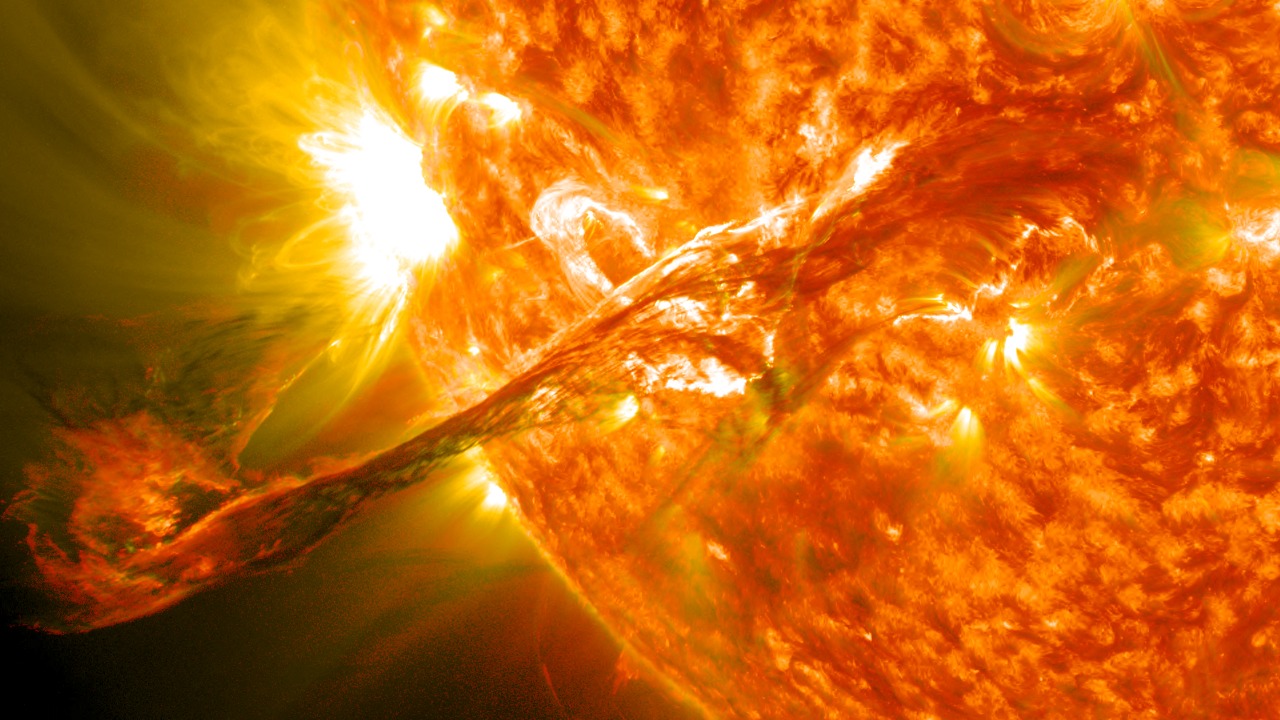

NASA scientists are warning that the Sun’s internal engine is behaving in ways they have not seen in years, pointing to an abrupt shift in the star’s magnetic and energetic rhythms that drive space weather across the solar system. The alert is not about the Sun “switching off,” but about a faster, more erratic climb into a turbulent phase that could test everything from satellites and GPS to power grids on the ground. I see this as a pivotal moment, when a usually distant astrophysical cycle suddenly becomes a very practical story about technological risk and resilience on Earth.
At the heart of the warning is a cluster of new observations and models that suggest the current solar cycle is intensifying more quickly and unevenly than expected, with unusual patterns in the Sun’s interior and atmosphere feeding stronger flares and storms. As researchers track this behavior, they are racing to upgrade monitoring networks, refine forecasts, and prepare societies for what a more volatile Sun could mean over the next decade and beyond.
Inside NASA’s fresh alert on a “sudden change”
When NASA researchers talk about a sudden change inside the Sun, they are pointing to shifts in the magnetic fields and plasma flows that power its activity cycle, not to a catastrophic breakdown of the star itself. In a recent briefing highlighted in The New NASA Warning About a Sudden Change Inside The Sun, scientists described “unusual patterns” in the solar interior that are feeding more frequent and energetic outbursts than they have recorded in recent years. I read that as a sign that the Sun’s magnetic dynamo, the churning process that flips its polarity and drives sunspots, is moving into a more excitable state faster than models had projected.
Those internal changes are already visible on the surface, where active regions and flares are clustering in ways that suggest the cycle is not only ramping up but also becoming more complex. NASA teams are watching how these patterns evolve because they can foreshadow the timing and intensity of solar storms that eventually slam into Earth’s magnetic field. The language of a “sudden change” is striking, but in scientific terms it reflects a rapid departure from the quieter behavior of the previous decade, not an existential threat to the Sun itself.
The Sun is “slowly waking up,” but the risks are accelerating
Even before this latest alert, researchers had been warning that the Sun was emerging from a relatively calm period into a more agitated phase that could last for decades. A new study from NASA described how “the sun is slowly waking up,” with models indicating that more extreme space weather could persist for decades to come. I see that phrase as deliberately measured: the wake-up is gradual in stellar terms, but the consequences for a technology-dependent civilization can feel abrupt when a single storm disrupts navigation, communications, or power.
What unsettles many space weather experts is that the same study acknowledges that scientists still “don’t completely understand” why the Sun’s activity is changing in this particular way. That uncertainty complicates planning for governments, grid operators, and satellite companies that need to know whether they are facing a short spike in activity or a prolonged era of heightened risk. The combination of a slowly waking star and a rapidly digitizing planet is what turns a routine solar cycle story into a strategic challenge.
Solar Cycle 25 and the race toward Solar Maximum 2026
The current upswing in activity is part of Solar Cycle 25, the roughly 11 year rhythm in which the Sun’s magnetic field flips and sunspots wax and wane. Observatories have already recorded a Strong Flare Erupts from the Sun, captured in detail by NASA’s Solar Dynamics Observatory, which watches the star constantly and tracks eruptions that can pose risks to spacecraft. That flare is one example of how Cycle 25 is already producing events strong enough to threaten satellites and high altitude aviation, even before the peak of activity arrives.
Forecasts now point to a Solar Maximum in 2026, with astronomers closely watching what they describe as Inside the Sunspot Cycle and Solar Activity Forecast Astronomers Are Watching. Because cycles often feature double peaks, activity could remain above long term averages even after the nominal maximum passes, extending the window for disruptive storms. I interpret that as a warning that 2026 is not a single spike to get through, but the start of a plateau of elevated risk that could stretch across several years.
From flares to forecasts: what NOAA is already seeing
While NASA focuses on the physics of the Sun, operational agencies are already translating that science into day to day alerts. The Space Weather Prediction Center’s homepage currently carries a Slider noting that G1 to G2 watches have been issued for Jan 01 03, 2026, with the advisory published on a Wednesday evening in UTC. Those G1 and G2 labels correspond to minor and moderate geomagnetic storms, the kind that can trigger auroras at lower latitudes and cause small fluctuations in power systems but are generally manageable for well prepared operators.
Behind that public slider is a more technical forecast that spells out the expected intensity of geomagnetic disturbances. On its enthusiasts dashboard, NOAA reports that the greatest expected 3 hr Kp for Dec 31 Jan 02 2026 is 5.00 on the NOAA Scale, which aligns with a G1 storm. I read that as a concrete example of how the Sun’s intensifying behavior is already translating into a steady drumbeat of low to moderate alerts, a pattern that could become the new normal as Solar Maximum approaches.
Why NASA fears a “technological darkness event”
For most people, a G1 or G2 storm is little more than a chance to see brighter auroras, but NASA’s deeper concern is what could happen if a much larger eruption hits Earth head on. Agency experts have begun to talk about the possibility of a “technological darkness event,” a scenario in which a powerful solar storm knocks out key systems for hours or days. One report invites readers to Visualize an environment where GPS signals disappear, power grids fluctuate, and satellites stop transmitting information, revealing that our infrastructure may be less resilient than we realize. I see that framing as a deliberate attempt to move the conversation from abstract probabilities to tangible, everyday consequences.
In such a scenario, the problem is not just the initial blackout but the cascading failures that follow when navigation, timing, and communication systems all falter at once. Commercial aviation relies on satellite navigation, container ships depend on precise timing for port logistics, and financial markets use synchronized clocks to clear trades. A technological darkness event would test all of those layers simultaneously, and the fact that NASA is willing to use such stark language underscores how seriously it takes the Sun’s abrupt shift in behavior.
New missions: SunRISE and the hunt for early warning
To reduce the odds that a major storm catches Earth off guard, NASA is investing in new missions designed to map and monitor the Sun’s most dangerous emissions. One of the most important is the Sun Radio Interferometer Space Experiment, a constellation of small spacecraft that will fly in formation to track low frequency radio bursts from solar eruptions. NASA is targeting a summer 2026 launch for its Sun Radio Interferometer Space Experiment, known as SunRISE, which will help scientists understand how solar storms are directed and predict their effects.
I see SunRISE as part of a broader shift from simply observing solar activity to actively forecasting its impact on specific regions and technologies. By capturing the radio signatures of eruptions as they leave the Sun, the mission could give forecasters more time to warn satellite operators, grid managers, and airlines before a storm arrives. In the context of a Sun that is changing more abruptly than expected, that extra lead time could be the difference between a manageable disruption and a full blown crisis.
Dangerous solar storms are already on the rise
The concern about future mega storms is not hypothetical, it is grounded in a measurable uptick in hazardous events. New findings summarized under the headline The Sun Is Slowly Waking UpNASA Warns That Dangerous Solar Storms Are on the Rise, with New NASA data indicating that the frequency and intensity of storms with real effects for us on Earth are increasing. That trend is consistent with the broader picture of a Sun that is not just waking up but doing so in a way that leans toward more extreme outbursts.
From my perspective, the key point is that these dangerous storms are no longer rare, once in a century curiosities. They are becoming regular features of the space weather landscape, each one a small stress test for the systems that keep modern life running. As the Sun’s internal dynamics continue to shift, the line between routine and dangerous events may blur, making it harder for policymakers and the public to know when to take warnings seriously until a truly severe storm arrives.
Living with a restless star
All of this adds up to a simple but sobering reality, we live next to a variable star whose moods we cannot control, only monitor and adapt to. The abrupt shift that NASA is flagging inside the Sun is a reminder that even well studied cycles can surprise us, and that our models are only as good as the data and missions that feed them. From the Nov alert about unusual internal patterns to the forecasts of a prolonged period of heightened activity, the message is that complacency is not an option.
At the same time, the response from agencies and researchers shows that we are not powerless. Better forecasting tools, missions like SunRISE, and more realistic planning for scenarios like a technological darkness event can all reduce the impact of whatever the Sun throws at us next. I see the current moment as a turning point, when space weather moves from a niche scientific concern to a mainstream policy issue, driven by the recognition that the Sun’s changing behavior is not just an astronomical curiosity but a direct factor in the stability of our technological world.
More from MorningOverview