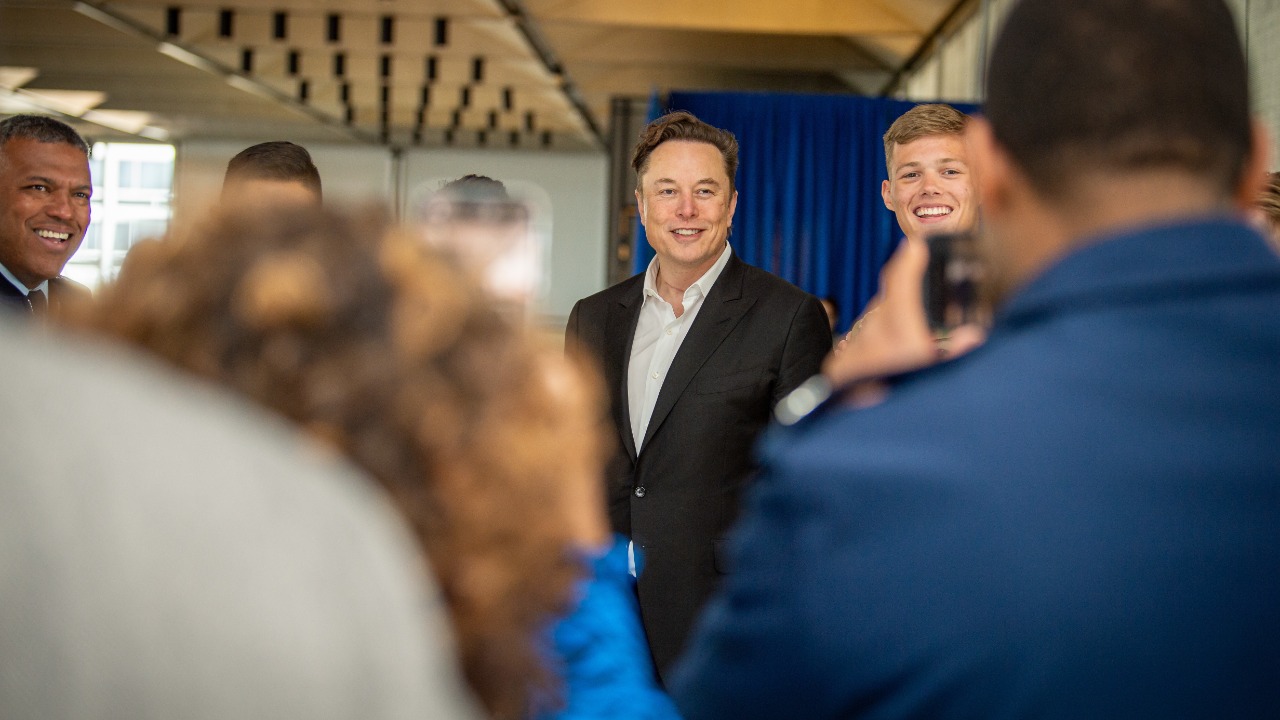

Elon Musk has issued one of his starkest warnings yet about the global artificial intelligence race, arguing that China is on track to dominate the raw computing power that underpins advanced systems. His claim that the country will “far exceed the rest of the world in AI compute” turns a technical metric into a geopolitical fault line, with energy grids, data centers, and industrial policy suddenly cast as strategic weapons.
At stake is not just who builds the fastest models, but who controls the infrastructure that makes artificial general intelligence plausible at all. As Musk tells it, the contest will be decided less by clever algorithms than by who can generate enough electricity, manufacture enough chips, and wire enough fiber to feed a new class of energy-hungry machines.
Musk’s bombshell prediction and why it matters
When Elon Musk says China will “far exceed the rest of the world in AI compute,” he is not talking about a marginal lead in benchmarks, but a structural advantage in the capacity to run and train models at scale. In his view, current trends point to a future in which Chinese data centers, chip supply chains, and power infrastructure collectively outstrip anything the United States or Europe can assemble, turning compute into a lever of economic and military influence. His warning reframes AI leadership as a race to build the largest, most power-hungry machine the world has ever seen, rather than a contest of clever code alone.
Musk’s comments, relayed through multiple reports that quote him saying China is poised to lead the world in AI computing power, have been amplified across financial and tech circles, including a widely shared assessment that he expects the country to outpace global rivals in AI compute. The phrase “far exceed” is doing heavy lifting here, signaling not a neck-and-neck rivalry but a potential gulf in capacity that could leave other nations dependent on Chinese infrastructure for critical AI services.
Inside Musk’s argument: energy first, algorithms second
Musk’s core thesis is blunt: the bottleneck for AI is shifting from chips to electricity. He has argued that the real constraint on future systems will be how much power grids can deliver to energy-intensive data centers, not how many clever tweaks researchers can make to neural network architectures. In his telling, the countries that can rapidly add low-cost generation capacity, especially from solar and other clean sources, will own the next decade of AI progress because they can simply afford to run more models for longer.
That logic underpins his claim that China’s decisive advantage lies in its ability to scale electricity generation and bring new power capacity online faster than competitors. Musk has warned that the synchronous development of AI, robotics, and other compute-heavy technologies will put intense pressure on existing power infrastructure, a concern echoed in his view that a looming power shortage is imminent unless clean generation ramps up. In that framing, whoever solves the energy problem first effectively sets the pace for global AI development.
China’s infrastructure play: grids, data centers, and supercomputers
China’s AI ambitions are not limited to software labs in Beijing or Shenzhen, they are embedded in a broader industrial strategy that fuses power generation, cloud infrastructure, and hardware manufacturing. Musk’s prediction rests on the observation that the country is already building vast new data centers and expanding its grid capacity in ways that align neatly with the needs of large-scale AI. From his perspective, this is less about a single breakthrough and more about a national buildout of the physical backbone required to run trillion-parameter models around the clock.
That buildout includes unconventional projects, such as a reported effort to create a new kind of supercomputer in orbit, with China building a supercomputer above Earth that would push compute capacity beyond terrestrial constraints. Analysts who track these developments note that such initiatives dovetail with Musk’s view that China will “figure out the compute problem” by combining aggressive infrastructure spending with integrated platforms, a pattern he often illustrates by pointing to how the country already unified payments, messaging, and services inside apps like WeChat.
“Based on current trends”: Musk’s timeline for Chinese dominance
Musk is not couching his forecast in distant hypotheticals, he is tying it to observable trajectories in energy, manufacturing, and AI investment. He has said that, based on current trends, China will not just edge ahead but far exceed the rest of the world in AI compute. In that same argument, he links China’s edge directly to its capacity to bring more electricity online, suggesting that the country’s buildout of power plants and grid infrastructure is already outpacing rivals in ways that will compound over time.
Financial analysts have picked up on this framing, with one summary of his remarks noting that Musk forecasts China to far surpass the rest of the world in AI computing power as energy-intensive AI data centers proliferate. The implication is that the tipping point could arrive within a few years, not decades, especially if Western grids struggle to keep up with demand while Chinese planners continue to treat AI infrastructure as a strategic priority on par with high-speed rail or 5G.
Signals from Beijing: political backing for AI and compute
Musk’s prediction does not exist in a vacuum, it aligns with political signals from Beijing that frame AI as a central pillar of national development. In his annual New Year’s address, the Chinese leader used his platform to emphasize the importance of technological self-reliance and digital modernization, a message that analysts interpreted as a clear endorsement of continued investment in AI and the infrastructure that supports it. That speech has been cited as evidence that the country’s top leadership sees compute capacity as a strategic asset rather than a niche tech issue.
Reports summarizing Musk’s comments note that the Chinese leader’s New Year’s address was read by analysts as reinforcing the country’s AI push, dovetailing with Musk’s view that political will is aligned with industrial capacity. Chinese commentators have gone further, arguing that Musk’s remarks validate their own assessment that the country’s ability to scale electricity generation and data center construction gives it a structural edge in the AI race, a point highlighted in coverage that notes Musk further noted China’s advantage in scaling power and infrastructure rather than in any single algorithmic breakthrough.
Musk’s broader AI worldview: AGI, power, and a “supersonic tsunami”
To understand why Musk fixates on compute and electricity, it helps to place his China comments inside his broader AI worldview. In a 173 minute podcast conversation, Musk framed AI, energy, and robots as the three pillars of a coming transformation, arguing that achieving artificial general intelligence will depend on harnessing vast amounts of power. In his view, the real constraint on AGI is not theoretical understanding but the ability to scale hardware and energy to the point where machine intelligence can exceed that of all humanity.
Commentary on his 2026 outlook describes how Musk characterizes the rapid advance of AI and robotics as a “Supersonic Tsunami” of AI that will reshape jobs, industry, and even the structure of civilization by harnessing solar energy at scale. In that narrative, China’s aggressive buildout of power infrastructure and manufacturing capacity makes it a natural candidate to ride that wave, which is why Musk keeps returning to the idea that whoever solves energy and compute at scale will effectively set the terms for AGI.
From BYD to WeChat: how China’s tech ecosystem feeds the compute race
Musk’s admiration for China’s AI prospects is intertwined with his experience competing with and observing its industrial champions. He has publicly acknowledged that companies like BYD have overtaken Tesla in electric vehicle sales, and he has suggested that Chinese firms are exceptionally good at scaling complex systems once they commit to a sector. That pattern, in his view, extends from cars to chips to AI infrastructure, reinforcing his belief that the country can move from follower to leader in emerging technologies with startling speed.
One report notes that Elon Musk is highly impressed by China’s edge in scaling AI systems, a sentiment he often illustrates by pointing to how platforms like WeChat integrate payments, messaging, and services in a way Western apps have struggled to match. In social media commentary, figures such as Guillermo Flor highlighted Musk’s “bombshell” line that China will far exceed the rest of the world in AI compute, tying it to the country’s track record of turning integrated digital ecosystems into engines for rapid adoption and data generation that can feed ever larger models.
Global reactions: opportunity, risk, and a looming power crunch
Musk’s forecast has landed in a world already anxious about AI’s impact on jobs, security, and industrial competition. At a U.S.–Saudi forum, he recently made bold predictions about how advancing AI would eventually reshape the global economy, even as he warned of intense competition in the auto industry from Chinese manufacturers. That dual message, admiration for Chinese efficiency paired with concern about Western competitiveness, has sharpened debates in Washington and European capitals about how to respond to a future in which critical AI infrastructure might be concentrated in a rival power.
Coverage of that forum notes that Elon Musk recently made bold predictions about AI while flagging competition from Chinese manufacturers, reinforcing his broader narrative that China’s industrial machine is well positioned for the AI era. At the same time, technical analysts who echo his warnings about power constraints argue that the world is heading toward a crunch in which data centers strain grids that were never designed for such loads, a dynamic that could magnify the advantage of countries, like China, that can rapidly build new generation capacity.
What Musk’s prediction means for the rest of the world
If Musk is right that China will far outstrip other nations in AI compute, the consequences will reach far beyond the tech sector. Countries that lag in building their own infrastructure could find themselves dependent on foreign cloud providers for critical services, from language models used in government to AI systems embedded in manufacturing and logistics. That dependence would carry both economic and security risks, especially if the dominant provider sits inside a strategic rival’s borders.For policymakers in the United States and its allies, Musk’s warning functions as both a provocation and a roadmap. Reports that analysts are already weighing his claim that China will far exceed the rest of the world in AI compute suggest that investors and strategists are taking the scenario seriously. For now, the outcome is not predetermined, but Musk’s argument is clear: unless other nations treat energy, compute, and AI infrastructure with the same urgency China has shown, they may wake up to find that the future of machine intelligence is being written somewhere else.
More from Morning Overview