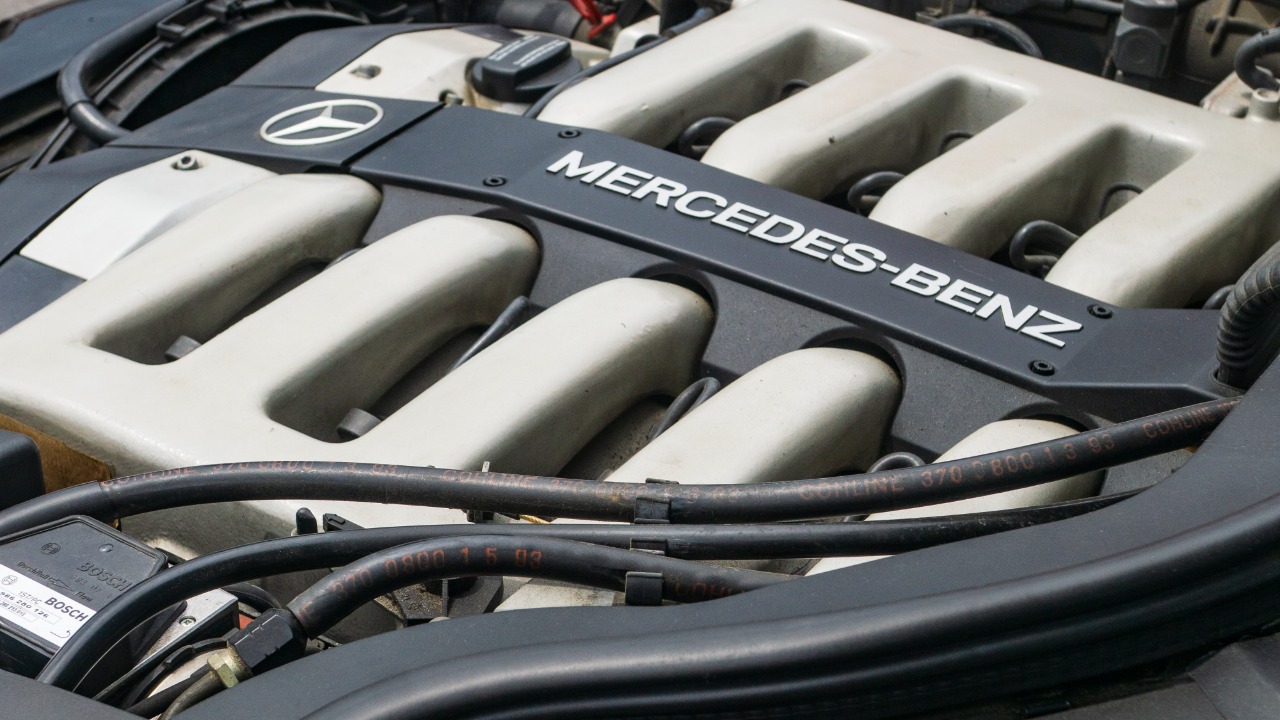

The latest Mercedes-Benz V12 engine patents have landed like a thunderclap in a market that was supposed to be gliding quietly toward full electrification. Instead of winding down its biggest combustion engines, the company appears to be refining them with new hardware that hints at a deeper technological shift hiding behind the familiar cylinder count. The filings suggest that what looks like a nostalgic play for twelve cylinders may actually be a test bed for breakthrough efficiency and valve innovations that could reshape how long combustion survives alongside electric power.
At a time when many rivals are trimming cylinder counts or dropping engines altogether, Mercedes-Benz is signaling that its flagship powerplant is not ready for retirement. The new V12 designs point to a strategy that treats combustion as a high-tech luxury feature rather than a legacy burden, with the patents offering a rare glimpse into how the brand plans to stretch its engineering advantage into the next decade.
The surprise return of a “new V12 monster”
The most eye-catching detail in the recent filings is simple: Mercedes-Benz is still spending serious engineering effort on a twelve-cylinder engine. One of the key documents, described as the Latest Mercedes Benz Engine Patent Shows Possibility Of a New V12 Monster, outlines a fresh combustion layout that keeps the classic V12 format alive while integrating modern control strategies. The language around a “New” and “Monster” configuration underscores that this is not a minor refresh of an old block but a clean-sheet rethink of how a large-capacity engine can coexist with tightening emissions rules.
What stands out in that patent is how deliberately Mercedes-Benz groups its engines, treating inline six, V8, and V12 architectures as a modular family rather than separate relics. By framing the design as a scalable platform that can support everything from a straight-six to a twelve-cylinder flagship, the company is effectively future-proofing its combustion lineup. The fact that this work is captured in a Dec filing focused on a V12 suggests that the brand still sees its largest engine as a halo technology, not just a stopgap until batteries take over.
A pledge to keep the V12 alive into the next decade
The patents do not exist in a vacuum. They line up neatly with a public commitment from the company to keep its biggest engine on sale well into the 2030s. The Manufacturer pledge to keep its largest combustion engine going past 2030 where possible makes clear that this is not a short-term swan song. When a brand as tightly managed as Mercedes-Benz tells customers and investors that the V12 will continue, and has its technology boss confirm that stance, it is effectively promising that the engine will meet future regulations and customer expectations rather than merely coasting on heritage.
That pledge also reframes the patents as part of a long-term roadmap rather than a nostalgic engineering exercise. If Mercedes-Benz intends to sell V12-powered models into the next decade, it needs more than incremental tweaks; it needs a platform that can absorb new fuels, stricter testing cycles, and hybrid integration. The combination of a formal commitment from the Manufacturer and a detailed patent trail suggests that the company is building a bridge between its combustion past and an electrified future, with the V12 positioned as a flagship technology that showcases what its engineers can still extract from gasoline.
Why Mercedes-Benz is doubling down while others retreat
At first glance, investing in a new V12 in the middle of an electric transition looks contrarian. Yet the strategy becomes clearer when viewed through the lens of brand positioning and market timing. According to a Dec analysis of the company’s engine plans, Mercedes Benz is planning new gas engines because the electric vehicle takeover has fallen behind schedule, which gives combustion more runway than many expected. If battery adoption is slower than forecast, a cutting-edge V12 becomes less of an anachronism and more of a differentiator for high-end buyers who still want range, sound, and instant refueling.
There is also a strategic logic in tying the V12 to a broader engine family that includes an inline six. By developing a shared architecture that can scale up to a V12 side badge, Mercedes-Benz can amortize development costs across multiple models and segments. That approach lets the company keep combustion technology fresh without betting the entire business on one engine type. In this context, the V12 is not a standalone indulgence but the top rung of a ladder that starts with more efficient six-cylinder units and climbs to the most exclusive sedans and coupes.
The hidden breakthrough: advanced valve control
The most intriguing clue that these patents are about more than raw cylinder count lies in how they handle airflow and combustion timing. Modern V12s live or die on their ability to breathe efficiently at high engine speeds, and the latest filings point toward increasingly sophisticated valve strategies. A technical report on how cutting-edge valve technologies improve V12 output notes that the goal was to enable higher engine speeds and improve the engine’s breathing capabilities, ultimately resulting in a significant milestone in V12 engine valve technology. That description, captured in a detailed valve technology report, aligns closely with what Mercedes-Benz appears to be chasing in its new designs.
By focusing on valve actuation, lift, and timing, engineers can extract more power and efficiency from a given displacement without resorting to extreme boost pressures or exotic fuels. In a V12, where packaging twelve cylinders already pushes the limits of engine bay space, smarter valves are one of the few remaining levers that can deliver both performance and emissions gains. The patents hint at a system that treats each cylinder as a finely tuned module, with airflow tailored to load and speed in real time. That kind of control is exactly what is needed to keep a large gasoline engine viable under future testing cycles that punish inefficient operation.
How a modular engine family supports both I6 and V12
Another key thread running through the patent trail is modularity. Rather than designing a bespoke V12 in isolation, Mercedes-Benz appears to be building a common architecture that can be configured as an inline six, a V8, or a twelve-cylinder flagship. The Dec documentation around the Latest Mercedes Benz Engine Patent Shows Possibility Of a New V12 Monster explicitly groups the V12 with the inline six and V8, signaling that the company wants shared bore spacing, component families, and control systems across its combustion range. That approach reduces complexity while giving engineers a consistent foundation for future updates.
For customers, a modular family means that lessons learned at the top of the range can filter down to more attainable models. If a new valve strategy or combustion chamber shape proves effective in the V12, it can be adapted to the inline six with relatively little rework. Conversely, efficiency improvements developed for high-volume six-cylinder cars can be scaled up to the V12 to keep it compliant. This two-way flow of technology is part of what makes the patents so significant: they suggest that the V12 is not a dead-end branch of the family tree but an integral part of Mercedes-Benz’s combustion roadmap.
Balancing luxury expectations with regulatory pressure
Keeping a V12 alive into the next decade is not just an engineering challenge, it is a regulatory and branding tightrope. On one side, buyers of top-tier Mercedes-Benz models expect effortless power, refinement, and a sense of occasion that smaller engines struggle to match. On the other, lawmakers are tightening fleet emissions targets and scrutinizing large-displacement engines. The Manufacturer pledge to keep its largest combustion engine going past 2030 where possible acknowledges that tension, with the phrase “where possible” hinting at markets and segments where regulations still allow such engines to be sold.
The patents suggest that Mercedes-Benz is responding by making its V12 as technically defensible as possible. Advanced valve control, modular architecture, and likely hybrid integration all serve to reduce the engine’s environmental footprint while preserving its character. In practice, that could mean V12-powered sedans and coupes that operate as electric-assisted grand tourers in urban areas, with the full twelve-cylinder experience reserved for open roads. By embedding breakthrough efficiency tech into the heart of the engine, the company can argue that its flagship combustion units are part of a responsible transition rather than a refusal to change.
What this means for future S-Class and Maybach flagships
Although the patents do not name specific models, the implications for the S-Class and Mercedes-Maybach lineups are hard to miss. These are the cars that have historically carried the V12 badge, and they are the most likely beneficiaries of a New V12 Monster configuration. A modular engine family that spans inline six to V12 gives Mercedes-Benz the flexibility to tailor powertrains to different trims and markets, from efficient six-cylinder plug-in hybrids to twelve-cylinder halo versions that showcase the full breadth of the company’s engineering.
For buyers, the hidden breakthrough is that future V12-powered flagships may feel more modern and responsive than their predecessors, not less. With cutting-edge valve technologies enabling higher engine speeds and better breathing, and with control systems refined across the entire engine family, a next-generation V12 S-Class or Maybach could deliver both stronger performance and lower emissions than the outgoing cars. The patents hint at a future where the most traditional symbol of luxury in the Mercedes-Benz range is also one of its most technically advanced components.
The V12 as a bridge to an uncertain electric future
Ultimately, the new patents and public commitments position the Mercedes-Benz V12 as a bridge technology rather than a museum piece. The company’s decision to keep investing in combustion, even as it develops electric platforms, reflects a pragmatic reading of the market. With the electric vehicle takeover having fallen behind schedule, as highlighted in the Dec analysis of Mercedes Benz planning new gas engines, there is still room for a highly optimized gasoline flagship that appeals to buyers who are not ready to go fully electric.
At the same time, the focus on modularity and advanced valve control shows that Mercedes-Benz is not treating the V12 as a separate world from its future powertrains. The same engineering mindset that drives efficiency in smaller engines and hybrids is being applied to the largest combustion unit in the lineup. That convergence is the real hidden breakthrough: a V12 that is not just bigger, but smarter, designed to coexist with batteries and electric motors rather than be replaced by them overnight.
More from MorningOverview