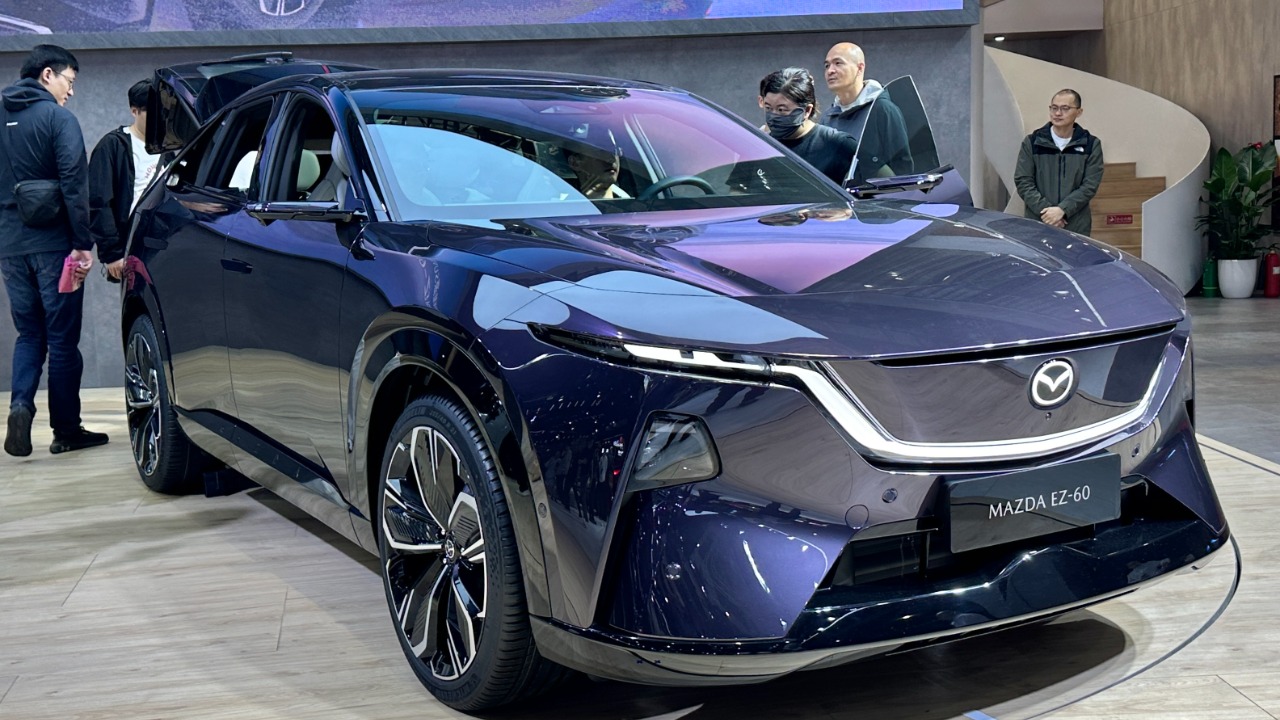

Mazda is leaning into a new kind of globalisation for its electric push in Europe, pairing Japanese design values with Chinese engineering and manufacturing. The Mazda 6e sedan and CX-6e SUV arrive as European-market EVs that are deeply rooted in joint-venture projects developed and built in China, yet tuned and positioned to compete head-on with established European and U.S. rivals. The result is a test case for whether European buyers will embrace an electric Mazda whose core hardware and software are shared with Chinese models.
Rather than hiding that lineage, Mazda is using it as a springboard, arguing that Chinese production and platforms can coexist with the brand’s familiar focus on driving feel and understated design. I see the 6e and CX-6e as the clearest sign yet that Mazda’s future in Europe will depend on how convincingly it can blend this Chinese DNA with the expectations of European customers who are cross-shopping Audi, Tesla and a wave of new Chinese brands.
Mazda’s China-built EVs head for Europe
The CX-6e is Mazda’s first electric SUV for Europe that is openly described as China-built, a mid-size model aimed squarely at premium battery rivals such as the Audi Q6 and Tesla Model Y. Reporting on the launch makes clear that the CX-6e is being shipped from China to Europe as a finished SUV, with Mazda positioning it as a stylish alternative that keeps a relatively low ground stance despite being an SUV, a nod to the brand’s traditional focus on driving dynamics rather than towering ride height, and a direct challenge to established European premium players in the segment from Jan and beyond in Europe and Audi territory through Mazda CX-6e. Under the skin, the CX-6e is not a clean-sheet European product but the export twin of a Chinese-market model, a strategic choice that lets Mazda move faster and keep development costs in check.
That shared DNA is explicit. The CX-6e rides on the same underpinnings as the Changan Depal S07, a Chinese SUV that is also scheduled for export to Europe, with Jan reports confirming that the two vehicles share their core platform and much of their engineering. By tying its European SUV to the Changan Depal architecture, Mazda is effectively betting that Chinese-developed EV hardware is mature enough to satisfy demanding European buyers, while it layers on its own design language and chassis tuning to maintain a distinct identity for The CX in Changan Depal. It is a pragmatic move that also signals how deeply Mazda’s electrification strategy is now intertwined with its Chinese joint-venture operations.
From Mazda EZ-6 to Mazda6e: Chinese sedan, European badge
The CX-6e does not arrive in a vacuum. It follows the Mazda 6e, a battery-electric sedan that is itself the European version of the Mazda EZ-6, a midsize BEV first shown at the Beijing Auto Show. Mazda has been clear that Mazda6e is the European version of the Mazda EZ-6, and that the car is built around a dedicated electric platform that showcases the company’s latest electrification and smart-cabin technologies, including a focus on connected services and advanced driver assistance, as set out in Jan communications on the European rollout of this BEV from the Beijing Auto Show in Mazda6e. In practice, that means European buyers are getting a car whose basic engineering was honed for Chinese roads and consumers, then adapted for Europe with revised tuning and branding.
Technical details underline how closely the European 6e tracks its Chinese sibling. The Mazda EZ-6 overview describes a midsize sedan available as a pure electric model, with a focus on range, fast charging and a cabin that leans heavily on digital interfaces and driver assistance, all of which carry over to the European Mazda 6e package in Mazda EZ. For Mazda, the key is to convince European buyers that a sedan conceived for China can still feel authentically Mazda in its steering, ride and refinement, even as it introduces a more software-centric experience than the brand’s traditional combustion models.
Joint-venture hardware, European tuning
Behind both the 6e and CX-6e is a deeper industrial story about how Mazda is using its Chinese joint venture to accelerate electrification. The 6e is described as an all-electric, fourth-generation project developed with China that has been tuned specifically for European tastes and even tested as far afield as Austr, a sign that Mazda is not simply rebadging a Chinese domestic product but actively reworking suspension, steering and software calibrations for export markets in a way that still leans on Chinese production scale in Mazda 6e. I see that as a hybrid model of global development, where core platforms are shared but final tuning is localised to preserve brand character.
The SUV follows the same playbook. The Mazda CX-6e is explicitly framed as the SUV counterpart to the battery-electric saloon Mazda 6e, sharing a wheelbase of 2.90 metres and much of its electrical and digital architecture, yet wrapped in a taller, more family-friendly body that targets the heart of the European SUV market. By pairing the two, Mazda is building a small EV family that can cover both sedan and SUV buyers in Europe while maximising the return on its Chinese-developed platform, as highlighted in Jan reports that describe The Mazda CX as an SUV that mirrors the Mazda 6e’s proportions and technology in SUV counterpart. The shared DNA is not just a cost play, it is also a way to ensure that software updates, driver-assistance systems and infotainment features can be rolled out consistently across both body styles.
China as Mazda’s EV export hub
The decision to base these European EVs on Chinese projects is not incidental, it reflects Mazda’s broader move to position China as its electrified vehicle sales and export hub. Changan Mazda has already started exports to Europe, and On April 22 China Mazda began shipping the EZ-6, which offers pure electric variants, from Chinese ports to overseas markets, signalling that the joint venture is now a key pillar of Mazda’s global EV logistics in Changan Mazda. That export flow underpins the Mazda 6e’s journey to Europe, with ships carrying finished cars from China to Belgium and beyond.
The logistics story is already visible in the 6e’s rollout. The Mazda 6e made its European debut at the Brussels Motor Show, and shipments have departed Shanghai for Belgium as Mazda ramps up deliveries, with the company emphasising that the car is based on a Chinese domestically developed EV that has been adapted for European roads and a more responsive and engaging driving experience in The Mazda. A similar pattern is set to follow for the CX-6e, which in China is known as the EZ-60, with reports noting that In China the EZ-60 is the equivalent of the CX-6e unveiled at the Brussels Motor Show for the European market and that the Chinese version includes practical touches such as a front compartment for storing a charging cable, a detail that hints at how closely the two markets’ products are aligned in In China. For Mazda, using China as an export base is a way to tap into competitive manufacturing costs and a fast-moving EV supply chain while still tailoring the final product to European expectations.
Tech, safety and the European buyer
For European customers, the question is less about where these EVs are built and more about how they perform, protect and connect. Mazda’s own description of the Mazda6e highlights a suite of electrification and smart-cabin technologies, and independent previews suggest the car is expected to secure a five-star Euro NCAP rating thanks to a long list of driver assistance systems, including emergency braking and lane-keeping features, as well as fast-charging capability that can add significant range in only 15 minutes, all of which are central to its pitch as a credible family BEV in Jan assessments of Euro NCAP expectations in Euro NCAP. Those systems are not just safety box-ticking, they are also a way for Mazda to show that its Chinese-developed EVs can match or exceed the digital sophistication of European rivals.
The CX-6e leans even harder into that tech-forward positioning. Official material describes intuitive connectivity including multilingual voice recognition and gesture control, backed by a suite of Advanced Driver Assist systems that go beyond what Mazda has offered in previous projects, underlining how central software and user interfaces have become to the brand’s EV strategy in Intuitive. I read that as Mazda’s attempt to reassure European buyers that, even if the CX-6e’s platform and production are shared with Chinese models, the in-car experience is tailored to multilingual, multi-market use, with driver assistance and connectivity that feel at home on European roads and in European languages.
Can Chinese DNA power a European Mazda renaissance?
All of this adds up to a bold experiment in brand perception. Mazda is effectively asking European buyers to accept that a Mazda can be conceived, engineered and built in China while still delivering the driving feel and understated design that have long defined the marque. The company’s own communications about the Mazda6e stress that it is part of a broader plan to roll out 202 electrified models and technologies over the coming years, a figure that underscores how central this Chinese-linked EV family is to Mazda’s future in Europe and beyond in 202. If the 6e and CX-6e succeed, they will validate a strategy that blends Chinese scale with Japanese brand equity and European tuning.
The stakes are just as high on the SUV side. Reports on the CX-6e’s European launch emphasise that Mazda is targeting buyers who might otherwise gravitate to an Audi Q6 or Tesla Model Y, positioning its China-built SUV as a design-led, dynamically focused alternative that still offers the ground clearance and practicality of a family EV, with Jan coverage highlighting how Mazda launches China-built CX-6e SUV in Europe to rival those established players while keeping a relatively low stance despite being an SUV in Mazda launches. In my view, the success or failure of that pitch will tell us a lot about whether European consumers are ready to embrace EVs whose origins are as much Chinese as they are Japanese, and whether Mazda can turn that hybrid identity into a competitive advantage rather than a liability.
More from Morning Overview