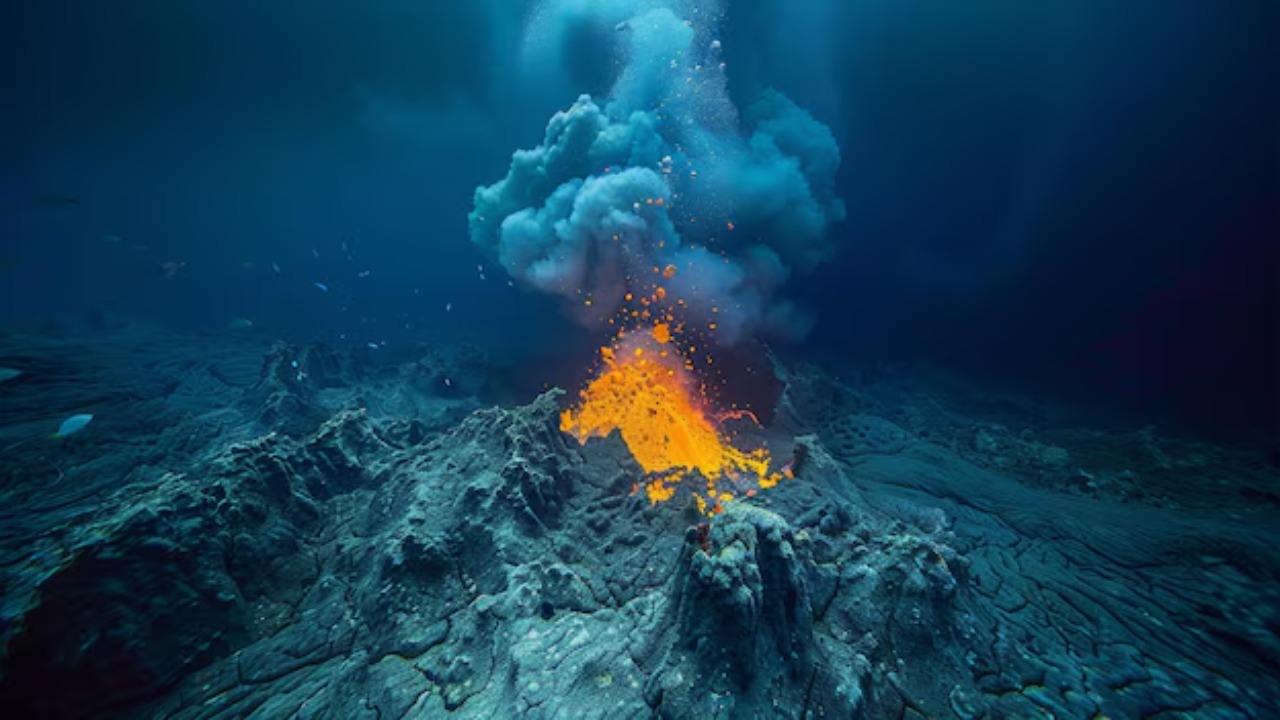

Far below the Pacific, a volcano long written off as geologically dead has turned out to be both active and teeming with life. When researchers sent cameras into its crater, they did not find bare rock but a carpet of massive deep-sea eggs, a nursery so dense it appears to cloak the summit in pale capsules and golden clusters.
The discovery forces a rethink of what an “extinct” volcano really is and how much of the deep ocean’s life cycle is wired to hidden sources of heat. It also links a series of recent finds, from giant skate eggs to glowing golden masses counted in the millions, into a single emerging picture of underwater volcanoes as biological engines rather than barren scars on the seafloor.
A volcano thought long dead, suddenly very alive
For years, the seamount at the center of this story sat in scientific databases as an ancient structure, a relic of past eruptions that had cooled into silence. When a new expedition mapped its flanks in high resolution, the team expected to confirm that status, not to find fresh signs of activity and a summit that looked, at first glance, like it had been dusted with pale stones. Only when the cameras drew closer did the “stones” resolve into leathery capsules, each one a massive egg anchored to the rock.
Subsequent analysis showed that the structure is not only geologically active but also wrapped in what one report described as up to a million giant eggs, a density that turns the crater into a living shell of embryos and protective cases. The same surveys that revealed the eggs also detected heat and hydrothermal circulation, confirming that the volcano is still active and that its summit is literally warm to the touch of the surrounding seawater, a crucial detail documented in Share.
Giant skate nurseries in the deep
Once the shock of the initial images faded, biologists began to recognize the distinctive shape of the capsules. These were not random gelatinous blobs but structured cases associated with deep-sea skates, relatives of rays and sharks that lay large, rectangular eggs often nicknamed “mermaid’s purses.” On the volcano’s summit, the capsules were stacked and clustered, suggesting that multiple generations of skates had been returning to the same site to reproduce.
The pattern echoed earlier work that had identified skate eggs on other seamounts, but never at this scale or in such direct association with active hydrothermal features. Reporting on the site described the volcano as covered in giant eggs and corals, with close-up footage showing individual capsules nestled among invertebrate colonies on the summit, a scene captured in detail in a profile linked through Jul.
Heat as a life-support system
What makes this volcano so attractive to skates and other deep-sea creatures is not just its topography but its warmth. In the deep ocean, where ambient temperatures hover near freezing, even a modest thermal anomaly can transform the local environment. The active crater appears to act as a natural incubator, bathing the eggs in slightly elevated temperatures that may speed development and improve survival odds for embryos that would otherwise grow very slowly in the cold.
Scientists exploring the site have emphasized that no one knew the ancient underwater volcano was active, let alone emitting enough heat to shape the biology around it, until instruments and cameras documented the geothermally influenced summit. One researcher, Du Preez, underscored that this hidden warmth is what turns the crater into a nursery, a point highlighted in coverage of the discovery of millions of golden eggs near a similar hydrothermal system, where Du Preez described the geothermally warmed habitat as a surprise.
From “extinct” to active: rewriting the volcano’s history
The reclassification of the volcano from extinct to active is not just a semantic tweak, it is a fundamental shift in how scientists understand the region’s geology. For a structure to be considered extinct, it is generally assumed that its magma supply has been cut off and that it no longer produces significant heat or eruptions. The presence of hydrothermal vents, warm fluids, and fresh mineral deposits on this seamount shows that magma is still close enough to the surface to drive circulation, which means the volcano is very much alive.
That realization came only after detailed surveys revealed both the thermal anomalies and the biological communities clustered around them, including the dense fields of eggs. One account of the expedition described how scientists uncover massive deep-sea eggs inside an active volcano that had been thought to be extinct for centuries, noting that the summit may host not just thousands but possibly over a million capsules, a scale that was documented in a report titled Scientists Uncover Massive Deep.
Golden eggs and Canadian vents
The volcano nursery is not an isolated oddity. Off Canada, along the Pacific margin, researchers have documented more than 2.6 m glowing golden eggs nestled around a hydrothermal vent field, a staggering count that shows how prolific deep-sea reproduction can be when conditions are right. These eggs, described as golden-hued and tightly clustered, form a halo around the vent structures, turning the seafloor into a shimmering mosaic under the submersible lights.
Images and video from that Canadian site show the eggs arranged in dense mats, each one reflecting the vent’s light and the camera beams, which is why observers described them as glowing. The figure of more than 2.6 m eggs has been shared widely in scientific updates and public posts, including a detailed visual account that highlighted the scale of the cluster near the Pacific vents in More.
Millions of eggs and the scale of deep-sea reproduction
When I look across these discoveries, what stands out is the sheer numerical scale. A single volcano summit can host up to a million giant eggs, while a nearby vent field can support more than 2.6 m golden capsules, each one representing a potential new life. In ecosystems where adult animals may be sparse and widely dispersed, this strategy of mass egg deposition appears to be a way of hedging against the harsh odds of the deep sea.
Another account of the Canadian vent system emphasized that scientists have uncovered more than 2.6 m glowing, golden-hued eggs clustered around an underwater volcano off the coast, a figure that underscores how prolific these nurseries can be when fueled by geothermal energy and stable habitat. That tally, shared in a research-focused update, was highlighted in a post that framed the discovery as a breakthrough enabled by new deep-sea technology, as described in Scientists.
Terrifying beauty: how scientists react in real time
For the researchers on board the ships and at the controls of the remotely operated vehicles, the first sight of these egg fields has been both exhilarating and unsettling. The scale and density of the capsules, combined with the eerie lighting of the deep sea, create a scene that some have described as almost alien, a living carpet that seems to pulse with potential life. That emotional response matters, because it shapes the questions scientists ask next about vulnerability, resilience, and the ethics of studying such concentrated nurseries.
One narrative of an expedition to an underwater volcano captured this mix of awe and fear, describing thousands of giant living eggs revealed in a breathtaking discovery that terrifies marine scientists, precisely because it exposes how little is known about the life cycles of deep-sea creatures and how easily such habitats could be disturbed. The account emphasized that the revelation came from an extraordinary survey beneath the waves, which showed how closely reproductive cycles are tied to geothermal features, a point detailed in coverage of how an Underwater volcano can reshape scientific expectations.
What the eggs reveal about deep-sea life cycles
Biologically, these egg fields are a rare window into stages of life that are usually hidden. Many deep-sea species lay eggs that drift or are scattered, making it difficult to link embryos to adults or to track development over time. In contrast, the capsules on the volcano summit and around the vents are anchored and relatively accessible to cameras and sampling tools, which means scientists can monitor them across months or years to see how temperature, chemistry, and local currents influence survival.
Reports from the volcano summit note that the only previous finding of such a dense skate nursery was far smaller, and that the new site, covered in giant eggs and corals, suggests a long-standing relationship between the species and the warm, mineral-rich habitat. That relationship, captured in close-up footage of the summit and its inhabitants, has been central to arguments that deep-sea reproductive strategies are far more specialized than once thought, a point reinforced in descriptions of how the summit is UNDERWATER VOLCANO FOUND COVERED WITH eggs and associated fauna.
Why these nurseries matter for conservation
From a conservation perspective, the discovery of massive egg nurseries on and around active underwater volcanoes raises urgent questions. If these sites are critical for the reproduction of skates and other deep-sea animals, then any disturbance, from mining to cable laying to unregulated tourism, could have outsized impacts on populations that are already slow to recover. Many deep-sea species mature late and produce relatively few offspring that survive to adulthood, so losing a key nursery could echo through the ecosystem for decades.
These concerns are sharpened by the fact that the volcano in question was long assumed to be an inert geological feature, not a biological hotspot. The realization that it is both active and densely populated with eggs suggests that other “quiet” seamounts may hide similar nurseries, which are currently invisible in environmental impact assessments. One widely shared account framed the discovery as scientists exploring an underwater volcano off the coast and finding it covered with thousands of giant eggs, a narrative that has already begun to influence how regulators and researchers talk about protecting vulnerable deep-sea habitats, as reflected in the description of the VOLCANO FOUND to be a nursery.
The next frontier: mapping hidden volcano nurseries
Looking ahead, the logical next step is a systematic search for similar volcano-linked nurseries across the world’s oceans. Advances in seafloor mapping, autonomous vehicles, and high-resolution cameras now make it possible to scan large areas of the deep sea more efficiently than in the past. By targeting seamounts that show subtle signs of hydrothermal activity, scientists can prioritize likely nursery candidates and then deploy remotely operated vehicles to confirm whether eggs or other reproductive structures are present.
The recent wave of discoveries, from the volcano covered in giant skate eggs to the more than 2.6 m glowing golden eggs off Canada’s Pacific coast, has already shown how quickly new technology can overturn assumptions about “barren” deep-sea landscapes. One synthesis of these findings noted that scientists uncover massive deep-sea eggs inside an active volcano thought to be extinct for centuries, and that similar methods have revealed golden-hued clusters around other underwater vents, a pattern that suggests the deep ocean is threaded with hidden cradles of life, as highlighted in the description of how Active Volcano Thought long dead can still surprise us.
More from Morning Overview