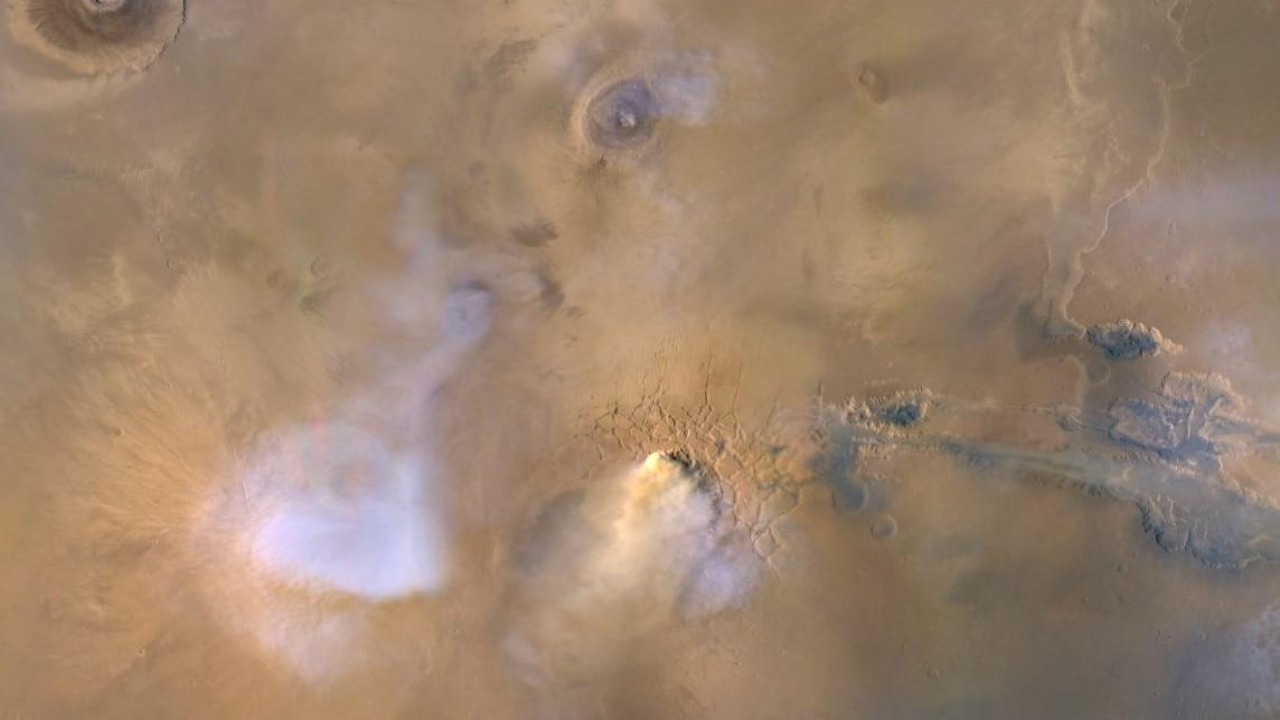

Mars has long been pictured as a cold, quiet desert, its famous dust storms more cinematic backdrop than active player in the planet’s story. New measurements are overturning that image, revealing that those swirling clouds are not just moving grit but also generating crackling bursts of electricity. Researchers now argue that Martian dust storms and dust devils can spark with charged discharges, a finding that reshapes how I think about the planet’s weather, chemistry, and the risks facing future astronauts.
The emerging picture is of a world where even “small” storms can behave like natural laboratories, charging and discharging in ways that echo lightning on Earth but follow Martian rules. Instead of bright bolts streaking across the sky, the Red Planet appears to host tiny, rapid-fire sparks hidden inside columns of dust, subtle enough to escape cameras yet loud enough for sensitive microphones and instruments to hear.
The first clear crackle from Martian dust
The turning point came when the Perseverance rover rolled into Jezero Crater and started listening as well as looking. Its microphones and environmental sensors picked up the passage of whirling columns of dust, the familiar “dust devils” that stalk the Martian surface, but layered on top of the wind noise were sharp, staccato pops that did not match simple grain impacts. These signatures, captured as dust devils swept past Perseverance in early September, revealed that the vortices were not just lifting sand, they were also producing electrical discharges inside their spinning cores, a pattern that repeated as the rover tracked dust activity over about two Martian years, according to detailed analyses of these dust devils.
Those pops are small compared with a lightning bolt on Earth, but they matter because they are the first direct evidence that Martian dust storms can electrify themselves. Earlier missions had hinted at this possibility through indirect measurements and theoretical models, yet none had captured the unmistakable acoustic and electrical signatures that Perseverance is now delivering. The rover’s vantage point on the ground, sitting directly in the path of passing vortices, gives scientists a front-row seat to the charging and discharging process inside the storms, turning what once was speculation into a measurable, repeatable phenomenon.
How rubbing dust grains turns wind into sparks
At the heart of these sparks is a simple process that plays out in a very alien environment. When Martian winds lift fine particles off the ground, the grains collide and rub against each other, a classic recipe for triboelectric charging that also makes plastic combs attract paper scraps on Earth. On Mars, the thin atmosphere and low humidity mean there is little moisture to bleed off that charge, so the dust grains can build up significant electrical potential as they swirl inside a vortex or along the front of a storm. As the charge separates, with some grains becoming more positive and others more negative, the electric field inside the dust cloud strengthens until it forces electrons to jump through the carbon dioxide air, creating tiny arcs.
Researchers from the Institut de recherche en astrophysique et planétologie, working with CNES, CNRS and Université de Toulouse, have modeled how these sparks can form and then reshape the surrounding air, showing that the discharges are energetic enough to break apart molecules and trigger new reactions in the Martian atmosphere. Their work suggests that the same charging that produces the pops heard by Perseverance can also drive chemical changes, with the sparks reshape Martian chemistry in ways that may influence everything from trace gases to the long-term stability of surface materials.
From “maybe” to measured: the first direct lightning evidence
For years, scientists debated whether Mars had anything that could fairly be called lightning, or whether its storms were simply dusty but electrically quiet. That argument shifted when Perseverance’s microphones recorded dozens of distinct electrical events during dust activity, giving researchers a dataset that went beyond theory. The audio captures short, sharp discharges that line up with changes in local electric fields and dust density, a combination that points strongly to real sparks rather than mechanical noise or instrument glitches. Now that these signals have been cataloged, they stand as the first direct evidence that lightning-like processes are active on the Red Planet, even if the discharges are smaller and subtler than the bolts familiar from Earth.
The recordings show that these events are not rare outliers but recurring features of Martian weather, especially when dust devils or storm fronts pass close to the rover. NASA scientists reviewing the data from Perseverance have identified dozens of such instances, each with a characteristic acoustic profile that distinguishes them from mere grain impacts or wind gusts. The pattern is strong enough that they now describe the signals as small electrical discharges that may represent the first confirmed lightning on Mars, a conclusion grounded in the rover’s sensitive microphones and environmental suite, which captured these small electrical discharges during dust events.
Counting 55 sparks and what that reveals about Martian weather
Once the team had a clear signature for these discharges, they combed through the rover’s records to see how often they occurred and under what conditions. The result was a catalog of 55 electrical events, a precise tally that shows the phenomenon is neither constant nor vanishingly rare. All but one of those 55 events took place when the local winds were strong enough to loft dust and sand, a correlation that ties the sparks directly to active lifting and transport of particles rather than to quiet background conditions. That pattern reinforces the idea that the discharges are born inside dust devils and storm fronts, where collisions between grains are most intense and charge separation is most efficient.
For me, that number is important because it turns a qualitative impression into a quantitative measure of how electrified Mars can become. The fact that nearly every recorded event coincided with gusty, dust-laden air suggests that electrification is a built-in feature of Martian storms, not a rare fluke. It also hints that larger regional or global storms, which move vastly more material than a single dust devil, could host even more extensive charging, potentially scaling up the same processes that produced those 55 events into broader, more complex electrical networks inside the atmosphere, a conclusion supported by the detailed breakdown of these electrical events.
Why Mars is primed for crackling dust storms
To understand why these sparks can form so readily, it helps to look at the basic physics of the Martian environment. Air near the planet’s surface becomes heated by contact with the warmer ground and rises through the denser, cooler air above, a setup that naturally creates convection cells and vortices. As that rising Air carries dust with it, the grains collide and separate, building up charge within the swirling column. The thin atmosphere, dominated by carbon dioxide, has a lower breakdown threshold than Earth’s thicker, nitrogen-rich air, so it takes less electric field strength to trigger a spark, allowing relatively modest charge separations inside dust devils to produce real electrical arcs that would be harder to ignite under terrestrial conditions.
Engineers and atmospheric scientists have long suspected that this combination of strong vertical temperature gradients, fine dust, and low-pressure carbon dioxide would make Mars a fertile ground for electrification. The new measurements confirm that expectation, showing that the same convective motions that drive dust devils and storms also set the stage for electrical activity. As the rising plumes of warm air and dust interact with cooler layers above, they create shears and turbulence that further enhance grain collisions, feeding a feedback loop of charging and discharge that can eventually produce visible or audible arcs, a process now directly linked to the way Air near the planet’s surface rises and organizes into dust-laden vortices.
Inside the “mini-lightning” at the heart of dust devils
When scientists zoom in on individual dust devils, the picture becomes even more vivid. Mars is not just dusty, it crackles with electricity, with measurements showing that dust devils can generate tiny electric fields that peak near their centers. As grains swirl around the vortex core, they separate by size and composition, creating layers of charge that stack up vertically and radially. At certain thresholds, those fields become strong enough to drive electrons across small gaps in the carbon dioxide air, producing miniature lightning-like discharges that flicker inside the spinning column. These events are too small to light up the sky, but they are powerful enough to alter the local environment and to be picked up by sensitive instruments as they pass over the rover.
Laboratory experiments and numerical models support this view, indicating that the strongest charging occurs near the center of the dust devils, where particle densities and collision rates are highest. The resulting electric fields can reach values that are significant for both atmospheric chemistry and potential hazards to equipment, even if they fall short of the spectacular bolts seen in terrestrial thunderstorms. The discovery that Mars isn’t just dusty but actively electrified, with dust devils hosting these tiny discharges near their cores, comes from detailed field and modeling work that highlights how Mars isn’t just dusty but dynamically charged at the heart of its storms.
Listening to the Red Planet’s static
One of the most striking aspects of this discovery is that it arrived through sound as much as through images or field meters. When Martian winds loft dust into the air, interactions between grains and the surrounding atmosphere create a complex acoustic environment that Perseverance’s microphones can dissect. The rover’s recordings capture the low roar of wind, the patter of particles hitting the vehicle, and, layered on top, sharp crackles that stand out as distinct events. Researchers describe these as “mini-lightning” sounds, short and impulsive, consistent with rapid electrical discharges rather than continuous mechanical scraping or vibration.
Listening to these signals gives scientists a new way to probe Martian weather, complementing visual and electrical measurements with an auditory channel that can pick up subtle changes in the environment. The fact that the crackles appear in sync with dust devils and storm fronts, and that they have a distinct audio signature, strengthens the case that they are genuine sparks rather than instrument noise. This acoustic evidence, captured when Martian winds were actively lifting dust and sand, has been likened to hearing the planet’s static, a description that fits the detailed analysis of how When Martian dust is in motion, the resulting discharges sound like tiny zaps superimposed on the background wind.
Solving a decades-old mystery about Martian lightning
For planetary scientists, these findings close a loop that has been open since the first orbiters and landers hinted at strange behavior in Martian dust storms. Earlier missions saw large regional storms and even planet-encircling dust events, yet they never delivered unambiguous proof of lightning, leaving the community divided over whether Mars truly hosted electrical storms. The new data from Perseverance, combined with refined models and lab work, now show that mini-lightning strikes created by whirling dust devils and storm fronts are not only possible but actually occurring, providing the missing piece in a long-running puzzle about how the planet’s atmosphere behaves during its most dramatic weather.
On Earth, lightning can occur in volcanic plumes, snowstorms, and even dust storms, so it was always plausible that Mars, with its frequent dust activity, might follow a similar pattern. The difference is that Mars’s thinner air and different composition change the scale and appearance of the discharges, making them smaller and harder to detect visually. By capturing both the acoustic and electrical signatures of these events, Perseverance has effectively solved the mystery of Martian lightning, showing that the Red Planet’s storms are not just visually impressive but electrically active, a conclusion underscored by detailed accounts of how Mini lightning strikes inside dust devils provide the long-sought confirmation.
Risks and rewards for future crews in an electrified desert
The discovery of electrical activity inside Martian dust storms is not just a scientific curiosity, it carries practical consequences for any human mission that sets down on the planet. Its atmosphere is extremely thin and composed mostly of carbon dioxide, which means far less electrical charge is needed to trigger sparks than on Earth, a property that could make equipment and habitats more vulnerable to discharges during storms. Electrical charging inside dust storms can affect communication systems, power hardware, and even the integrity of materials if not properly managed, especially when fine dust infiltrates seals and coatings while carrying charge that can accumulate on exposed surfaces.
At the same time, understanding this electrification opens the door to better engineering and perhaps even to harnessing some of the energy involved. By designing habitats, suits, and vehicles that can safely dissipate charge, mission planners can reduce the risk that sparks will damage electronics or ignite unexpected reactions in stored gases or fuels. The new findings highlight that electrical charging inside dust storms has major implications for future missions if not properly managed, a point emphasized in detailed analyses of how Its atmosphere is extremely thin and therefore more prone to breakdown under electric stress.
From sparks to chemistry: why the atmosphere may be different than we thought
Beyond hardware concerns, the sparks inside Martian dust storms may be quietly rewriting the planet’s atmospheric chemistry. Each discharge, however small, injects energy into the surrounding carbon dioxide and trace gases, breaking molecular bonds and creating reactive fragments that can recombine into new compounds. Over time, repeated discharges inside dust devils and storms could influence the abundance of key species, including oxidants that affect how long organic molecules survive on the surface. This matters for interpreting measurements from landers and rovers that search for signs of past or present life, because the chemical environment they sample may be shaped in part by storm-driven electrical activity.
Researchers studying these processes argue that the sparks can drive reactions that would be difficult to sustain under the planet’s cold, thin, and otherwise relatively inert conditions. By providing localized bursts of high energy, the discharges act as micro-reactors scattered across the atmosphere, potentially altering the balance of gases over time. This perspective is gaining traction as models incorporate the new measurements and as scientists explore how the sparks might affect everything from perchlorate formation to the stability of methane and other trace species, a line of inquiry that builds on the idea that Sparks reshape Martian chemistry in ways that were not fully appreciated before these observations.
Designing hardware for a crackling planet
For mission designers, the new picture of Mars as an electrically active world forces a rethink of how to protect both robots and people. These strong substances that make up Martian dust, including sharp, abrasive grains and chemically reactive salts, can effectively cling to surfaces and carry charge, increasing the risk that equipment will experience sudden discharges. Astronaut suits, solar panels, and exposed connectors all become potential sites where charge can accumulate during a storm, only to release in a spark that might disrupt electronics or degrade materials. Planning for long-duration stays on the surface now has to account for this added layer of environmental stress, alongside radiation, temperature swings, and mechanical abrasion.
NASA engineers are already considering how to build in grounding paths, shielding, and coatings that can handle both the physical and electrical challenges posed by Martian dust. The goal is to ensure that future crews can operate safely even when dust devils or larger storms pass overhead, without losing power or communications at critical moments. Detailed mission briefings now emphasize that these strong substances can effectively hold and transfer charge in ways that matter for astronauts exploring the Red Planet, a concern captured in technical discussions of how These strong substances interact with hardware and human systems during dust events.
A new sensory era for Mars exploration
What stands out to me in this story is how a single rover, equipped with microphones and modern environmental sensors, has transformed our understanding of Martian weather from silent images into a multi-sensory experience. The combination of audio, electric field measurements, and atmospheric modeling has revealed that the planet’s dust storms are not passive backdrops but active, crackling systems that shape both the physical and chemical landscape. As more missions adopt similar instruments, including future landers and possibly aerial platforms, the catalog of electrical events is likely to grow, filling in the picture of how often and how intensely Mars sparks during its stormy seasons.
For now, the key lesson is that the Red Planet is more dynamic and more electrically alive than the old image of a quiet desert suggested. Dust devils and storms are not just hazards to be avoided, they are also windows into fundamental processes that govern the planet’s atmosphere and surface. By listening to the crackle of tiny lightning bolts coming from red planet dust clouds, scientists have opened a new chapter in Martian meteorology, one that will shape both scientific questions and engineering designs for years to come, a shift captured in detailed accounts of the tiny lightning bolts that now define the planet’s most familiar storms.
More from MorningOverview