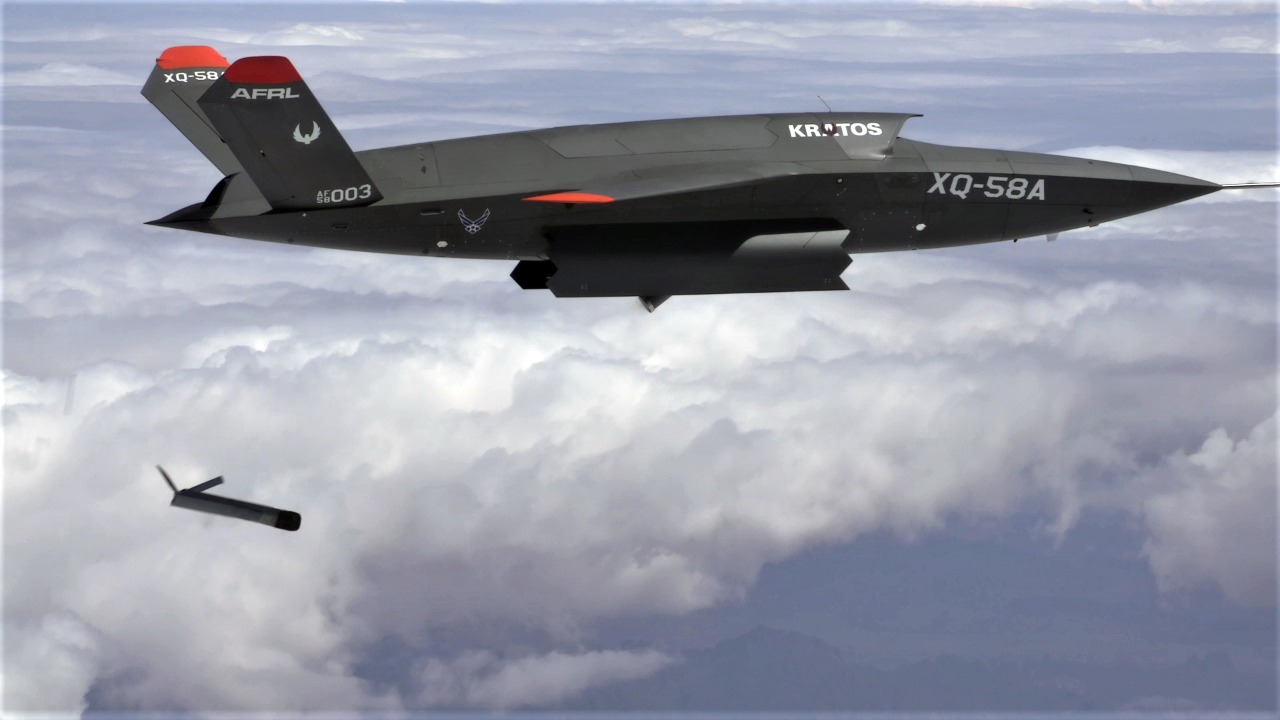

The US Marine Corps is moving quickly to field lethal autonomous drones that can fly alongside crewed fighters, absorb enemy fire, and strike targets on their own. At the center of this push is the Kratos XQ-58 Valkyrie, a low-cost uncrewed aircraft that has shifted from experimental curiosity to the backbone of a new class of robotic wingmen.
By pairing these drones with F-35s and other jets, the Marines aim to extend range, add extra weapons, and keep human pilots farther from the most dangerous air defenses. The result is a rapid, well-funded effort to turn what were once testbed aircraft into operational “killer” teammates for combat aviators.
The Valkyrie moves from experiment to combat wingman
The Kratos XQ-58 Valkyrie started life as a demonstrator, but it is now being reshaped into a frontline asset for the Marines. The aircraft, officially designated the XQ-58A, is a stealthy, runway-independent drone designed to fly in formation with fighters while carrying sensors and weapons of its own. As a relatively small and expendable platform, the Kratos XQ design gives commanders a way to push deep into contested airspace without risking a pilot in every aircraft.
The Marines have already begun flight testing the Valkyrie under a program explicitly focused on “penetrating, affordable, autonomous, collaborative killer” roles. In those early trials, officials highlighted how Kratos, Valkyrie and Marine teams were exploring autonomous strike profiles and data-sharing with crewed aircraft. Those experiments laid the groundwork for the current push to turn the XQ-58 into a fully missionized combat partner rather than a one-off science project.
A Northrop–Kratos team and a new class of Marine combat aircraft
The Marine Corps has now locked in an industry team to turn that vision into reality, selecting Northrop as the prime integrator for a Valkyrie-based Collaborative Combat Aircraft. Under this effort, Northrop will integrate mission systems on Kratos’ XQ-58 platform, effectively transforming the drone into a tailored Marine Corps robot wingman. The initial award, valued at $23 million according to program details, is structured to move quickly from design to flight demonstrations.
Reporting on the contract notes that the Marine Corps expects this Valkyrie variant to become its first operational Collaborative Combat Aircraft, with a performance period of 24 months to deliver a mission-ready configuration. A related account underscores that the service has tapped Northrop, Kratos and their Valkyrie design as the core of this new fleet, with By Stephen Losey detailing how the program is structured to move from prototype to squadron use in roughly two years.
From test flights to “killer” autonomy
The Marines’ interest in Valkyrie did not appear overnight. Prior to the current MUX TACAIR award, the Prior testing campaign saw the Marine Corps partnering with Kratos and conducting flight tests of the XQ-58 to validate basic performance and autonomy. Those sorties helped prove that the drone could launch without a traditional runway, navigate complex routes, and coordinate with other aircraft, all prerequisites for a “killer” role in high-threat airspace.
That experimentation has now evolved into a push for a fully missionized combat configuration. Analysts tracking the program note that The Marine Corps is pursuing a version of the Valkyrie equipped with advanced sensors, secure datalinks, and weapons, building on earlier test flights where Kratos’ Valkyrie demonstrated stealthy profiles and autonomous navigation. In parallel, a separate overview of the aircraft’s development history notes that US Air Force have heavily tested Kratos’ Valkyrie, officially designated the XQ-58, reinforcing that both services see the same potential in its autonomous combat role.
Plugging into F-35 cockpits and naval networks
For these drones to matter in a fight, they have to plug cleanly into the way pilots already operate. The Navy has been training F-35 aviators to control multiple uncrewed aircraft at once using touchscreen tablets, treating the drones as extensions of the jet’s sensors and weapons. In one recent tactical exercise, F-35 pilots used tablets to manage several Collaborative Combat Aircraft at once, a clear preview of how Valkyries could be tasked from the cockpit in real time.
The Marines have also been working to tie Valkyrie directly into the F-35’s data networks. In December 2022, the Pentagon announced that the Department of the Navy had awarded a $15.5 m contract, valued at $15.5 million, to Krato to develop a data link between Valkyrie and F-35s. That effort is central to the Marines’ broader autonomous program, since it allows pilots to see what the drone sees, hand off targets, and potentially authorize weapons releases from a safe distance.
Industrial muscle and the road to fielding
Behind the scenes, the industrial architecture for this new drone fleet is taking shape. Northrop Grumman has taken the prime role on the Marine program, with Northrop Grumman providing the enabling mission systems for the Kratos XQ-58 Valkerie CCA. Program details indicate that the Marine Co expects deliveries of up to 20 Valkyries in 2026, a scale that would move the concept firmly out of the lab and into operational squadrons.
At the same time, the Marines are coordinating closely with Kratos and other partners to refine the aircraft’s capabilities. One account notes that US Marine Corps leaders see the Valkyrie as a way to field a cost-effective wingman that can be upgraded over time, while another overview of the contract stresses that MUX TACAIR is structured to keep the Marine Corps, Kratos and Northrop aligned on rapid iteration. A separate analysis of the uncrewed fighter effort quotes a Source from the Marine Co saying that the enhanced capability set is meant to ensure optimal performance for both crewed and uncrewed platforms, underscoring how tightly the drone’s future is tied to the rest of the air wing.
More from Morning Overview