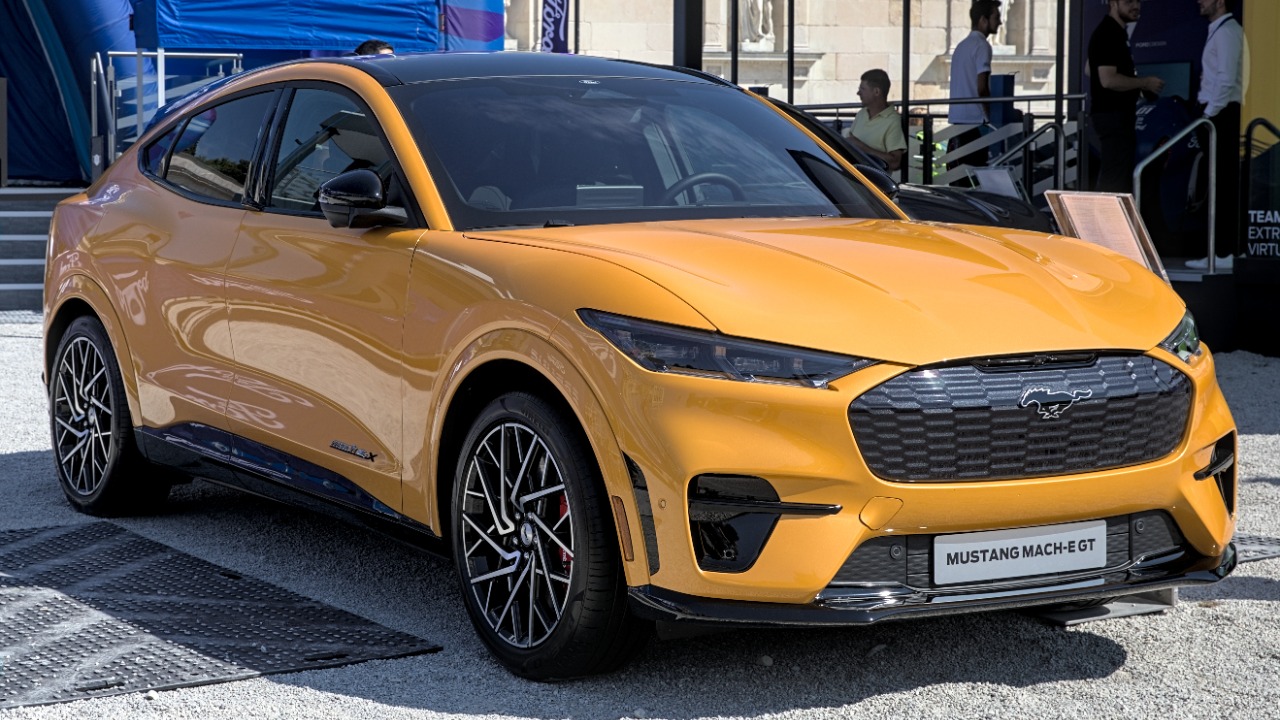

The Mustang badge is now carried more often by a battery pack than a burbling V8. After a year in which the electric crossover version surged ahead of its coupe sibling, fresh sales data shows that the Mach-E has again become the dominant Mustang in Ford’s stable. The shift is no longer a one-off anomaly but a pattern that is reshaping what the nameplate means on American roads.
The numbers that crowned a new Mustang leader
The turning point came when The Mustang Mach moved more units than the traditional pony car over a full calendar year. The Mustang Mach logged 51,745 units in 2024, while the classic Mustang managed 44,003, a reversal that would have been unthinkable when the crossover was announced. That 51,745 units figure did not just edge the coupe, it put clear daylight between the two body styles and confirmed that buyers were willing to accept an electric, family-friendly shape as a legitimate bearer of the Mustang name.
Context makes that gap even more striking. The Blue Oval has struggled to keep the gas car’s momentum, with 44,003 units in 2024 ranking among the weakest sales years in Ford Mustang history. While the coupe’s volumes sagged, the electric crossover kept climbing, helped by broader appeal and a market that increasingly rewards efficiency and tech over raw displacement. In that environment, the Mach-E did not just win a single year, it established a new baseline for what “normal” Mustang sales look like.
Quarterly surges and the Q3 tipping point
The annual totals were backed by sharp quarterly swings that showed how quickly the balance of power shifted. In the third quarter of 2025, In the numbers that filtered out of Ford’s sales reports, 20,177 M examples of the Mustang Mach-E found buyers, a figure that dwarfed the gas car’s tally in the same period. During that stretch, which counted the final days of summer and the start of fall, the electric crossover was not just competitive, it was the clear volume driver for the badge, underscoring that the earlier full-year win was no fluke.
Those quarterly results landed after months in which the Mach-E had already been chipping away at the coupe’s dominance. Pretty much since the day the crossover arrived in showrooms, it has been on an upward trajectory, and by the time Oct rolled around with that 20,177 M figure, the story was less about a surprise and more about confirmation of a trend. For a nameplate that once lived or died on two doors and rear-wheel drive, seeing the Mustang Mach lead the line in a family-friendly format signaled a profound shift in what customers now expect from Ford.
How pricing and positioning tilted the field
Raw volume tells only part of the story. The Mustang Mach benefited from a pricing and product strategy that made it easier to justify than the coupe for a wide range of buyers. Analysts tracking the segment have pointed to Ford’s decision to pitch the Mach-E as a practical daily driver with performance options, rather than a niche halo car, as a key reason it could reach 51,745 units while the Mustang coupe stalled at 44,003. By offering multiple battery sizes, trims that ranged from sensible to sporty, and a cabin that could handle family duty, Ford turned the electric Mustang into a rational purchase rather than a purely emotional one.
That strategy contrasted with the way the traditional Mustang has long been positioned. The gas car still leans heavily on nostalgia, sound, and style, which resonates with Enthusiasts but narrows its audience. The Mach-E, by comparison, slots into the heart of the crossover market, where buyers are already shopping, and then layers on the heritage badge as a bonus. When I look at the way The Mustang Mach was framed in early coverage, with Many longtime fans skeptical of the nameplate sharing space with a battery pack, it is clear that Ford bet on winning over new customers rather than only appeasing purists. The sales data suggests that bet paid off.
From controversy to “Best-Selling Mustang” status
When the electric crossover debuted, The Mustang Mach name was mildly controversial among the Ford faithful, who saw a risk of diluting decades of pony car history. Many enthusiasts argued that a tall, five-door EV could never embody what the Mustang stood for. Yet only a few model years later, the Mach-E is not just accepted, it is the volume leader. Reports from early 2026 describe how The Mach is Once Again Ford in the spotlight as the Best, Selling Mustang, with the gas car unable to reclaim the crown even after policy changes that were expected to help internal combustion.
That evolution from skepticism to dominance has been accelerated by the broader shift in consumer expectations. The Mach-E arrived as a very good electric crossover in its own right, with performance variants that could satisfy drivers who still cared about acceleration and handling. Sep coverage noted that, Despite the hullabaloo from the pony car faithful, the Ford Mustang Mach was rising fast in the sales charts, and by the time the 2024 and 2025 numbers were tallied, the argument over whether it “deserved” the badge had largely been settled by buyers. The market, not the message boards, decided which Mustang mattered most.
What the Mach-E’s lead means for Ford and performance icons
The Mach-E’s repeat win as the top-selling Mustang lands in a mixed moment for Ford’s broader electric strategy. Company data shows that Ford reports fewer US EV sales in 2025, with overall volumes slipping in the face of tougher competition and a cooling market. Like other automakers, Ford saw its electric deliveries drop in the fourth quarter to 25,219 units, and one of its three EV nameplates recorded a 59% decline to 5,186 units. Against that backdrop, the Mach-E’s resilience stands out, especially as Ford’s hybrids and extended range models picked up some of the slack in the showroom.
Zooming out to the wider performance landscape, the Mustang’s pivot to an electric-led lineup mirrors pressure on other icons. In the sports car world, Enthusiasts have watched as nameplates like Corvette adjusted to changing tastes, with one recent tally showing that model down 26.4% to 24,533 units in the United States. Who Won and Who Didn in the broader Auto Sales picture is increasingly determined by practicality and efficiency as much as by horsepower, and the Mach-E’s success shows how a legacy performance badge can adapt without disappearing.
A new Mustang era, and a new kind of king
For longtime fans, the idea that The Mach could have Outsold The Mustang and that analysts would seriously ask, Does This Mean a New King Has Emerged, would once have sounded like sacrilege. Yet that is exactly the conversation happening now, as Fitment Industries and other observers frame the Mach-E’s run as evidence that electric performance crossovers are not a fad, they are here to stay. Feb commentary on the changing Mustang landscape captured how quickly the hierarchy flipped, with the coupe now playing supporting role to the crossover that shares its badge.
The symbolism of that shift is hard to overstate. Jan analysis of how Ford Mustang Mach models Gallops Past Gas, Powered Counterpart In 2024 described it as a historic change in consumer preferences, one that reflects both environmental concerns and the practical realities of modern car ownership. When I look at the combined picture, from the 20,177 M quarterly spikes to the 51,745 units full-year tally and the gas car’s 44,003 units, the conclusion is clear. The Mach-E has not only outsold every other Mustang again, it has redefined what the Mustang is, turning a once singular pony car into a family of vehicles led, fittingly, by the one that points toward the future.
Supporting sources: Mach-E Outsold The, GM sold more, Mach-E Is Once, Ford Mustang Mach-E, Ford Mustang Mach-E.
More from Morning Overview