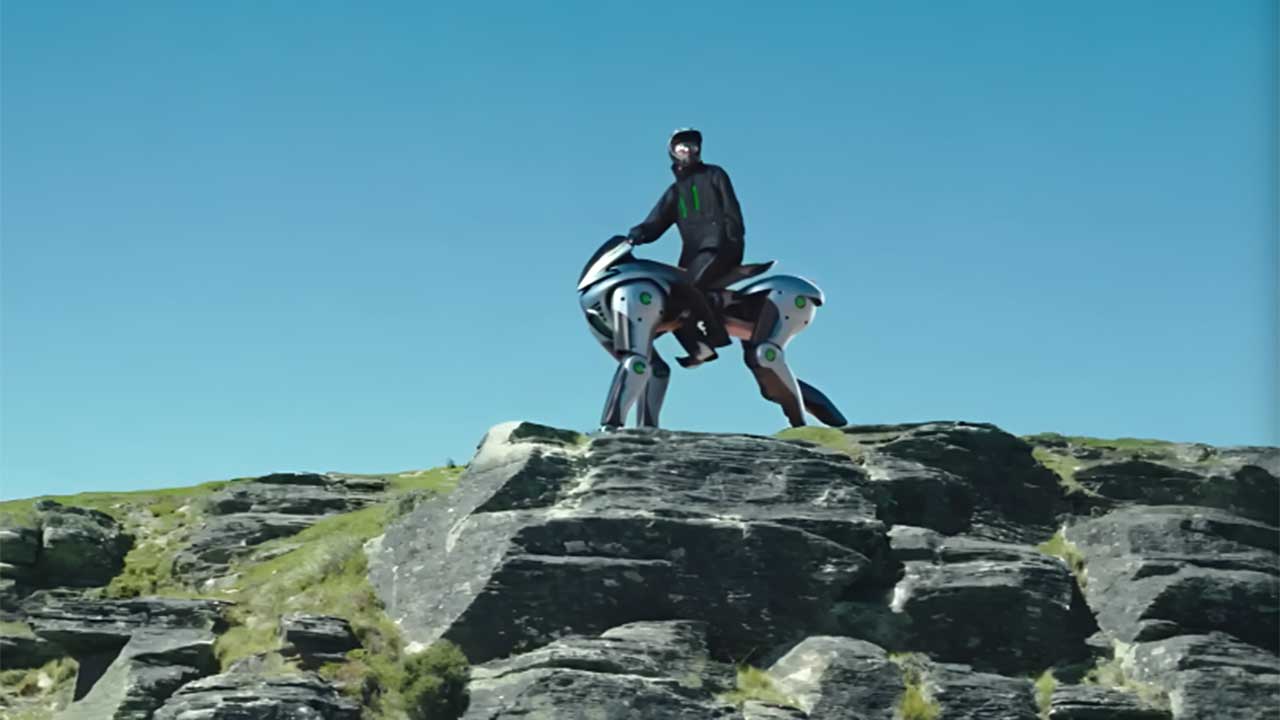

Kawasaki’s decision to commercialize its four-legged robot horse marks a rare moment when a far-off concept vaults almost directly into the real world. What began as a futuristic hydrogen-powered quadruped for a distant 2050 scenario is now being prepared as an actual vehicle that people will be able to ride, with the company positioning it as both a mobility tool and a technology showcase. I see this shift as a signal that legged robotics, clean propulsion and human-machine interfaces are converging faster than even optimistic engineers expected.
From 2050 fantasy to factory reality
When Kawasaki from Japan first floated the idea of a hydrogen-powered, four-hooved, all-terrain robot horse, it framed the machine as a 2050 vision rather than a near-term product. The concept was ambitious even by speculative standards, promising a rideable quadruped that could traverse rough ground while running on clean fuel, and early descriptions made it sound like something out of a science fiction storyboard rather than an engineering roadmap. That is why the recent confirmation that this machine is heading into production represents such a sharp pivot from long-range aspiration to concrete industrial plan, especially given that the original framing explicitly cast it as a distant “pipe dream” for mid century mobility, as highlighted in early coverage of what was announced as a 2050 pipe dream by Kawasaki.
The production move also reflects a broader pattern in robotics where ideas that once lived only in glossy expo videos are being hardened into platforms that can survive real terrain and real customers. What once sounded like a far-future sci-fi concept is suddenly feeling very real, with prototype testing showing the robot horse handling uneven ground and even water crossings, and that shift from render to rideable machine is central to Kawasaki’s new narrative. In my view, the company is using this leap from 2050 fantasy to factory reality to signal that it intends to compete not just in motorcycles and industrial machinery but in a new category of hydrogen-powered robotic mobility, a direction that aligns with the way what once sounded like a far-future sci-fi concept is suddenly feeling very real has been described.
Meet CORLEO, Kawasaki’s rideable robot horse
The production-bound machine carries a name that is likely to become familiar far beyond robotics circles: CORLEO. Kawasaki’s four-legged robot-horse vehicle is going into production under this branding, and the company is positioning CORLEO as a rideable platform that blends motorcycle-like thrills with the stability and versatility of a quadruped. I see CORLEO as a deliberate attempt to create a new product category that sits somewhere between an off-road bike, a pack animal and a small utility vehicle, with the four legs and hooves doing the work that wheels and tracks usually handle, a direction underscored by detailed previews of how Kawasaki’s four-legged robot-horse vehicle is going into production.
Earlier concept material introduced a closely related design under the name Kawasaki Coro, a bold quadruped that reimagined what off-road exploration could look like in 2050 through zero emission propulsion and animal-like gait control. That earlier Kawasaki Coro vision laid much of the groundwork for CORLEO’s eventual form, from the stance of the legs to the idea that a rider would sit astride the machine rather than behind a steering wheel, and it framed the robot as a tool for exploring remote landscapes that would be difficult for conventional vehicles. As I read it, CORLEO is essentially the production evolution of that Kawasaki Coro concept, taking the same four-legged architecture that was showcased in video form and turning it into a machine that can be manufactured and sold, a lineage that is clear when you look at how the Kawasaki Coro is a bold concept that redefines what off-road exploration could look like in 2050.
Hydrogen power and the “hydrogen horse” vision
At the heart of CORLEO is a hydrogen propulsion system that turns the robot horse into a rolling demonstration of Kawasaki’s clean energy ambitions. Instead of relying on batteries alone, the machine is described as hydrogen-powered, which places it squarely in the emerging category of so-called hydrogen horses that aim to deliver zero tailpipe emissions while still offering long range and quick refueling. I see this as a strategic choice for Kawasaki, which has deep experience in heavy industry and energy systems and is now using CORLEO to show how hydrogen can move beyond trucks and trains into more experimental forms of mobility, a direction captured in analyses of how Hydrogen Horses and the Future of Clean Mobility include Kawasaki unveiling Corleo, a hydrogen-powered robotic horse.
Hydrogen power also fits the narrative Kawasaki has been building around CORLEO as a machine designed for long treks into remote areas where charging infrastructure is scarce but where compressed hydrogen could be delivered in tanks or produced on site. The company has already framed the robot horse as a zero emission vehicle that could appear at the Osaka-Kansai Expo 2025, using that global stage to promote hydrogen as a practical fuel for next generation mobility platforms. From my perspective, the hydrogen horse concept is doing double duty: it gives CORLEO a technical edge in endurance and refueling speed, and it reinforces Kawasaki’s broader push to position hydrogen as a cornerstone of its future product portfolio, an approach that aligns with the way Kawasaki from Japan has revealed a hydrogen-powered, four-hooved, all-terrain robot horse for the Osaka Expo.
How the four-legged gait actually works
What sets CORLEO apart from more familiar off-road vehicles is not just its fuel but its legs. Rather than relying on traditional controls, CORLEO responds to the rider’s shifts in body weight, adjusting its gait and balance in a way that mimics how a living animal interprets a rider’s cues. That means the machine’s four legs and hooves are constantly recalculating their positions to keep the rider stable, whether it is walking, trotting or climbing, and the control system is designed to translate subtle movements into changes in speed and direction. I see this as a significant step in human-robot interaction, because it moves away from joysticks and handlebars and toward a more intuitive, full-body interface, a shift that is described in detail in technical breakdowns of how rather than relying on traditional controls, CORLEO responds to the rider’s shifts in body weight.
The legs themselves are engineered to handle a wide range of environments, from flat ground to rubble fields, and the rear leg unit in particular has been highlighted as capable of adapting to steep slopes and unstable surfaces. Scientists and Japanese engineers working on the robot horse have emphasized that the design is meant to cope with areas that would be difficult for wheeled vehicles, including mountain trails and disaster zones, and that the gait algorithms are tuned to maintain stability even when individual hooves encounter loose rocks or water. In my view, this focus on gait adaptability is what turns CORLEO from a novelty ride into a potentially serious mobility tool, and it is consistent with technical descriptions of how scientists and Japanese engineers designed a hydrogen-powered robot horse that can handle steep slopes, areas and rubble fields.
Riding experience: part motorcycle, part animal
For riders, CORLEO promises an experience that blends elements of motorcycling with the sensation of being on a living creature. The machine is described as a four-legged hydrogen-powered robot you can actually ride, with a saddle-like seat and controls that rely more on posture and weight shift than on twisting a throttle. That makes the learning curve different from a conventional bike, but it also opens the door to a more immersive ride where the machine feels like it is moving with you rather than simply responding to mechanical inputs. From my perspective, this is a clever way for Kawasaki to leverage its motorcycle heritage while still offering something genuinely new, a point that comes through clearly in demonstrations of a 4-legged hydrogen-powered robot you can actually ride.
Motorcycle-focused observers have already zeroed in on how the rear half of the Corleo concept, which underpins CORLEO, is essentially a modular unit that could be swapped or adapted, hinting at future variants that might prioritize cargo, passengers or specialized equipment. What is particularly interesting, at least from a motorcycle perspective, is that this rear section carries much of the drive and suspension hardware, which could allow Kawasaki to experiment with different front-end configurations without redesigning the entire machine. I read this as a sign that the company is thinking beyond a single model and toward a family of legged vehicles, a direction that aligns with early commentary on how what’s particularly interesting, at least from a motorcycle perspective, is that the entire rear half of the Corleo is a distinct module.
From expo showpiece to real-world tool
Before CORLEO was earmarked for production, Kawasaki used the robot horse as a showpiece for the Osaka-Kansai Expo 2025, presenting it as a glimpse of how people might explore remote landscapes in 2050. The expo context encouraged a certain amount of spectacle, including stylized videos and dramatic scenarios, but it also gave engineers a deadline and a public platform to test the machine’s core technologies. I see that expo phase as a crucial bridge between concept and product, because it forced Kawasaki to build hardware that could operate reliably in front of crowds while still leaving room to refine the design for mass production, a trajectory that matches descriptions of how Kawasaki has unveiled Corleo, a hydrogen-powered robotic horse, for the Osaka-Kansai Expo 2025.
Now that the company is talking about production, the narrative is shifting from spectacle to utility. Instead of focusing solely on futuristic exploration scenarios, Kawasaki is highlighting how a hydrogen-powered quadruped could support tasks like mountain tourism, remote patrols or even disaster response, where its ability to step over debris and wade through shallow water could be more valuable than raw speed. In my view, this evolution from expo showpiece to real-world tool is what will determine whether CORLEO becomes a niche curiosity or a platform that other industries adopt, and it reflects a broader trend in robotics where machines that debut as attention-grabbing demos are increasingly expected to justify themselves as practical assets, a pattern that is visible in the way prototype testing has shown the robot horse handling uneven ground and water crossings.
Why Kawasaki is betting on legged mobility
Kawasaki Heavy Industries, Ltd, often shortened to KHI, is not a startup chasing a single flashy product but a sprawling industrial group with interests in ships, aircraft, energy systems and motorcycles. For a company of that scale, choosing to invest in a four-legged robot horse is less about novelty and more about staking a claim in the next wave of mobility technologies that blend robotics, AI and alternative fuels. I see CORLEO as a strategic experiment that allows KHI to combine its expertise in mechanical engineering, hydrogen systems and vehicle dynamics into a single, highly visible platform, a move that fits with the way Kawasaki Heavy Industries, Ltd (KHI) presents itself as a diversified engineering powerhouse.
Legged mobility also offers Kawasaki a way to differentiate itself in a crowded field of electric bikes, scooters and autonomous shuttles. By focusing on a hydrogen-powered quadruped that can go where wheels struggle, the company is targeting use cases that are less likely to be disrupted by conventional EV makers and more aligned with its strengths in heavy-duty machinery. From my perspective, this bet on legged mobility is as much about brand positioning as it is about technology, signaling that Kawasaki intends to be seen not just as a motorcycle manufacturer but as a leader in advanced robotics and intelligent mobility systems, a direction that is echoed in technical discussions of how CORLEO showcases Kawasaki’s work in robotics and intelligent mobility systems.
What production could mean for riders and robotics
As CORLEO heads toward production, the implications extend beyond Kawasaki’s balance sheet. For riders, the arrival of a commercially available robot horse could redefine what it means to go off-road, offering a machine that can step over obstacles, pivot in place and maintain stability on surfaces that would unsettle even the most capable adventure motorcycles. I expect early adopters to come from sectors like guided mountain tours, search and rescue teams and industrial site operators, where the combination of hydrogen range and legged agility could justify the likely premium price, especially if the machine proves as robust in the field as it has in controlled demonstrations of a 4-legged hydrogen-powered robot you can actually ride.
For the robotics community, a production run of CORLEO would provide a rare large-scale test bed for legged locomotion in everyday use, generating data on wear, failure modes and user behavior that could feed back into future designs. It would also raise expectations for what legged robots should be able to do, pushing competitors to move beyond lab demos and into real-world deployments that match or exceed Kawasaki’s offering. In my view, that competitive pressure could accelerate progress across the entire field, from warehouse robots to planetary rovers, and it underscores why the shift from a 2050 concept to a production-bound hydrogen horse is more than a marketing story. It is a sign that legged machines are finally stepping into the mainstream, a transition that has been building since early visions of the Kawasaki Coro showed how the Kawasaki Coro is a bold concept that redefines what off-road exploration could look like in 2050.
More from Morning Overview