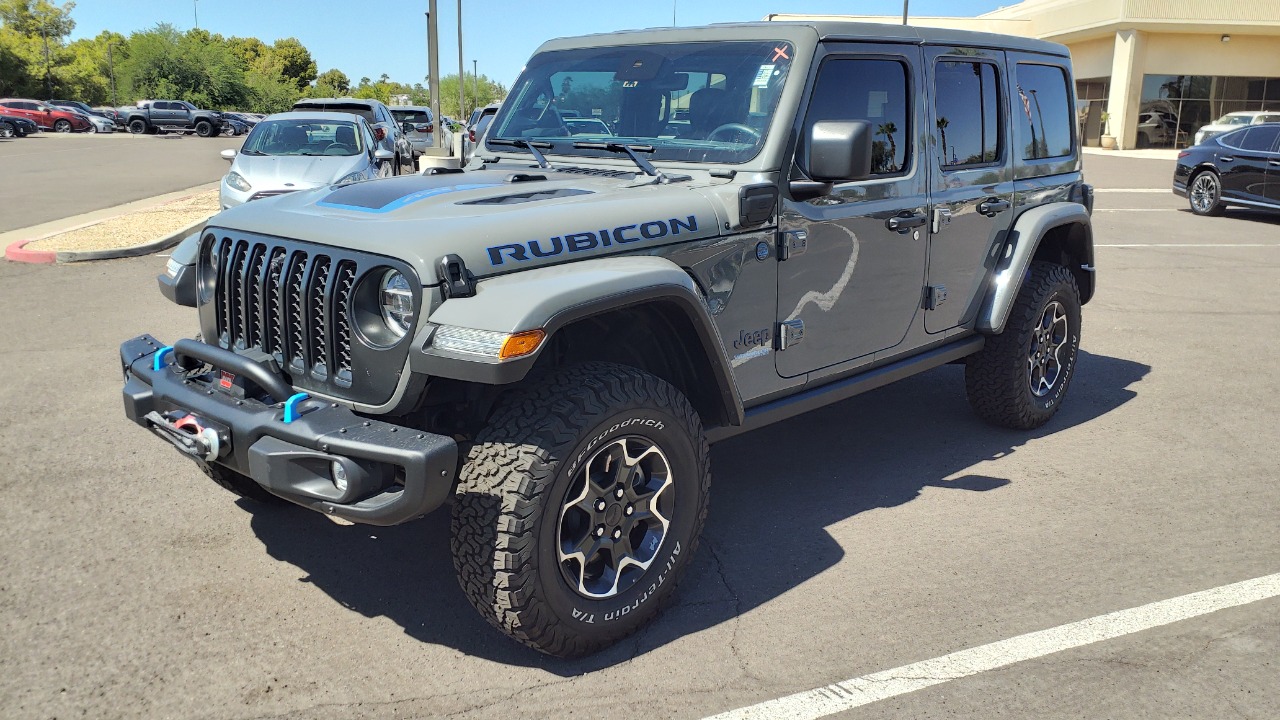

Jeep’s plug-in hybrids have been central to its pitch that off-road icons can go electric without losing their edge, yet shoppers looking for a Wrangler 4xe or Grand Cherokee 4xe recently discovered those models had quietly vanished from online configurators. The disappearance coincided with a stop-sale tied to safety concerns and software problems, leaving one of America’s most visible PHEV lineups in limbo. I see that low-key pause as a revealing stress test of how far the brand, and its parent Stellantis, are willing to go to protect both safety and sales momentum in a volatile electrified market.
How a quiet website change exposed a big problem
The first public sign that something was off did not come from a splashy recall notice, but from shoppers who noticed that Wrangler 4xe and Grand Cherokee 4xe builds had been scrubbed from Jeep’s own digital storefront. Over the holidays, an attentive reader flagged that the Grand Cherokee and Wrangler plug-in hybrids were missing from the brand’s online tools, a change that had largely flown under the radar until it was surfaced in a detailed report on Jeep pulls Wrangler and Grand Cherokee 4xe. That discovery confirmed what dealers and some customers already suspected, that a stop-sale was in effect even as the company avoided drawing attention to it in consumer-facing marketing.
In that reporting, Jan was identified as the moment when the quiet pause finally came into focus, with Jeep acknowledging that it did not yet have a fix in hand and was instead targeting a resolution sometime in the second quarter. I read that timeline as a clear signal that this was not a minor software patch that could be pushed overnight, but a deeper technical issue that required engineering work, validation, and regulatory coordination. By the time the missing 4xe models were widely noticed, the stop-sale had already been dragging on, underscoring how a subtle change in a configurator can mask a much larger disruption behind the scenes.
The safety recall that triggered a stop-sale
Behind the quiet website edits sat a more serious concern, a safety recall that effectively froze sales of the Grand Cherokee 4xe and cast a shadow over the broader plug-in lineup. Earlier coverage from Mopar-focused outlets detailed how a software glitch in the Grand Cherokee 4xe’s control systems prompted a formal stop-sale, with the issue serious enough to affect one of America’s best-selling plug-in hybrids. In that context, the phrase “Software Glitch Prompts Stop, Sale Of One Of America, Best, Selling, Jeep” was not marketing copy but a blunt description of how a single defect could sideline a flagship electrified SUV, as laid out in the Jeep Grand Cherokee 4xe stop-sale analysis. Video coverage from Sep added further context, walking through how the recall affected almost all Grand Cherokee 4xe examples on dealer lots and in customer hands, and explaining that the stop-sale would remain until updated software could be installed. In that breakdown, the host referenced earlier reporting from Mopar Insiders and emphasized that the recall was not limited to a narrow batch of vehicles, but instead swept across the core Grand Cherokee 4xe lineup, a point reinforced in the Jeep Grand Cherokee 4xe stop-sale video. I see that breadth as crucial, because it meant Jeep could not simply route shoppers to unaffected trims; the very heart of its plug-in SUV strategy was effectively on hold.
Fire risk, “park outside” warnings, and the PHEV recall wave
The software problems did not exist in a vacuum, they landed on top of a broader safety crisis around plug-in hybrid fire risk that forced Stellantis to take sweeping action. In an official Statement titled “Jeep PHEV Fire Risk,” the company disclosed that FCA US LLC was recalling an estimated 320,065 plug-in hybrids, including Jeep Wrangler and Grand Cherokee variants, due to concerns that the high-voltage battery packs could pose a fire hazard even when parked and turned off. That notice, issued from Auburn Hills, Mich, made clear that the recall was not a narrow technicality but a large scale intervention, as spelled out in the Statement, Jeep, PHEV, Fire Risk release.
Regulators amplified the urgency with a Consumer Alert that expanded the “park outside” guidance to more Jeep Grand Cherokee and Jeep Wrangler PHEVs, warning owners that their vehicles should be kept away from structures because of the Recall for Fire Risk. The alert stressed that even some vehicles that had already received remedy software might still be at risk, and it framed the situation as an Important Expanded Jeep Grand Cherokee and Jeep Wrangler Park Outside directive that owners needed to follow immediately. That language, captured in the Consumer Alert, Important Expanded Jeep Grand Cherokee and Jeep Wrangler notice, helps explain why Jeep could not simply keep selling 4xe models while it worked quietly in the background; the safety stakes were too high and too visible.
Production “adjustments” and swelling inventories
Even before the fire risk recall and software stop-sale converged, Stellantis had already been wrestling with how many plug-in Jeeps it could realistically move in the United States. In Sep, the company temporarily halted production of certain Jeep Wrangler and Grand Cherokee models as inventories swelled, describing the move as a set of “production adjustments” rather than a long term shutdown. Reporting on that pause highlighted how Stellantis Pauses Jeep Wrangler And Grand Cherokee Production As Inventories Swell, a phrase that captured both the official framing and the underlying reality that dealers were sitting on more vehicles than they could quickly sell, as detailed in the Stellantis Pauses Jeep Wrangler And Grand Cherokee Production As Inventories Swell report.
From my perspective, that earlier production pause set the stage for the current 4xe sales freeze to hit even harder. When a manufacturer is already dialing back output because lots are full, a subsequent stop-sale tied to safety and software issues can turn those parked vehicles from slow moving assets into stranded inventory. Dealers who had stocked up on plug-in Wranglers and Grand Cherokees in anticipation of strong demand suddenly found themselves holding units they could not legally sell, a situation that magnified the financial and reputational impact of the recall beyond the immediate engineering challenge.
Customer complaints hint at deeper reliability worries
While official recalls and stop-sales grab headlines, individual owner experiences often reveal how those technical problems play out in daily use. One complaint filed for a Vehicle identified as a 2025 jeep grand cherokee 4xe anniversary edition described how a leased SUV with roughly 5,000 m on the odometer became inoperable until a module replacement was performed. That account, captured in the 2025 Jeep Grand Cherokee recalls database, underscores how software and control unit issues can translate into real world breakdowns for relatively new plug-in hybrids.
I see that kind of early life failure as particularly damaging for a technology that still needs to win over skeptical buyers. For shoppers considering their first plug-in SUV, stories of a Grand Cherokee 4xe anniversary edition sidelined at around 5,000 m because of a module fault reinforce the perception that complex electrified drivetrains may be less dependable than traditional gasoline setups. When those anecdotes are layered on top of formal recalls for fire risk and software glitches, the cumulative effect is to erode confidence in the 4xe badge at precisely the moment Jeep is trying to position it as a core part of the brand’s future.
Jeep’s sales narrative stays upbeat despite the pause
Publicly, Stellantis has continued to emphasize strong overall performance for its American operations, even as specific electrified models face headwinds. In a recent sales update from Auburn Hills, Mich, FCA US LLC reported that it sold 332,321 vehicles in the fourth quarter, describing that result as the second consecutive period of year over year growth. The release, issued under the banner of FCA, LLC, highlighted momentum across several nameplates and framed the broader portfolio as healthy despite pockets of disruption, as laid out in the FCA US fourth-quarter total sales announcement.
From where I sit, that upbeat tone is both understandable and incomplete. Automakers rarely foreground bad news in their sales communications, and Jeep still sells a large number of non plug-in Wranglers and Grand Cherokees that help offset any 4xe specific slowdown. Yet the decision to quietly remove the 4xe models from online configurators while touting aggregate volume figures illustrates the tension between short term messaging and long term trust. Shoppers who dig into the details will notice that the very plug-in variants that once headlined Jeep’s electrification story are now conspicuously absent, even as the company celebrates overall growth.
Future tech: a new plug-in drivetrain waiting in the wings
Even as current 4xe models face recalls and stop-sales, Stellantis is preparing a new generation of plug-in hardware that could reshape the Wrangler and its siblings. Reporting on upcoming product plans indicates that 2026 Jeep Wrangler and Gladiator 4xe Models Will Get This new high performance plug-in hybrid system, built around a ZF 8HP80PH transmission designed specifically for electrified applications. That drivetrain, described as High, Performance Plug technology for Wrangler and Gladiator, promises more capability and efficiency than the current setup, according to the preview of Jeep, Wrangler and Gladiator, Models Will Get This, High, Performance Plug.
I read that move as a tacit acknowledgment that the first wave of 4xe hardware, while commercially successful, may not be the final word on how Jeep wants to execute plug-in off-roaders. A more integrated transmission based hybrid system could address some of the software and drivability issues that have surfaced, while also giving engineers more flexibility to manage battery temperatures and power delivery in demanding conditions. If Jeep can pair that upgraded technology with a clean safety record and transparent communication, the next generation of Wrangler and Gladiator 4xe models could help reset the narrative that has been clouded by the current stop-sale.
How the pause reshapes the Wrangler and Grand Cherokee story
The quiet removal of 4xe models from Jeep’s website also changes how the Wrangler and Grand Cherokee lineups are perceived in the broader market. For several years, the brand has used plug-in variants to showcase that its most iconic nameplates can adapt to emissions rules and urban restrictions without sacrificing trail credibility, positioning the Wrangler 4xe as a halo product. When those electrified versions suddenly vanish from configurators, as they did when a Jan reader noticed the Grand Cherokee and Wrangler plug-ins missing and shared that tip on Over the Jeep Grand Cherokee and Wrangler, it sends an implicit message that the most advanced variants are also the most fragile.
At the same time, the core appeal of these vehicles has not changed overnight. Enthusiasts still value solid axles, selectable four wheel drive, and genuine off-road hardware, and many buyers will simply pivot to non plug-in trims while the 4xe issues are resolved. I see the real risk not in short term sales dips, but in the possibility that some customers will now associate the 4xe badge with recalls, fire risk warnings, and software glitches rather than with cutting edge capability. Rebuilding that association will require more than a technical fix; it will demand a sustained effort to prove that future plug-in Wranglers and Grand Cherokees can deliver both adventure and reliability.
More from Morning Overview