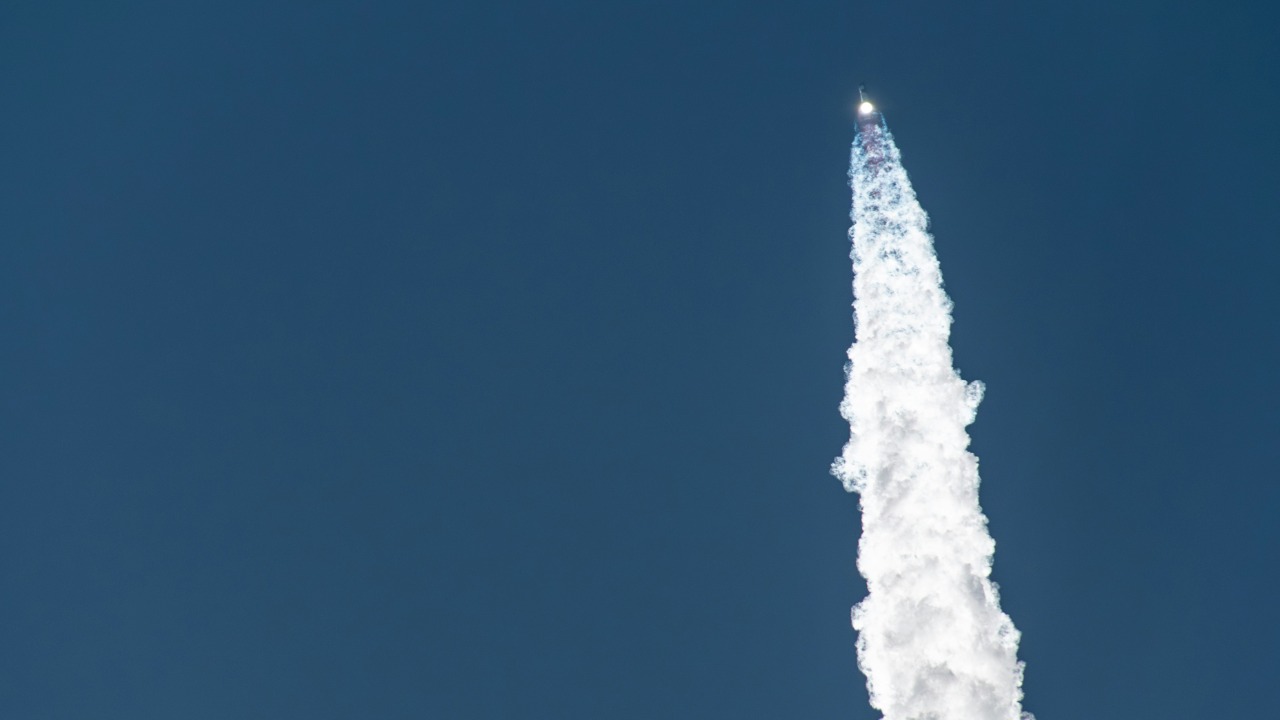

SpaceX’s latest Starship test has delivered the kind of spectacle that even seasoned launch watchers are replaying frame by frame: a glowing, plasma-wrapped plunge back through the atmosphere that looks more like science fiction than flight test data. The fiery descent, captured in multiple camera angles, turns the world’s largest rocket into a streak of incandescent orange as it slams into thicker air on its way home. For all the drama, the footage is more than a viral clip, it is a window into how SpaceX is trying to tame reentry for a fully reusable system.
What stands out in this new video is not just the beauty of the glowing shockwaves but the sense of control threaded through the chaos, from the way the vehicle holds its attitude to the timing of engine burns and telemetry callouts. I see a company that is deliberately flying at the edge of its envelope, accepting hardware losses in exchange for the kind of high-fidelity data that will eventually make this fiery return feel routine.
Starship’s blazing reentry, frame by frame
The most striking sequences show Starship enveloped in a sheath of plasma as it reenters at orbital velocity, the hull tracing a bright arc across the darkness while the camera struggles to keep up with the shifting glow. In one widely shared clip, the vehicle’s silhouette is barely visible behind curtains of ionized gas, with the heat shield tiles taking the brunt of the inferno as the ship knifes back toward Earth, a scene captured in vivid detail in the latest reentry footage. The visual is a reminder that reusability is not just about landing legs and propellant margins, it starts with surviving this brutal interface between space and air.
Another angle, shot from onboard and ground-based cameras, shows the glow building gradually as Starship descends, then intensifying into a continuous flare that wraps around the nose and leading edges. The commentary over one of the official streams underscores that the goal at this stage is to “learn as much as we can,” a line echoed in a separate clip from Aug where engineers emphasize that even a splashdown counts as a win if the data is rich enough, a point reinforced in the dramatic descent sequence. Watching the vehicle ride that fire, I am struck by how much of the test is about characterizing exactly how the ship behaves when everything around it is trying to tear it apart.
From fiery fall to precision catch
As spectacular as the upper stage’s reentry looks, the other half of the story unfolds much closer to the ground, where the Super Heavy booster is now performing a kind of aerial ballet that would have sounded implausible a decade ago. On Flight 8, the company not only launched the stack but also guided the giant Super Heavy back toward the launch site, using grid fins and engine burns to steer it into position for a controlled capture. According to detailed accounts of Flight 8, SpaceX again lost the Starship upper stage but successfully recovered the booster, demonstrating a jaw dropping “catch” technique that relies on the launch tower’s mechanical arms to grab the returning stage, a maneuver documented in coverage of the Flight 8 test.
The choreography involved is easier to appreciate when you watch the full launch and landing sequence, where the booster’s engines throttle, cut, and reignite in a carefully timed sequence as it lines up with the tower. In a broadcast from Jan, commentators walk through how the Starship program has evolved from simple splashdowns to this kind of high precision recovery, highlighting how each test builds on the last, a progression that is clear when you follow the full launch and recapture coverage. I see the fiery reentry of the upper stage and the booster’s pinpoint return as two halves of the same ambition, a fully reusable architecture that treats even the most violent phases of flight as problems to be engineered away.
Learning from explosions and near misses
The path to that level of control has been anything but smooth, and the latest reentry footage lands in a context shaped by high profile failures as much as by successes. Earlier tests have ended in dramatic breakups, including one widely circulated clip where Starship disintegrates into a massive fireball, the vehicle vanishing in a bloom of flame that briefly turns the sky white hot before debris rains down, a sequence captured in a launch video that has become shorthand for the program’s risks. Another broadcast shows the vehicle exploding into a towering plume that dominates the frame, underscoring how thin the margin can be between a controlled test and a catastrophic loss, as seen in the fireball coverage.
The same pattern of risk and rapid iteration shows up on the ground. During a routine static fire test in Jun, Starship 36 erupted in a series of massive explosions that rattled homes miles away in Texas, turning what was supposed to be a stationary engine firing into a destructive chain reaction, an event documented in detail in footage of how Starship 36 tore itself apart. Separate video from Jun shows another Starship rocket exploding during a static fire test in Texas, with the camera capturing the shockwave and debris cloud as the vehicle fails on the pad, a stark reminder in the static fire clip that even ground tests carry real risk. I read these failures not as outliers but as integral to the company’s test philosophy, where each explosion is mined for telemetry that feeds directly into the next design tweak.
The evolution of reusability techniques
To understand why the latest fiery reentry matters, it helps to look at how SpaceX has been refining its recovery playbook across multiple flights. In Starship flight test 5, the booster’s return showcased a particularly intricate maneuver: as the booster approached the launch pad, it slowed to a near hover and did a horizontal slide maneuver to line itself up with two structural arms before the engines shut down, a sequence described in detail in the As the booster account. That horizontal slide is not just a party trick, it is a way to buy time and precision in the final seconds, giving the tower a better chance to catch the stage without overstressing the hardware.
On the upper stage side, the company has been equally aggressive in pushing the envelope on reentry profiles, experimenting with different angles of attack and control surface deflections to manage heating and loads. The Aug commentary that “if we do make it all the way down to the water who knows but the goal of this part of the flight is to learn as much as we can” captures the mindset behind these tests, a philosophy that treats even partial successes as valuable, as heard in the Aug segment. When I watch the newest footage of Starship wrapped in plasma, I see the latest iteration of that same approach, a willingness to fly aggressive trajectories precisely because the company expects to lose vehicles on the way to a more robust design.
Why the fiery footage matters for Mars
All of this drama, from the glowing reentry to the tower catches and pad explosions, sits inside a larger narrative about what SpaceX is trying to build. The company has been explicit that Starship is central to its long term plan for Mars colonization and high cadence orbital operations, with recent updates highlighting ongoing missions that include advanced satellites and preparations for Mars bound expeditions, as laid out in an overview of Mars focused plans. A vehicle that can survive repeated, fiery plunges through Earth’s atmosphere is a prerequisite for any system that hopes to land on, depart from, and eventually shuttle between worlds, and the current tests are clearly aimed at proving that kind of durability.
The latest reentry video, then, is not just a viral spectacle but a proof point in a long chain of incremental steps. When I line it up alongside the earlier launch streams, the explosive failures, and the increasingly precise booster recoveries, a pattern emerges of a program that is willing to absorb very public setbacks in exchange for rapid learning. The fiery glow around Starship as it falls back to Earth is the visible edge of that process, a reminder that behind every jaw dropping frame is a spreadsheet of temperatures, pressures, and control inputs that will shape the next flight. Even the more polished highlight reels, like the curated Starship recaps and the dramatic Video segments, hint at a program that is as much about data as it is about spectacle. Watching this latest descent, I am left with the sense that the fire is not a side effect, it is the crucible in which the next generation of reusable rockets is being forged.
More from Morning Overview