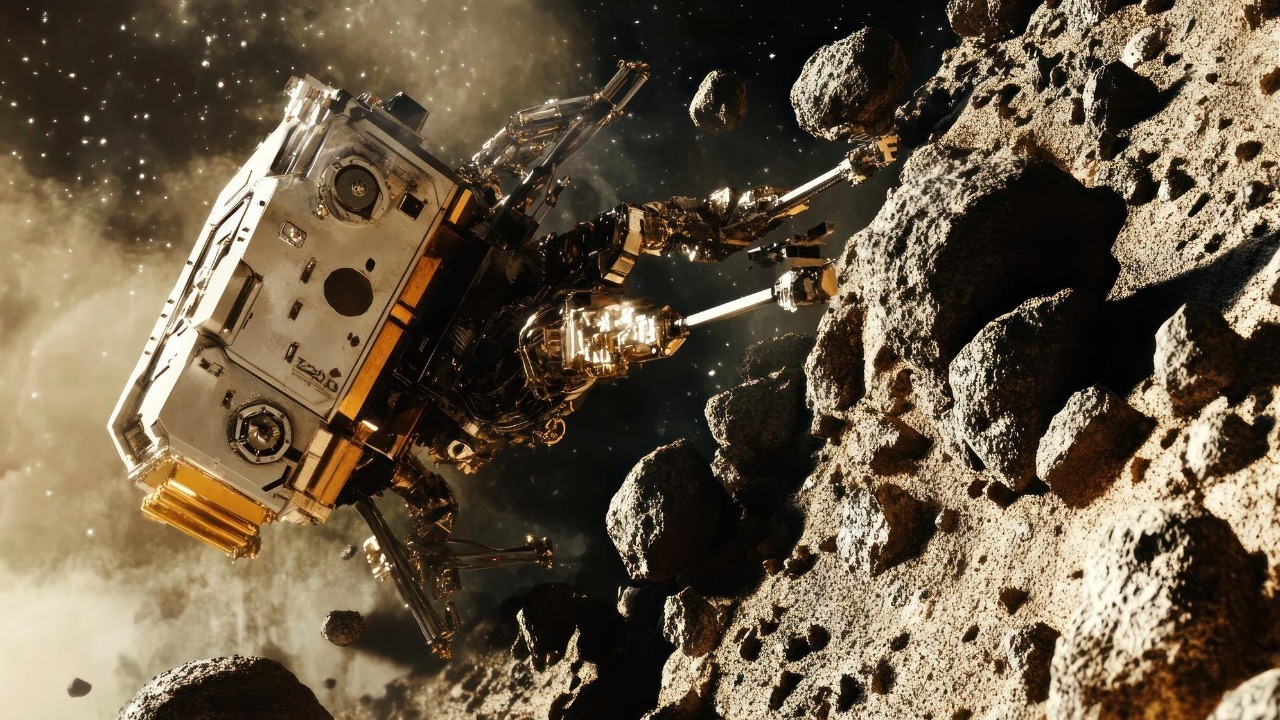

Asteroid mining has moved from science fiction pitch decks into serious technical studies, but the gap between concept and commercial reality remains wide. A new wave of research is trying to quantify that gap, testing whether the physics, economics and law can line up in time to matter for both space exploration and Earth’s resource markets.
At stake is not just a futuristic supply of platinum or nickel, but access to water ice and other volatiles that could fuel deep space missions and reshape how we build infrastructure beyond Earth. I want to unpack what the latest studies actually say about feasibility, where the hype goes too far, and why the most realistic payoff may come from supporting space operations rather than flooding terrestrial commodity markets.
From sci‑fi dream to serious business plan
For decades, asteroid mining lived comfortably in the realm of speculative fiction, a convenient plot device for limitless wealth. Over the past several years, however, it has shifted into a potential industrial strategy as launch costs fall and robotic systems improve. A detailed white paper on space resources notes that Asteroid mining has shifted from science fiction to a potential industrial reality, with Advances in propulsion, autonomy and in‑space manufacturing making the prospect far more plausible than it looked even a decade ago.
That shift has attracted not only startups but also national space agencies and large industrial players, all trying to map out which parts of the value chain might be viable first. The same white paper frames asteroid resources as a “bridge to the future” for the broader SpaceTech economy, arguing that early missions could focus on small, high‑value targets and in‑space use of materials rather than immediate bulk export to Earth. In other words, the business plan is evolving from a gold‑rush narrative to a more incremental infrastructure play.
What asteroid mining actually means
Before judging feasibility, I need to be precise about what is on the table. In industry terms, What, Asteroid Mining, Asteroid refers to the proposed extraction of raw materials from asteroids and other minor planets, using robotic spacecraft to identify, approach, and process ore in microgravity. The targets range from metal‑rich bodies packed with nickel, iron and platinum‑group elements to carbonaceous asteroids that may contain water ice and organic compounds.
In practice, that means several distinct operations bundled under one label: prospecting to understand composition, anchoring or capturing the Asteroid in a controllable way, extracting material, and then either refining it in situ or transporting it to a processing hub. Each step carries its own technical and financial risk. The same industry analysis that defines Asteroid Mining also stresses the core problem: with current technology and prices, the activity is not profitable enough yet, which is why most serious roadmaps focus on long‑term potential rather than near‑term windfalls.
The new feasibility study: water first, metals later
The latest detailed assessment of viability takes a deliberately conservative approach, asking not whether asteroid mining is imaginable but whether it can be made to work with realistic spacecraft and market assumptions. One recent analysis of how feasible such operations might be concludes that the most promising early targets are not precious metals but water‑bearing asteroids that could supply propellant and life support for missions in cislunar space and beyond. That study emphasizes that many asteroids contain water ice which could be split into hydrogen and oxygen to manufacture fuel for deep space operations, a point underscored in a technical review of how feasible asteroid mining might be.
Another pioneering study that explicitly assesses the likelihood of asteroid mining argues that the benefits are immense if the technical hurdles can be cleared, particularly for supporting long‑duration exploration and building a permanent presence beyond Earth orbit. The authors of that work frame asteroid resources as a way to reduce dependence on Earth‑launched supplies, highlighting how in‑space fuel depots and construction materials could change mission architectures. Yet they also stress that the path to that future is contingent on launch economics, robotic reliability and a clear regulatory framework, all factors that temper the optimism in a pioneering study that assesses the likelihood of asteroid mining.
What asteroids are really made of
Any realistic assessment has to start with the rocks themselves. Not all asteroids are created equal, and only a fraction contain the right mix of accessible material and favorable orbits. Recent work on carbon‑rich bodies shows that Scientists are digging into the hidden makeup of these objects to see whether they could one day fuel space exploration, using meteorite samples and spectral data to refine models of their composition. Those Scientists suggest that certain classes of carbonaceous asteroids could be promising targets, especially for water extraction, a conclusion detailed in new analysis of what asteroids are really made of.
On the metallic side, some near‑Earth objects are thought to be fragments of ancient planetary cores, rich in iron, nickel and platinum‑group metals. These are the bodies that fuel headlines about trillion‑dollar space rocks. Yet composition alone is not enough. The ore has to be concentrated in a way that makes extraction practical, and the asteroid’s orbit must allow relatively low‑energy missions. Studies of asteroid populations suggest that while there are many metal‑bearing objects, only a subset combine favorable composition with accessible trajectories, which is why careful target selection is central to every serious mining proposal.
The harsh economics: why “everyone is wrong” about the jackpot
Even if the technical challenges can be solved, the economics of hauling metals back to Earth are far more sobering than the hype suggests. A widely discussed critique points out that there are about 20 million tons of gold at the bottom of the ocean, yet no one has been interested in going down to get it because the cost would dwarf the value. The same argument applies to space: the presence of valuable material does not automatically translate into a viable business. This perspective is laid out starkly in a video essay titled Everyone is Wrong About Asteroid Mining, which argues that most projections ignore how supply shocks would crush prices and how expensive it is to operate in such a hostile environment.
That critique aligns with more formal economic modeling that treats asteroid metals as a potential disruptor of global markets only if extraction and transport costs fall by orders of magnitude. Analysts looking at how Asteroid metal mining could reshape markets by 2040 describe it as a big data‑driven, capital‑intensive industry that would need to integrate advanced robotics, AI‑based prospecting and in‑space refining to have any chance of competing with terrestrial mines. They also note that the timing and scale of any impact on commodity prices are highly uncertain, a point embedded in the detailed discussion of How Asteroid Metal Mining Could Reshape Global Markets by 2040.
Few asteroids are worth mining at all
One of the most sobering findings in the literature is that only a tiny fraction of known asteroids look attractive when both physics and finance are taken into account. A study associated with Harvard, reported by Paul Rincon, concludes that Few asteroids are worth mining once you factor in delta‑v requirements, mission duration and realistic processing yields. That work, highlighted in a Few asteroids are worth mining, suggests Harvard study summary, emphasizes that the combination of orbital mechanics and low ore grades wipes out the majority of seemingly promising candidates.
The implication is that asteroid mining is not a generic resource bonanza but a highly selective hunt for rare, well‑placed bodies. That scarcity of viable targets raises the stakes for early prospecting missions, since a misjudged composition or underestimated engineering challenge could sink the economics of an entire campaign. It also suggests that competition for the best objects could become intense once the technology matures, especially if multiple countries and companies converge on the same handful of attractive near‑Earth asteroids.
Technology is catching up, but not fast enough for the hype
On the technical front, the trajectory is encouraging but incremental. Robotic spacecraft are becoming more capable, and sample‑return missions have demonstrated precision navigation and surface interaction with small bodies. The broader SpaceTech ecosystem is also maturing, with the “A Bridge to the Future” white paper arguing that Advances in propulsion, autonomous operations and on‑orbit servicing have made the prospect of exploiting an Asteroid far more plausible. Yet those same analyses caution that mining operations require a level of reliability and redundancy that goes beyond current one‑off science missions, as detailed in the A Bridge to the Future SpaceTech white paper.
In parallel, industrial studies of The Emergence of Asteroid Metal Mining and Understanding Asteroid Metal Mining Technology describe a roadmap that leans heavily on automation, in‑space 3D printing and modular processing units that can be upgraded over time. These concepts are promising, but they remain largely at the design and prototype stage. When I weigh those realities against the more exuberant forecasts, the gap is clear: the technology is advancing, but not yet at the scale, cost or reliability needed to support the most ambitious commercial timelines.
The legal vacuum: who owns a mined asteroid?
Even if engineers and financiers can make the numbers work, asteroid mining still has to navigate a murky legal landscape. International space law was written in an era when resource extraction beyond Earth was a distant abstraction, and key treaties focus on preventing national appropriation of celestial bodies rather than clarifying commercial rights. Legal experts note that property claims over lunar or asteroid resources remain contested, and that any large‑scale mining venture would likely trigger diplomatic disputes unless clearer rules emerge.
One analysis of space property rights, framed around the question of mining the Moon, underscores that even basic issues such as how to register claims or resolve conflicts are unsettled. It also highlights how users of certain websites must agree to Terms, Conditions and Privacy Policy and notices before accessing detailed commentary, a small reminder of how terrestrial legal frameworks are far more mature than their orbital counterparts. The broader uncertainty is captured in a discussion of how space property rights remain unclear, which stresses that without predictable rules, investors will be wary of committing billions to hardware that could end up stranded in a legal gray zone.
So, is asteroid mining realistic in the near term?
When I pull these threads together, a pattern emerges. The physics does not forbid asteroid mining, and in some niches it looks increasingly practical. Water extraction from carbon‑rich asteroids to support fuel depots and life support in space appears to be the most realistic early application, backed by compositional studies and feasibility analyses that prioritize in‑space use over Earth return. The combination of Scientists’ work on carbonaceous bodies, the conservative modeling of recent feasibility studies, and the infrastructure‑focused vision in the SpaceTech white paper all point in the same direction: asteroid resources as a strategic enabler for exploration rather than a quick route to planetary‑scale riches.
At the same time, the harsh economic critiques, the finding that Few asteroids are worth mining, and the unresolved legal questions make it hard to see a near‑term scenario in which asteroid metals flood terrestrial markets or overturn global commodity pricing. For now, I see asteroid mining as realistic only in a narrow, carefully scoped sense: as a long‑term bet on building a sustainable presence in space, starting with small‑scale water and material extraction for use beyond Earth, while the more extravagant visions of trillion‑dollar metal hauls remain, at best, a distant possibility. Unverified based on available sources.
More from MorningOverview