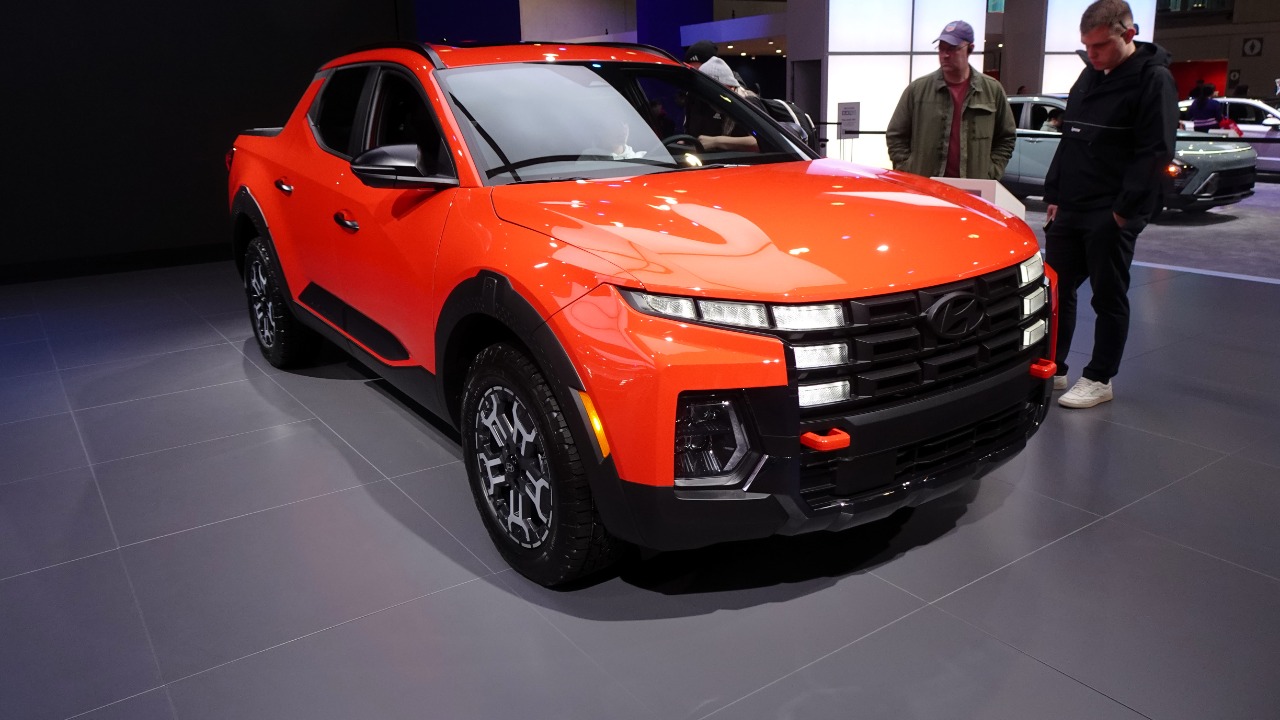

Hyundai is quietly laying the groundwork for a very American kind of comeback story: a midsize pickup that borrows one of Chevrolet’s cleverest tricks and tries to fix its biggest flaw. The company has filed a series of patents that point to a truck with a configurable midgate, modular body hardware and a surprisingly practical focus on how owners actually use their beds. Taken together, they suggest Hyundai is not just entering the pickup arena, it is trying to rethink how flexible a truck can be for daily life.
Instead of chasing shock value, the filings sketch out a methodical plan to blend SUV comfort with real cargo capability, from drainage channels in the midgate to removable doors that change the truck’s character in minutes. For a brand that already sells the unibody Santa Cruz, this next step looks like a deliberate move upmarket into the same space as the Toyota Tacoma and Ford Ranger, with a technical twist that could make the midgate relevant again.
Hyundai’s midsize truck push is no longer hypothetical
Hyundai has moved beyond vague hints and has now confirmed that it is developing a midsize pickup specifically for the American market, with the new truck scheduled to arrive before 2030 and positioned above the existing Santa Cruz. Reporting on a Hyundai patent notes that the vehicle is expected to share its basic architecture with the Tucson and Santa Fe crossovers, which signals a focus on ride comfort and efficiency rather than a body-on-frame bruiser. That choice puts Hyundai squarely into the heart of the lifestyle truck segment, where buyers want four-door practicality and decent fuel economy as much as towing numbers.
The strategic intent has been spelled out more broadly as well, with the South Korean automaker publicly vowing to introduce a midsize pickup truck to its U.S. lineup while it also works to double its hybrid offerings. In that context, the truck is framed as a direct challenger to the best-selling Toyota Tacoma, a benchmark that Hyundai name-checks when outlining its ambitions for the segment. The company’s plan, described in detail in coverage of the South Korean Hyundai strategy, is to blend that Tacoma-chasing capability with a broader electrification push, which makes the choice of a flexible, SUV-related platform even more logical.
The midgate returns, this time with a drainage twist
The most intriguing clue to how Hyundai wants this truck to stand out is a patent that focuses not on styling or powertrains but on the humble problem of water management. In a filing highlighted by David Carter, Editor, the company details a Midgate design that integrates drainage channels and seals to keep rain and wash water from pooling where the cabin meets the bed. The document describes how the Midgate can open to extend the cargo floor into the passenger compartment, while a network of passages directs water away from the interior and out of the vehicle, solving a long-standing headache for owners who use their trucks in bad weather. That focus on practicality is why coverage of Hyundai’s Midgate patent explicitly frames it as a solution to drainage for an upcoming U.S. pickup.
What makes this more than a niche engineering exercise is the way Hyundai appears to be learning from earlier midgate experiments. The patent material compares the concept to the setup used in the electric Silverado EV, which also uses a pass-through to stretch bed length, but it goes further by trying to keep the cabin dry when the barrier is open. By addressing that weak point, Hyundai is signaling that it wants the midgate to be something owners actually use, not a party trick that stays closed because it is a hassle in real life. The attention to sealing, channels and how the Midgate interfaces with the bed floor suggests the company expects buyers to haul lumber one day and passengers the next without worrying about soggy carpets.
Why Hyundai thinks the midgate is worth reviving
Hyundai’s interest in this layout is not happening in a vacuum, it is part of a broader midgate revival that looks back at ideas that have been circulating for roughly 25 years. The concept of a fold-down barrier between cabin and bed first gained attention with Chevrolet products, where the feature opened up new possibilities for carrying long items without moving to a full-size truck. That history is explicitly referenced in reporting that notes how the midgate has been opening up possibilities for 25 years, particularly under the Chevrolet banner, and it sets the stage for why Hyundai sees value in revisiting the idea.
Inside Hyundai, the feature appears to be tied directly to the company’s U.S. truck ambitions. Hyundai executive Don Romano has described the plans for the new American pickup as “mind-blowing,” language that has been cited alongside the midgate patent as a sign that the brand wants to do more than just copy existing players. At the same time, coverage of the obscure Hyundai filing is careful to stress that a patent is not confirmation of production intent, a caveat that applies here as well. Even so, the fact that the company is investing engineering effort into a configurable barrier and drainage system, and that this work is being discussed in the same breath as Romano’s comments, suggests the midgate is central to how Hyundai imagines its truck standing out in a crowded field.
Patent breadcrumbs: from obscure filing to product roadmap
For anyone trying to decode Hyundai’s truck strategy, the patent trail has become a kind of roadmap. One analysis of the midgate filing opens by noting that patent documents are often the first glimpse of new features or even entire models, and it treats this particular submission as a window into how Hyundai wants its pickup to function day to day. The piece points out that the Patent material, filed by Hyun, shows a pass-through system that can be configured in multiple positions, hinting at a truck that can morph between SUV-like enclosed space and open-bed hauler. That framing, which appears in a discussion that begins with the line that Patent filings are often our first glimpse of what is coming, underlines how seriously observers are taking this document.
Another look at the same filing emphasizes how Hyundai seems to be learning from past attempts that did not quite land. The analysis notes that earlier midgate-style efforts, including some that tried to blend car and truck attributes, struggled because the execution did not really work for buyers who needed both comfort and utility. By contrast, the new patent sketches a more refined approach, with better sealing, more flexible folding options and a clearer focus on how the feature integrates with the rest of the body. That perspective is captured in a discussion of how One such filing by Hyun revisits the idea in light of vehicles like the Subaru Baja, which tried a similar trick but never found a large audience.
Hyundai’s truck ambitions: taking on Tacoma, Ford and Chevy’s coolest trick
Hyundai is not shy about where it wants this truck to compete. The company has confirmed that it is building a midsize pickup to take on the Toyota Tacoma, and it has framed the project as a direct challenge to both Toyota and Ford in what it calls the biggest and toughest pickup market in the world. Reporting on Hyundai’s internal expectations notes that executives believe the new truck is ready to take on established players, with the midgate and related features positioned as part of what makes the vehicle “mind-blowing” in their eyes. That ambition is laid out clearly in coverage that explains how Hyundai has confirmed it is building a midsize pickup aimed squarely at Toyota Tacoma buyers and Ford loyalists.
At the same time, Hyundai is openly borrowing one of Chevrolet’s most talked-about tricks by embracing a configurable barrier between bed and cabin. Analysts have described the new American pickup as getting “Chevy’s coolest feature,” a reference to the way Chevrolet has used a midgate-style opening to extend bed length on models like the electric Silverado EV. In that sense, Hyundai is not just targeting Tacoma and Ranger, it is also trying to match or surpass the clever packaging that has helped Chevrolet differentiate its trucks. The significance of that move is highlighted in reporting that frames the midgate patent as a sign that Want a sign Hyundai is getting ready to get serious about trucks in the United States, pointing to the feature as a key part of that seriousness.
From obscure patent to “mind-blowing” promise
What began as an obscure filing has quickly become a focal point for speculation about Hyundai’s product plans. Early coverage described the document as an “obscure Hyundai patent” that might have revealed a midgate feature for a new U.S. truck, underscoring how little official detail the company has shared so far. Yet that same reporting connects the dots between the patent and public comments from Hyundai leadership, treating the combination as a strong indicator that the midgate is more than a design exercise. The narrative that an obscure Hyundai patent may have revealed a core feature of the truck has helped elevate the filing from legal paperwork to a kind of unofficial teaser.
Inside that same discussion, Hyundai executive Don Romano’s description of the truck plans as “mind-blowing” is treated as a key piece of context. The implication is that a conventional, me-too midsize pickup would not justify that kind of language, whereas a vehicle that blends SUV comfort, a configurable midgate and potentially electrified powertrains might. Even so, the reporting is careful to remind readers that patents are not guarantees, and that the company has not yet confirmed the midgate for production. That tension between excitement and caution is part of what makes the story compelling: the patent is detailed enough to show how the feature could work, but official statements still stop short of treating it as a done deal.
Modular doors and a broader vision of truck flexibility
The midgate is not the only sign that Hyundai wants its truck to be more adaptable than the average midsize pickup. Another recent filing reveals a system of modular, removable doors for pickups and SUVs, designed to make customization, repairs and personalization notably easier. The patent describes how the doors can be detached or reconfigured, allowing owners to change the vehicle’s character for off-road use, open-air driving or easier access in work settings. That idea, detailed in coverage of a Hyundai patent for removable modular doors, fits neatly alongside the midgate as part of a broader push toward configurable body hardware.
Seen together, the midgate drainage system and modular doors suggest Hyundai is thinking about its truck as a platform for different lifestyles rather than a single fixed configuration. A buyer could, in theory, open the midgate to carry long surfboards or lumber one weekend, then remove the doors for a trail run the next, all while retaining the comfort and safety of a modern crossover-derived cabin when everything is closed. That approach mirrors trends in the off-road and lifestyle segments, where vehicles like the Jeep Gladiator and Ford Bronco emphasize removable panels and open-air experiences, but Hyundai’s twist is to combine those ideas with a unibody-like structure and a focus on everyday usability.
How the midsize pickup fits Hyundai’s U.S. growth strategy
Hyundai’s truck plans do not exist in isolation, they are part of a larger effort to grow its presence in the United States by filling gaps in its lineup and leaning into electrification. The company has already committed to doubling its hybrid range, and it has framed the upcoming midsize pickup as a key piece of that puzzle, especially as it targets segments where Toyota has long dominated. In outlining this strategy, Hyundai has been explicit that the truck is meant to challenge the best-selling Toyota Tacoma while also appealing to buyers who might otherwise consider a Ford Ranger or Chevrolet Colorado. That intent is spelled out in reporting that describes how the South Korean Hyundai brand vows to introduce a midsize pickup as part of its U.S. expansion.
At the same time, Hyundai has been clear that it sees the truck as a way to showcase new technology and design thinking, not just to add volume. The company’s decision to base the pickup on platforms related to the Tucson and Santa Fe suggests a desire to bring car-like refinement to a segment where many buyers still accept compromises in ride and handling. Combined with the midgate, modular doors and a likely focus on hybrid or electrified powertrains, the truck becomes a kind of rolling billboard for Hyundai’s broader ambitions. It signals that the brand wants to be seen not only as a value player but as an innovator capable of challenging long-established rivals on their home turf.
Why the midgate could matter more this time
The midgate has always been a clever idea on paper, but its past incarnations struggled to become must-have features. What could make Hyundai’s attempt different is the way it integrates the concept into a holistic package that prioritizes daily usability, weather protection and modularity. By focusing on drainage, sealing and how the barrier interacts with the rest of the body, Hyundai is trying to remove the friction points that kept earlier designs from being used regularly. The company’s engineers appear to be betting that if the midgate can be opened without worrying about leaks or complicated setups, owners will treat it as a normal part of how they use the truck rather than a novelty.
There is also a timing advantage. The rise of lifestyle trucks, the popularity of crossover-based pickups and the growing expectation that vehicles should adapt to multiple roles all create a more receptive environment for a feature like this. Hyundai’s decision to pair the midgate with other flexible elements, such as modular doors and a crossover-derived platform, suggests it sees the truck as a Swiss Army knife for buyers who want one vehicle to do everything. If the company can deliver on the promise hinted at in its patents and in Don Romano’s “mind-blowing” comments, the midgate could finally move from clever footnote to central selling point in the midsize pickup market.
More from MorningOverview